
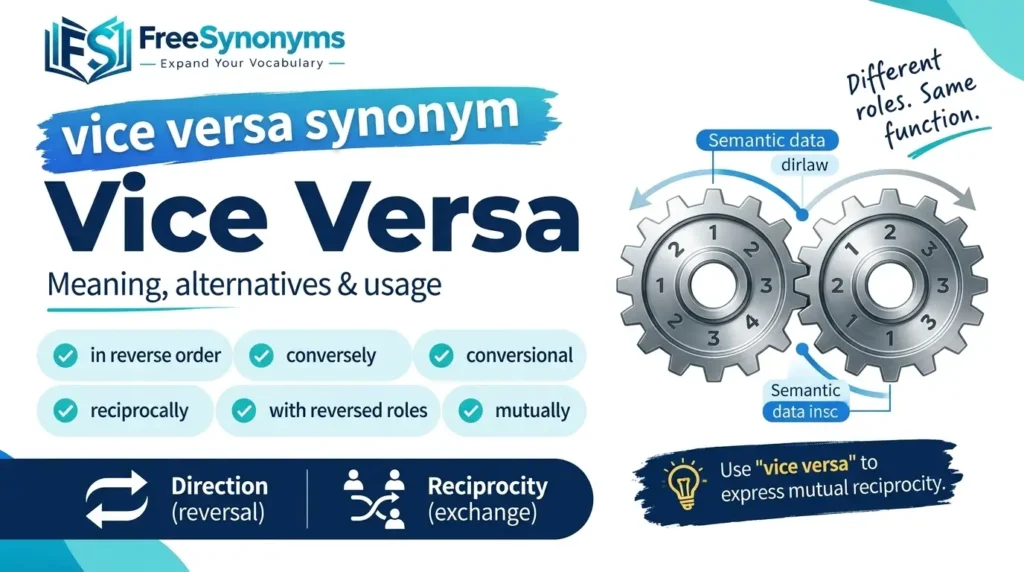
If you need a synonym for “vice versa,” the best alternative depends on what you are trying to express. Common choices include the other way around, conversely, in reverse, the reverse is also true, and the opposite is also true. However, these expressions are not interchangeable in every sentence.
“Vice versa” is an adverbial phrase used when the statement just made is also true when the two people, things, actions, or directions are reversed. Cambridge defines it as referring to something being true “in the opposite order,” while Oxford similarly describes it as saying that the opposite of what was just stated is also true.
For example:
You can travel from New York to Boston, and vice versa.
This means you can travel from Boston to New York as well.
If you want a more conversational expression, “the other way around” is often the most natural replacement. In formal or academic writing, “conversely” may work better in some contexts.
Quick Answer: What Is a Good Synonym for “Vice Versa”?
The closest alternatives are:
- the other way around — the most natural everyday alternative
- the reverse is also true — clear and explicit
- the opposite is also true — useful when emphasizing a reversed relationship
- conversely — formal and common in academic or professional writing
- in reverse — appropriate when describing a reversed order or direction
- in the opposite direction — useful for movement, processes, or relationships
- the other way round — essentially the same meaning, though “the other way around” is especially natural in American English
- in the reverse order — useful when sequence matters
- reciprocally — appropriate only in certain formal contexts involving mutual relationships
The key point is that “vice versa” does not simply mean “the opposite.” It specifically signals that the preceding relationship, arrangement, or statement also works when its elements are reversed.
What Does “Vice Versa” Mean?
Vice versa means with the two sides, people, things, or directions reversed.
It is an adverbial expression, not a noun, verb, or adjective. Oxford’s American dictionary lists it as an adverb and gives the meaning that the opposite of what has just been stated is also true.
Consider:
Maria helps David, and vice versa.
The first statement is:
Maria helps David.
“Vice versa” reverses the relationship:
David helps Maria.
So the complete meaning is:
Maria helps David, and David helps Maria.
Another example:
You can drive from Chicago to Milwaukee, or vice versa.
The reverse direction is:
You can drive from Milwaukee to Chicago.
This is why a good substitute needs to preserve the idea of reversal, not merely opposition.
A simple way to remember it
Think of vice versa as:
A → B, and vice versa = B → A
That makes the expression particularly useful when two people, places, concepts, actions, or directions can be switched without losing the intended relationship.
The Best Synonyms for “Vice Versa”
Not every alternative has exactly the same tone or grammatical behavior. The following options are the most useful depending on context.
| Alternative | Meaning / Nuance | Formality | Best Used When |
| the other way around | The relationship works in the reverse direction | Neutral | Everyday conversation and general writing |
| the reverse is also true | The reversed statement is also valid | Neutral/Formal | Clear explanations and professional writing |
| the opposite is also true | The opposite relationship or statement also applies | Neutral | Explanatory writing |
| conversely | In an opposite or reversed way | Formal | Academic and professional writing |
| in reverse | With the order or direction reversed | Neutral | Processes, sequences, and directions |
| in the opposite direction | The same movement or relationship applies backward | Neutral | Travel, movement, physical direction |
| the other way round | Same basic meaning as “the other way around” | Neutral | General English; somewhat less characteristic of US usage |
| in the reverse order | With the sequence reversed | Formal/Neutral | Instructions, procedures, lists |
| reciprocally | In a mutually corresponding way | Formal | Specific relationships and technical contexts |
The first three are generally the safest choices when you want to preserve the meaning of vice versa without changing the sentence too much.
1. The Other Way Around
The other way around is usually the closest natural conversational alternative to vice versa.
For example:
John works for Sarah, and vice versa.
You could write:
John works for Sarah, and the other way around.
However, the more natural construction is often:
John works for Sarah, and Sarah works for John.
Or, where the context makes the reversal obvious:
John works for Sarah, and it works the other way around, too.
“The other way around” is especially useful when speaking or writing for a general audience because it is immediately understandable without requiring the reader to know the Latin-derived phrase.
Examples
Original:
The manager supports the employees, and vice versa.
Alternative:
The manager supports the employees, and it works the other way around.
Original:
You can convert dollars to euros and vice versa.
Alternative:
You can convert dollars to euros and the other way around.
A particularly natural version would be:
You can convert dollars to euros and euros to dollars.
Best for
- Casual conversation
- General writing
- Explanations
- Accessible web content
- Readers who may not be familiar with Latin expressions
2. The Reverse Is Also True
The reverse is also true is a highly useful alternative when clarity matters more than brevity.
It explicitly tells the reader that the relationship works in the opposite direction.
For example:
Higher demand can lead to higher prices, and vice versa.
You could write:
Higher demand can lead to higher prices; the reverse is also true.
This version is particularly helpful when the relationship is somewhat complex and the reader could otherwise misunderstand what is being reversed.
Examples
Parents influence their children, and vice versa.
Becomes:
Parents influence their children; the reverse is also true.
Or:
Technology affects education, and vice versa.
Becomes:
Technology affects education; the reverse is also true.
This expression works well in:
- Professional writing
- Explanatory articles
- Reports
- Essays
- Academic-style writing
It is also useful when you want to avoid a phrase that some readers may consider less direct.
3. The Opposite Is Also True
The opposite is also true can replace “vice versa” when the intended reversal is clear.
For example:
What is good for employees is often good for employers, and vice versa.
A possible alternative is:
What is good for employees is often good for employers, and the opposite is also true.
The expression emphasizes that the reverse proposition applies.
However, there is an important distinction: “the opposite” can be broader than the precise reversal expressed by “vice versa.”
Compare:
Dogs often chase cats, and vice versa.
This means:
Cats often chase dogs.
But:
Dogs often chase cats, and the opposite is also true.
may be understood similarly, but “opposite” does not always explicitly identify which elements are being switched.
For that reason, “the other way around” or “the reverse is also true” may be clearer when precision matters.
4. Conversely
Conversely is a more formal alternative that can work particularly well in academic, analytical, and professional writing.
Oxford defines conversely as meaning “in a way that is the opposite of something” and labels it as formal.
For example:
If prices rise, consumers may buy less, and vice versa.
Depending on the intended meaning, this could become:
If prices rise, consumers may buy less. Conversely, if prices fall, consumers may buy more.
Notice an important difference.
“Conversely” often introduces a separate contrasting or reversed statement, rather than simply replacing “vice versa” at the end of a sentence.
Another example
Students who read regularly tend to develop stronger vocabulary, and vice versa.
A more explicit formal version might be:
Students who read regularly tend to develop stronger vocabulary. Conversely, students with stronger vocabulary may be more likely to engage with complex texts.
Here, conversely introduces a related reverse relationship.
Best for
- Academic writing
- Reports
- Analytical writing
- Professional communication
- Formal explanations
It is not always the best choice for casual conversation because it can sound more formal than necessary.
5. In Reverse
In reverse is useful when something can literally or conceptually be done backward.
For example:
Read the instructions from beginning to end and then vice versa.
A clearer alternative might be:
Read the instructions from beginning to end and then in reverse.
It works particularly well for:
- sequences
- processes
- directions
- physical movement
- ordered steps
Examples
The machine can operate clockwise and vice versa.
Depending on the context:
The machine can operate clockwise and in reverse.
Or:
The sequence works forward and in reverse.
But “in reverse” is not a universal substitute for “vice versa.”
Consider:
Sarah trusts Mark, and vice versa.
Replacing it with:
Sarah trusts Mark, and in reverse.
sounds unnatural.
In that sentence, “the other way around” or “the reverse is also true” is better.
6. In the Opposite Direction
When the subject involves movement, travel, transportation, or direction, in the opposite direction can be much clearer than “vice versa.”
For example:
The train travels from Boston to New York and vice versa.
You could say:
The train travels from Boston to New York and in the opposite direction.
An even clearer version is:
The train travels from Boston to New York and from New York to Boston.
This type of replacement is particularly useful when the reader needs to know exactly what the reversed direction means.
More examples
The river flows downstream, and vice versa during the return process.
Depending on the context, you might write:
The process can occur downstream and in the opposite direction.
Or:
The system transfers information from the server to the device and in the opposite direction.
The last version makes the relationship explicit instead of asking the reader to mentally reverse it.
7. The Other Way Round
The other way round has essentially the same core meaning as the other way around.
For example:
You can use this method to solve the problem, and vice versa.
A possible alternative is:
You can use this method to solve the problem, and the other way round.
However, for a US audience, “the other way around” will generally sound more natural than “the other way round.”
That does not make “the other way round” incorrect. It is a standard English expression, but American writers often favor around in this construction.
For FreeSynonyms readers writing specifically for a US audience, the other way around is therefore the more useful everyday recommendation.
Is “Vice Versa” a Synonym for “Conversely”?
Sometimes, but not always.
The two expressions overlap because both can describe something in an opposite or reversed relationship. However, they do not function identically.
Vice versa
Vice versa usually points backward to the preceding statement and says that the same relationship applies with the elements reversed.
Alex helps Jordan, and vice versa.
Meaning:
Alex helps Jordan, and Jordan helps Alex.
Conversely
Conversely generally introduces an opposite or contrasting point.
Alex prefers working independently. Conversely, Jordan prefers working with a team.
The second sentence does not necessarily mean that the first sentence can simply have its elements swapped.
That distinction matters.
A useful rule is:
Use “vice versa” when you mean “with the two sides switched.”
Use “conversely” when you mean “on the other hand” or “in an opposite way,” especially in formal writing.
The two can overlap, but treating them as perfect substitutes in every sentence can create awkward or inaccurate wording. Oxford’s definition of “conversely” specifically emphasizes an opposite manner, while dictionary definitions of “vice versa” focus on reversing the order or relationship.
Is “The Other Way Around” the Same as “Vice Versa”?
In many everyday sentences, yes.
For example:
I help her, and vice versa.
can be expressed as:
I help her, and it works the other way around, too.
Both communicate the idea that the relationship is mutual in the reverse direction.
However, the expressions differ in style.
| Expression | Typical style |
| vice versa | Concise, established, somewhat formal |
| the other way around | Conversational, natural, accessible |
| the reverse is also true | Explicit, explanatory |
| conversely | Formal, analytical |
| in reverse | Process- or sequence-oriented |
If you’re writing for a broad American audience, the other way around is often the easiest plain-English replacement.
“Vice Versa” in Formal Writing
There is nothing inherently incorrect or unprofessional about using vice versa in formal writing. It is a standard English adverbial expression and appears in academic, technical, professional, and general contexts. Cambridge and Oxford both classify it as an adverb.
Still, the best choice depends on the audience.
In an academic paper
The relationship between income and education may operate in both directions, and vice versa.
A more explicit version could be:
The relationship between income and education may operate in both directions; the reverse is also true.
In a business report
Customers influence product development, and vice versa.
This is concise and professional.
In an explanatory article
You can use the same process in the other direction.
This may be easier for a general audience than a Latin-derived expression.
The important point is not to replace “vice versa” simply because you think it is too informal. Context and clarity should determine the choice.
Choosing the Right Alternative to “Vice Versa”
The best replacement depends on what is being reversed and how explicitly you want to express that reversal.
A short phrase such as “the other way around” is often ideal in conversation. A more explicit construction such as “the reverse is also true” can prevent ambiguity in professional or academic writing. When the reversal involves a sequence or direction, “in reverse” may be more precise.
Quick comparison
- the other way around → natural and conversational
- the reverse is also true → explicit and clear
- the opposite is also true → emphasizes the opposite proposition
- conversely → formal and analytical
- in reverse → emphasizes reversed order or operation
- in the opposite direction → useful for movement or directional relationships
- in the reverse order → best when sequence matters
The right choice is therefore determined less by the word itself and more by the relationship being described.
Formal Alternatives to “Vice Versa”
If you are writing an essay, report, research paper, business document, or other formal material, several alternatives can make the relationship more explicit.
The reverse is also true
This is one of the clearest formal alternatives.
Strong communication improves teamwork, and vice versa.
Could become:
Strong communication improves teamwork; the reverse is also true.
The second version clearly signals that the relationship works in both directions.
Conversely
Use conversely when you want to introduce a contrasting or reversed proposition.
Some employees prefer remote work, while others prefer working in an office.
You could write:
Some employees prefer remote work. Conversely, others prefer working in an office.
This is not always a direct replacement for “vice versa,” but it can be the better choice when the sentence structure calls for a formal contrast.
In the reverse order
This expression is particularly appropriate when discussing a sequence.
Complete the steps in numerical order and then vice versa.
A clearer alternative is:
Complete the steps in numerical order and then in the reverse order.
Here, the word order supplies information that “vice versa” leaves implicit.
In the opposite direction
This is useful for systems, transportation, communication, and physical movement.
The pipeline carries water from the reservoir to the treatment plant and vice versa.
A more explicit version is:
The pipeline carries water from the reservoir to the treatment plant and in the opposite direction.
When precision matters, explicitly naming the reverse direction can be preferable.
Casual Alternatives to “Vice Versa”
In ordinary conversation, the other way around is usually the easiest substitute.
Instead of:
I call her, and vice versa.
You might say:
I call her, and she calls me—the other way around, too.
Or simply:
We call each other.
That last example illustrates an important principle: you do not always need a synonym.
Sometimes the clearest replacement is to rewrite the sentence so that the reciprocal meaning is stated directly.
Another example
Original:
Parents learn from their children, and vice versa.
Possible conversational rewrite:
Parents learn from their children, and children learn from their parents, too.
This may be longer, but it is immediately understandable.
“Vice Versa” Alternatives by Context
In Professional Communication
Professional writing benefits from clarity and economy.
Consider:
Managers depend on employees, and vice versa.
This is perfectly understandable, but alternatives include:
Managers depend on employees, and employees depend on managers.
Or:
Managers depend on employees; the reverse is also true.
The first version is the most explicit. The second preserves the concise structure while making the reversal clear.
For emails
In a workplace email, the other way around can sound natural:
I thought the deadline affected the schedule, but it may actually work the other way around.
Here, “the other way around” is more conversational than “conversely” and fits an ordinary workplace message.
In Academic Writing
Academic writing often benefits from specifying the logical relationship rather than relying on a compact expression.
For example:
Education can influence income, and vice versa.
Possible rewrite:
Education can influence income, and income can likewise influence educational opportunities.
Notice that this version does more than mechanically replace the phrase. It explains the relationship.
This is particularly useful when the two directions are not exactly identical.
That distinction is important because “vice versa” can sometimes make a complex relationship appear more symmetrical than it actually is.
If the relationship in one direction differs from the relationship in the other, spelling out both directions may be more accurate.
In Technical Writing
Technical documents often need maximum precision.
Suppose an instruction says:
The device sends data to the server and vice versa.
A reader may understand this as:
The device sends data to the server, and the server sends data to the device.
If that is exactly what you mean, the explicit version is often clearer:
The device sends data to the server, and the server sends data to the device.
For technical documentation, clarity should generally take priority over brevity.
Similarly:
The process can be performed from A to B and vice versa.
can become:
The process can be performed from A to B or from B to A.
The second construction removes the need for the reader to determine what “vice versa” reverses.
When “Vice Versa” Is Better Than a Synonym
Replacing a word simply for the sake of avoiding repetition is not always an improvement.
Vice versa has an advantage: it is compact.
Compare:
The customer can contact the company, and the company can contact the customer.
with:
The customer can contact the company, and vice versa.
The second sentence is substantially shorter while preserving the meaning.
Likewise:
You can move the file from your computer to the server and vice versa.
is concise and natural.
Replacing it with:
You can move the file from your computer to the server and the other way around.
does not necessarily improve the sentence.
In fact, it may sound less polished depending on the context.
Good writing is not about replacing every repeated expression with a different expression. It is about choosing the clearest and most natural wording for the situation.
When You Should Avoid “Vice Versa”
Although “vice versa” is useful, there are situations where an explicit rewrite is better.
1. When the reversed meaning could be ambiguous
Consider:
The policy affects employees and managers, and vice versa.
What exactly is being reversed?
Does it mean:
- employees affect the policy and managers affect the policy?
- managers affect employees and employees affect managers?
- the policy affects both groups, with some other relationship reversed?
The phrase does not make the relationship sufficiently clear.
A better sentence would specify the intended relationship.
The policy affects employees and managers, while employees and managers can also influence how the policy is implemented.
The explicit wording eliminates ambiguity.
2. When the two directions are not actually equivalent
“Vice versa” works naturally when the reverse relationship is genuinely intended.
Suppose:
A manager supervises an employee, and vice versa.
This would normally imply that the employee supervises the manager as well.
If that is not what you mean, “vice versa” is inappropriate.
Instead, describe the two relationships separately.
A manager supervises an employee, while the employee provides feedback to the manager.
The relationships are related, but they are not reversals of one another.
This is one of the most important limitations to remember.
3. When the sentence involves a one-way relationship
Some relationships naturally operate in only one direction.
For example:
A parent is legally responsible for a minor, and vice versa.
The reverse statement may not have the same meaning or legal effect.
In such cases, adding “vice versa” can incorrectly imply symmetry.
When the relationship is inherently one-directional, state the relevant direction directly.
“Vice Versa” vs. “The Other Way Around”
These are often the closest alternatives, but they have different stylistic qualities.
| Feature | Vice versa | The other way around |
| Basic meaning | Reversal of the preceding relationship | Reversal of the preceding relationship |
| Tone | Neutral to somewhat formal | Conversational |
| Common in conversation | Yes | Yes |
| Common in professional writing | Yes | Yes |
| Easy for learners to understand | Moderate | Very easy |
| Concise | Very | Moderate |
| Good for explicit explanation | Sometimes | Usually |
| US English | Natural | Very natural |
Example
I trust him, and vice versa.
Natural alternative:
I trust him, and he trusts me—the other way around.
But in many cases, the cleanest rewrite is simply:
We trust each other.
This demonstrates why context matters more than producing a long list of supposedly interchangeable words.
“Vice Versa” vs. “Conversely”
These expressions are related but serve different grammatical and rhetorical purposes.
Vice versa
Usually refers back to the preceding statement:
The teacher learns from the students, and vice versa.
The implied reversal is:
The students learn from the teacher.
Conversely
Often introduces a contrasting statement:
Some students prefer visual instruction. Conversely, others learn better through hands-on activities.
The second sentence contrasts with the first; it is not necessarily a literal reversal of the first sentence’s subjects.
A useful distinction
Vice versa = switch the sides.
Conversely = introduce the opposite or contrasting point.
There are situations where both can communicate related ideas, but they should not be treated as interchangeable in every sentence.
“Vice Versa” vs. “In Reverse”
The distinction is even clearer here.
In reverse usually emphasizes the reversal of an order, sequence, direction, or operation.
Play the recording normally and then in reverse.
“Vice versa” would not be the natural choice:
Play the recording normally and then vice versa.
That sounds incomplete because the expression does not clearly identify what is being reversed.
By contrast:
The two devices can send information to each other, and vice versa.
works because the phrase refers to a relationship between two sides.
Simple rule
Use in reverse for something being done backward.
Use vice versa when two sides of a relationship are being switched.
“Vice Versa” vs. “Reciprocally”
Reciprocally can overlap with “vice versa,” but it has a narrower and more specialized feel.
It generally describes something occurring mutually or in return.
For example:
The two organizations provide support to each other reciprocally.
But replacing “vice versa” with “reciprocally” can change the structure and emphasis.
Compare:
The two companies support each other, and vice versa.
This is awkward because the first statement is already reciprocal.
A better sentence would be:
The two companies support each other.
The lesson is straightforward: reciprocally is not a general-purpose replacement for vice versa.
Use it when the idea of mutual action or correspondence is specifically relevant.
Sentence Examples: Different Ways to Replace “Vice Versa”
Seeing the alternatives in context makes their differences easier to understand.
Example 1: Mutual help
Original:
I help my brother, and vice versa.
Natural alternative:
I help my brother, and he helps me.
Conversational alternative:
I help my brother, and it works the other way around, too.
Here, “the other way around” works because the relationship is clearly mutual.
Example 2: Travel
Original:
The train runs from Philadelphia to Washington, D.C., and vice versa.
Explicit alternative:
The train runs from Philadelphia to Washington, D.C., and from Washington, D.C., to Philadelphia.
Directional alternative:
The train runs in both directions between Philadelphia and Washington, D.C.
Here, the explicit directional version can be clearer than a general synonym.
Example 3: Professional relationship
Original:
Employees depend on managers, and vice versa.
Formal alternative:
Employees depend on managers; the reverse is also true.
Explicit alternative:
Employees depend on managers, and managers depend on employees.
Both alternatives preserve the intended relationship.
Example 4: Process
Original:
The software can convert the file from one format to another and vice versa.
Clear alternative:
The software can convert the file in either direction.
This is shorter and may actually be more natural than forcing a direct synonym into the sentence.
Example 5: Direction
Original:
The road is open to traffic traveling north and vice versa.
Clearer alternative:
The road is open to traffic traveling in both directions.
Again, a complete rewrite can be better than a word-for-word substitution.
Alternatives That Are Not Always True Synonyms
A common problem with synonym articles is treating every related phrase as interchangeable. That approach can produce misleading vocabulary advice.
Several expressions may be related to “vice versa” without being true substitutes in every context.
“On the other hand”
On the other hand introduces a contrasting idea or alternative perspective.
The apartment is small. On the other hand, it is affordable.
This does not mean:
The apartment is affordable in reverse.
Therefore, “on the other hand” is not a general synonym for “vice versa.”
“Otherwise”
Otherwise can mean “if not,” “in a different way,” or “apart from that,” depending on context.
Leave now; otherwise, you may miss the train.
That has nothing to do with reversing the relationship between two elements.
So otherwise should not normally be used as a replacement for “vice versa.”
“Oppositely”
Although oppositely might appear to resemble “vice versa,” it is not generally a natural substitute in ordinary American English.
Instead of forcing it into a sentence, use:
- conversely
- the other way around
- in reverse
- the reverse is also true
depending on the intended meaning.
“Mutually”
Mutually means something is shared by two or more parties.
The two organizations mutually agreed to the terms.
It does not necessarily express the reversal signaled by “vice versa.”
For example:
The manager respects the employee, and vice versa.
does not become:
The manager respects the employee, mutually.
A natural rewrite is:
The manager and employee respect each other.
How to Choose the Right Alternative
When deciding how to replace “vice versa,” ask yourself one question:
What exactly is being reversed?
Then choose the wording that makes that reversal clearest.
If you are talking about people and relationships
Use:
- the other way around
- the reverse is also true
- the other person does the same
Example:
She supports him, and vice versa.
→ She supports him, and he supports her.
If you are discussing a formal argument
Use:
- the reverse is also true
- conversely
Example:
The relationship can work in both directions; the reverse is also true.
If you are discussing movement
Use:
- in the opposite direction
- in both directions
Example:
The shuttle travels from the hotel to the airport and in the opposite direction.
If you are discussing a sequence
Use:
- in reverse
- in the reverse order
Example:
Complete the procedure from Step 1 through Step 5, then repeat it in reverse.
If maximum clarity matters
Do not use a synonym at all.
Simply state both sides:
The customer contacts the company, and the company contacts the customer.
This is sometimes the strongest editorial choice.
A Practical Decision Guide
| If you mean… | Consider using… |
| The same relationship with the two sides switched | the other way around |
| A reversed proposition is also true | the reverse is also true |
| A formal contrast or opposite point | conversely |
| A sequence performed backward | in reverse |
| A sequence with its order switched | in the reverse order |
| Movement back in the opposite direction | in the opposite direction |
| Both directions explicitly | in both directions |
| Maximum clarity | State both sides directly |
This approach is more reliable than memorizing a long list of “synonyms,” because many of the alternatives are useful only in particular contexts.
Common Mistakes With “Vice Versa”
“Vice versa” is easy to understand once the underlying relationship is clear, but several usage mistakes are common. Most involve using it when the reverse relationship is not actually intended.
Mistake 1: Using “vice versa” when the relationship is not reversible
Consider:
A teacher evaluates a student, and vice versa.
This technically suggests that the student evaluates the teacher in the same relationship.
If you only mean that the teacher evaluates the student and the student gives the teacher feedback, “vice versa” is too strong.
Better:
A teacher evaluates a student, while the student can provide feedback to the teacher.
The two actions are related, but they are not necessarily reversals of one another.
Mistake 2: Assuming “vice versa” always means “the opposite”
“Vice versa” does not simply mean the opposite.
For example:
I prefer tea to coffee, and vice versa.
This construction can be confusing because the reader has to determine exactly what is being reversed.
If the intended meaning is:
I prefer tea to coffee, and someone else prefers coffee to tea.
say so directly.
Likewise, “vice versa” is not automatically interchangeable with oppositely, otherwise, or on the other hand.
The key concept is reversal, not merely opposition.
Mistake 3: Using “in reverse” for every situation
“In reverse” is useful for sequences and directions but can sound unnatural when describing interpersonal or conceptual relationships.
Awkward:
She respects him, and in reverse.
Better:
She respects him, and vice versa.
Or:
She respects him, and he respects her.
“In reverse” becomes natural when the action itself can be reversed:
Play the recording in reverse.
Repeat the steps in reverse.
Mistake 4: Choosing “conversely” when you actually mean mutual reversal
“Conversely” sounds sophisticated, but that does not make it a universal replacement.
For example:
The customer can contact the company, and conversely.
This is incomplete and unnatural.
Better:
The customer can contact the company, and the company can contact the customer.
Or:
The customer can contact the company, and vice versa.
“Conversely” usually works better when it introduces a complete contrasting or reversed proposition:
Customers may prefer lower prices. Conversely, some may prioritize convenience.
Grammar: How “Vice Versa” Works in a Sentence
“Vice versa” generally appears after a statement whose elements it reverses.
Basic pattern
A does X to B, and vice versa.
The implied second statement is:
B does X to A.
For example:
Emma trusts Noah, and vice versa.
Means:
Emma trusts Noah, and Noah trusts Emma.
Another pattern is:
A → B, and vice versa.
For example:
The bus travels from Dallas to Austin and vice versa.
Means:
The bus travels from Dallas to Austin and from Austin to Dallas.
The expression is particularly convenient because it prevents the writer from repeating the entire reversed statement.
Does “Vice Versa” Need a Comma?
The punctuation depends on the sentence structure.
When “vice versa” follows a complete clause joined by and, a comma is commonly appropriate:
She helps him, and vice versa.
When the phrase is integrated into a shorter construction, punctuation can vary according to the sentence:
The system transfers information between the two devices and vice versa.
The important consideration is not to add punctuation mechanically. Read the entire sentence and determine whether the comma is separating independent clauses or simply interrupting a closely connected phrase.
Can You Use “Vice Versa” at the Beginning of a Sentence?
It is possible to encounter “vice versa” in different positions, but it most naturally refers back to something already stated.
For example:
The reverse is also true, and vice versa can be awkward because the reversal is already being expressed.
A clearer construction is:
The two systems can exchange information. The same is true in the opposite direction.
Or:
The two systems can exchange information with each other.
In most cases, “vice versa” is most effective when its antecedent—the statement or relationship it reverses—is immediately clear.
Alternatives for Essays and Academic Papers
If you are writing an essay, research assignment, or academic discussion, you have several options.
Concise
Students influence teachers, and vice versa.
More explicit
Students influence teachers, and teachers influence students.
Formal
Students influence teachers; the reverse is also true.
Analytical
Students can influence teachers. Conversely, teachers can influence students.
The best version depends on whether you prioritize brevity, explicitness, or formal analytical style.
If the relationship is central to your argument, explicitly stating both directions may be preferable because it removes any possibility of ambiguity.
Alternatives for Emails and Workplace Writing
For a professional email, natural language usually works better than unnecessarily complicated wording.
Natural
The design affects the development process, and vice versa.
Plain English
The design affects the development process, and the development process affects the design.
Conversational
The design affects development, and it works the other way around, too.
More formal
The design affects the development process; the reverse is also true.
All four can work, but they create different impressions.
Vice versa is concise.
The other way around is more conversational.
The reverse is also true is more explicit.
The fully repeated version provides the greatest clarity when the subject is complicated.
Alternatives for Students and ESL Learners
For English learners, the other way around is often easier to understand than “vice versa.”
For example:
A affects B, and vice versa.
A learner-friendly explanation is:
A affects B, and B affects A too.
Or:
A affects B, and it works the other way around as well.
This makes the meaning explicit rather than requiring the reader to understand an established Latin phrase.
When teaching or learning the expression, remember:
vice versa = with the two sides switched
For example:
Tom teaches Lisa, and vice versa.
→ Tom teaches Lisa, and Lisa teaches Tom.
That simple substitution captures the core meaning.
Can “Vice Versa” Be Used With More Than Two Things?
The expression works most naturally when the relationship being reversed is clear between two sides.
For example:
The software sends information from the computer to the server and vice versa.
There are two clearly identified sides:
computer ↔ server
With multiple entities, however, the reader may not know exactly what is being reversed.
For example:
The manager, employees, customers, and suppliers communicate with each other and vice versa.
This is awkward because the reader cannot easily determine what “vice versa” is supposed to reverse.
In a sentence involving several parties, explicit wording is often better:
The manager, employees, customers, and suppliers communicate with one another.
The general rule is simple: the more complicated the relationship, the more useful explicit wording becomes.
Better Rewrites Instead of Direct Synonyms
Sometimes the strongest alternative to “vice versa” is not another phrase at all.
Consider:
Parents teach children, and vice versa.
Possible rewrite:
Parents and children learn from each other.
This is shorter and more natural.
Another example:
The buyer evaluates the seller, and vice versa.
Could become:
The buyer and seller evaluate each other.
And:
The system sends data to the server and vice versa.
Could become:
The system and server exchange data.
These rewrites demonstrate an important writing principle: look for the underlying meaning rather than replacing words mechanically.
A good vocabulary resource should help readers express the idea more naturally, not simply provide a longer list of substitute phrases.
Frequently Asked Questions
What is the closest synonym for “vice versa”?
The other way around is usually the closest natural alternative in everyday American English. The reverse is also true is another strong choice when you want to make the reversed relationship explicit.
What is a formal synonym for “vice versa”?
Depending on context, conversely or the reverse is also true can work in formal writing. However, “conversely” is not a perfect substitute in every sentence because it often introduces a contrasting proposition rather than simply reversing two elements.
Is “the other way around” the same as “vice versa”?
In many contexts, yes. Both can indicate that the preceding relationship applies when its elements are switched. “The other way around” generally sounds more conversational.
What is a synonym for “vice versa” in an essay?
For an essay, consider the reverse is also true, conversely, or simply state the reversed relationship directly. The best choice depends on whether you are expressing a literal reversal or a broader contrast.
Can I use “conversely” instead of “vice versa”?
Sometimes, but not universally. “Conversely” generally introduces an opposite or contrasting statement, while “vice versa” specifically signals that the preceding relationship is true with its elements reversed.
What does “vice versa” mean in simple English?
It means “with the two sides switched” or “the other way around.”
For example:
I help Sarah, and vice versa.
means:
I help Sarah, and Sarah helps me.
Is “vice versa” formal or informal?
“Vice versa” is neutral and widely used, including in professional and formal writing. It is not restricted to casual speech.
What is the opposite of “vice versa”?
There is not a standard single-word antonym for “vice versa.” The expression describes a reversal, so the opposite idea would generally be keeping the original direction or relationship unchanged.
Is “vice versa” grammatically correct?
Yes. “Vice versa” is a standard English adverbial expression. It is normally used to indicate that a preceding statement also applies when its relevant elements are reversed.
Can “vice versa” mean “both ways”?
Often, yes, when the sentence clearly establishes a two-way relationship.
For example:
The road is open from A to B and vice versa.
means traffic can travel from A to B and B to A.
However, “both ways” can sometimes be clearer, especially when discussing physical directions:
The road is open in both directions.
Final Takeaway
The best synonym for “vice versa” depends on what you are reversing.
If you want a natural everyday expression, choose “the other way around.” If you want to make the meaning especially clear, use “the reverse is also true.” For formal analytical writing, “conversely” can work when you are introducing an opposite or contrasting proposition. For sequences and operations, “in reverse” or “in the reverse order” may be more precise.
The most useful alternatives are:
- the other way around — natural and conversational
- the reverse is also true — clear and explicit
- the opposite is also true — emphasizes the reversed proposition
- conversely — formal and analytical
- in reverse — for reversed actions or sequences
- in the opposite direction — for directional relationships
- in the reverse order — when sequence matters
- the other way round — another form of the conversational expression
But remember that a synonym is not always the best solution. If the relationship is complicated, state both sides directly. If a concise word such as “vice versa” communicates the meaning perfectly, there is no need to replace it simply to sound different.
Good word choice is ultimately about precision, context, and clarity. The strongest alternative is the one that tells the reader exactly what is being reversed without making them stop and interpret the sentence.

Daniel Brooks
Daniel Brooks is an English vocabulary specialist focused on synonyms, word meanings, and practical language learning. He helps students, writers, and English learners understand subtle differences between words and choose the right expressions for clear, effective communication.