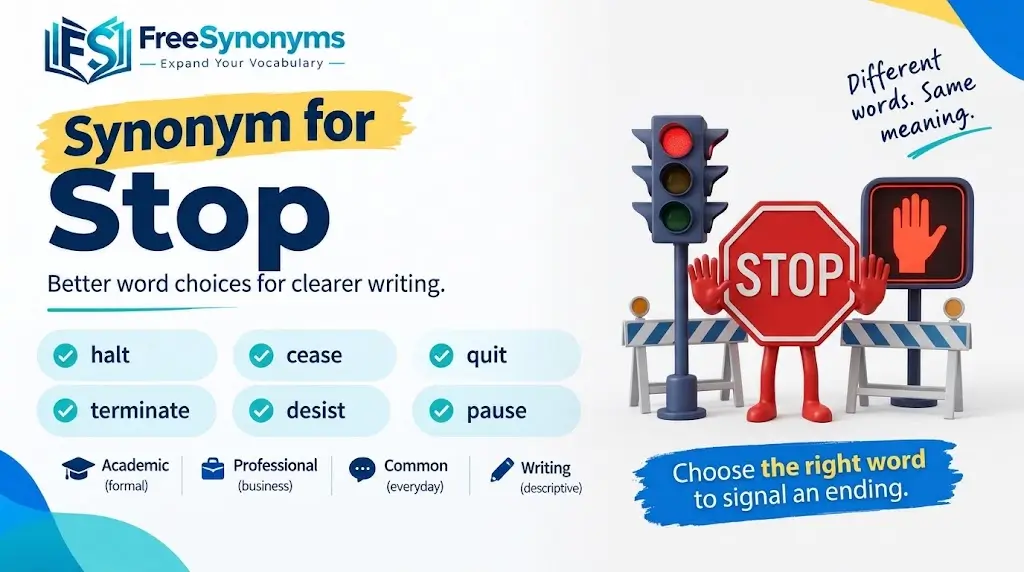
A useful synonym for stop depends on what you mean by “stop.” You might mean to end an action, halt movement, pause temporarily, prevent something, quit an activity, or discontinue a service. Common alternatives include halt, pause, cease, end, quit, discontinue, terminate, prevent, restrain, interrupt, suspend, and finish. However, these words are not interchangeable in every sentence.
The best choice depends on the action, duration, tone, and context. For example, “pause the video” suggests a temporary break, while “cease operations” suggests that an activity has ended. Similarly, “quit smoking” and “stop smoking” have nearly the same basic meaning, but “quit” is more specific to abandoning an activity or habit.
This guide explains the most useful alternatives to stop, including their meanings, differences, formality, and natural usage.
The Closest Synonyms for Stop
The following words are among the closest general alternatives to stop. However, each one carries a slightly different meaning.
| Synonym | Main meaning | Formality | Best used when |
|---|---|---|---|
| Halt | Stop movement or activity | Neutral/Formal | Something needs to come to a stop |
| Cease | Stop completely | Formal | An activity or process ends |
| Pause | Stop temporarily | Neutral | Something will resume later |
| End | Bring something to a conclusion | Neutral | An event, activity, or situation finishes |
| Quit | Stop doing something | Neutral | Someone abandons an activity or habit |
| Discontinue | Stop providing or doing something | Formal | A service, product, or activity is ended |
| Terminate | Bring something to an end | Formal | Contracts, processes, employment, or services |
| Interrupt | Break the continuity of something | Neutral | An action or process is stopped temporarily |
| Suspend | Stop temporarily | Formal | An activity is put on hold |
| Prevent | Stop something from happening | Neutral | An action is blocked before it occurs |
For instance, “Please stop the car” can become “Please halt the car,” although “halt” sounds more formal. In contrast, “Please pause the video” specifically indicates that the video can continue later.
Therefore, choosing a synonym requires more than finding a word with a similar dictionary definition.
Synonyms for Stop Doing Something
When stop means no longer doing an activity, several alternatives can work naturally.
Quit as a Synonym for Stop
Quit commonly means to stop doing something, especially an activity, job, habit, or behavior.
- She decided to quit smoking.
- He quit his job last month.
- They quit playing after sunset.
The word often suggests a deliberate decision to leave or abandon something. As a result, it can sound stronger than a simple temporary stop.
For example, “I stopped playing tennis” does not necessarily mean that the person will never play again. “I quit playing tennis” more strongly suggests that the person abandoned the activity.
Cease as a Synonym for Stop
Cease means to stop something completely. It is more formal than everyday stop.
- The company ceased production.
- The noise finally ceased.
- Officials ordered the group to cease operations.
Because of its formal tone, cease is common in legal, official, academic, and professional writing. In casual conversation, “stop” or “quit” usually sounds more natural.
Discontinue as a Synonym for Stop
Discontinue means to stop something that has been provided, produced, used, or carried out.
- The manufacturer discontinued the product.
- The clinic discontinued the treatment.
- The store discontinued the old service.
Unlike quit, this word often applies to products, services, procedures, programs, or established practices. Therefore, “discontinue the product” sounds natural, while “discontinue walking” usually does not.
Synonyms for Stop Temporarily
Sometimes stop does not mean ending something permanently. Instead, it means taking a break.
Pause
Pause is one of the clearest alternatives when something stops temporarily.
- Please pause the video.
- She paused the meeting for lunch.
- He paused to think about the question.
The key idea is that the activity may continue later. For that reason, pause is usually better than cease when describing a temporary interruption.
Suspend
Suspend also means to stop something temporarily, but it often has a more formal or official tone.
- The school suspended classes because of the storm.
- The company suspended the service temporarily.
- The account was suspended pending an investigation.
In addition, suspend can imply that an authority or organization deliberately places something on hold.
Interrupt
Interrupt means to break the continuity of an action, conversation, process, or event.
- A phone call interrupted the meeting.
- Please do not interrupt me while I am speaking.
- The power outage interrupted the broadcast.
Unlike pause, interruption often suggests that something or someone causes the break.
Synonyms for Stop Movement
When stop describes physical movement, the best alternatives are different.
Halt
Halt means to stop moving or to cause movement to stop.
- The train halted at the station.
- The officer ordered the vehicle to halt.
- Heavy traffic forced the procession to halt.
The word is especially useful for vehicles, groups, military movements, and organized activity. However, it can sound more formal than ordinary conversational English.
Come to a Standstill
Come to a standstill means to stop moving or progressing completely.
- Traffic came to a standstill after the accident.
- Construction came to a standstill during the dispute.
This phrase emphasizes a complete lack of movement or progress. Therefore, it is useful when describing a situation rather than a simple command.
Park
In specific contexts, park can mean to stop and leave a vehicle in a particular place.
- She parked the car outside.
- We parked near the entrance.
However, park is not a general synonym for stop. It describes stopping a vehicle in a location, usually for a period of time.
Synonyms for Stop Something From Happening
Another important meaning of stop is to prevent an action, event, or condition.
Prevent
Prevent means to make something impossible or less likely to happen.
- Seat belts can prevent serious injuries.
- The warning helped prevent an accident.
- Strong passwords can prevent unauthorized access.
The timing matters here. Prevent usually refers to stopping something before it happens.
Block
Block means to stop movement, access, communication, or progress.
- The fallen tree blocked the road.
- The firewall blocked the connection.
- The policy may block further development.
Because of this broader meaning, block works well for physical obstacles and abstract barriers.
Restrain
Restrain means to hold back, control, or prevent someone or something from acting freely.
- The guard restrained the suspect.
- She struggled to restrain her anger.
- The rules restrain certain activities.
This word often involves control rather than simply stopping something.
Prohibit
Prohibit means to officially or legally prevent something.
- The rules prohibit smoking indoors.
- The law prohibits unauthorized access.
- The school prohibits certain devices during exams.
As a result, prohibit is more specific than stop when rules or laws are involved.
Formal Synonyms for Stop
Formal writing often requires more precise alternatives.
Cease
Use cease when an activity, process, or condition comes to an end.
The company ceased operations in December.
Discontinue
Use discontinue when a product, service, treatment, program, or practice is no longer offered or performed.
The manufacturer discontinued the older model.
Terminate
Terminate means to bring something to an end. It commonly appears in professional, legal, technical, and administrative contexts.
- The employer terminated the contract.
- The system automatically terminated the session.
- Either party may terminate the agreement.
The word can sound considerably more formal than stop. Therefore, it is usually unnecessary in ordinary conversation.
Conclude
Conclude means to bring something to an end, especially an event, discussion, report, or formal process.
- The meeting concluded at noon.
- The report concludes with several recommendations.
However, conclude does not work as a universal substitute. You can “conclude a meeting,” but you would not normally say “conclude the car” when you mean “stop the car.”
Casual Alternatives to Stop
Everyday American English often favors short, direct words.
Quit
“Quit” is natural when someone stops an activity, habit, or job.
I quit drinking soda.
Hold On
Hold on can mean to stop temporarily or wait.
Hold on a second; I need to check something.
The phrase is conversational. Therefore, it should generally be avoided in formal reports unless the conversational tone is intentional.
Cut It Out
Cut it out means “stop doing that,” especially when speaking informally.
Cut it out. You’re distracting everyone.
This expression can sound irritated or forceful. As a result, it is not a direct replacement for stop in professional communication.
Professional Alternatives for Stop
Professional writing benefits from precise verbs rather than repetitive use of stop.
| Situation | Better alternative | Example |
|---|---|---|
| End a service | Discontinue | The company discontinued the service. |
| End a contract | Terminate | Either party may terminate the contract. |
| Put work on hold | Suspend | The project was suspended temporarily. |
| Prevent an action | Prevent | The update prevents unauthorized access. |
| End a process | Cease | The facility ceased production. |
| Break a process | Interrupt | The outage interrupted operations. |
| Stop movement | Halt | The vehicle was ordered to halt. |
| Abandon an activity | Quit | She quit the program. |
In addition, context should determine the choice. Using a highly formal word does not automatically make professional writing better.
Academic Alternatives for Stop
Academic writing often benefits from precise verbs such as cease, inhibit, prevent, terminate, discontinue, and interrupt.
For example:
- The treatment ceased after eight weeks.
- The chemical reaction was inhibited by the compound.
- The intervention helped prevent further damage.
- The procedure was discontinued because of safety concerns.
Inhibit deserves special attention. It means to slow, restrict, or prevent an action or process rather than necessarily stopping it completely.
For instance:
High temperatures may inhibit bacterial growth.
That sentence does not necessarily mean that bacterial growth stops entirely. Instead, the growth is reduced or restricted.
Stop Synonyms by Meaning
The easiest way to choose the right alternative is to identify what stop means in your sentence.
| Meaning of “stop” | Useful alternatives |
|---|---|
| End an activity | End, cease, conclude, discontinue |
| Stop temporarily | Pause, suspend |
| Stop moving | Halt, come to a standstill |
| Stop doing something | Quit, cease, discontinue |
| Prevent something | Prevent, block, prohibit |
| Control something | Restrain, inhibit |
| Break continuity | Interrupt, disrupt |
| End a contract | Terminate |
| End a service | Discontinue, terminate |
| Wait temporarily | Pause, hold on |
This distinction prevents many awkward substitutions. For example, pause, quit, and prevent can all relate to stopping, but they describe different actions.
Stronger and Weaker Alternatives
Not every synonym has the same intensity.
Pause is usually weaker because it suggests a temporary break.
Interrupt focuses on breaking continuity rather than necessarily ending something.
Halt suggests a definite stop, particularly for movement or organized activity.
Cease often suggests complete or permanent ending.
Terminate can sound especially final in formal contexts.
Prevent is different because it normally concerns something that has not happened yet.
Therefore, replacing stop without considering intensity can subtly change the meaning of a sentence.
Positive, Neutral, and Negative Connotations
The word you choose can also affect tone.
Stop is generally neutral and direct.
Quit can be neutral, but depending on the context, it may suggest abandonment or giving up.
Cease is formal and sometimes authoritative.
Terminate can sound severe because it is associated with ending contracts, employment, services, or processes.
Interrupt can carry a negative implication when someone breaks another person’s speech or activity.
Prevent is often positive when describing protection from harm.
For example, compare these sentences:
The company stopped the program.
The company discontinued the program.
The first is broad and neutral. The second sounds more precise because discontinued suggests that an established program is no longer being offered.
How to Choose the Right Synonym for Stop
Start by asking what exactly is stopping.
If an activity ends completely, cease, end, or discontinue may work.
If something stops temporarily, choose pause or suspend.
If physical movement stops, halt is often appropriate.
If someone abandons a habit or activity, quit may be the natural choice.
If an event is prevented before it happens, use prevent, block, or prohibit depending on the context.
If a contract or formal arrangement ends, terminate is often more precise.
Finally, consider the audience. Everyday conversation usually favors stop, pause, quit, or end, while formal documents may require cease, suspend, discontinue, or terminate.
Examples of Stop and Its Synonyms
Seeing the alternatives in complete sentences makes their differences clearer.
Everyday Writing
Original:
Please stop talking.
Alternative:
Please be quiet.
Here, be quiet is a contextual alternative rather than a perfect synonym. It describes the desired result rather than the action of stopping speech.
Temporary Break
Original:
Let’s stop the meeting for ten minutes.
Alternative:
Let’s pause the meeting for ten minutes.
In this case, pause is more precise because the meeting will resume.
Ending a Service
Original:
The company stopped offering the service.
Alternative:
The company discontinued the service.
The second version sounds more professional and specific.
Abandoning a Habit
Original:
He stopped smoking.
Alternative:
He quit smoking.
Both sentences are natural. However, quit more clearly emphasizes abandoning the habit.
Preventing an Event
Original:
The barrier stopped the vehicle from entering.
Alternative:
The barrier prevented the vehicle from entering.
Here, prevented is more precise because the barrier kept the event from occurring.
Formal Ending
Original:
The organization stopped its operations.
Alternative:
The organization ceased operations.
The alternative has a more formal tone and is common in official or professional contexts.
Common Mistakes With Stop Synonyms
Treating Every Synonym as Interchangeable
Words with similar meanings do not necessarily work in the same grammatical or contextual situations.
For example:
Please pause smoking.
This sounds unnatural because pause normally describes a temporary interruption of an activity, while quit smoking or stop smoking is more natural.
Using Formal Words in Casual Conversation
A sentence such as “Please cease talking” is grammatically possible, but it sounds unusually formal in ordinary conversation.
Instead, “Please stop talking” is usually more natural.
Confusing Prevent With Stop
Prevent usually means stopping something before it occurs.
The lock prevented the door from opening.
By contrast:
The guard stopped the person from entering.
The meanings overlap, but the construction and emphasis differ.
Confusing Pause With End
A pause implies that something may continue.
An end means the activity has reached its conclusion.
Therefore, “pause the meeting” and “end the meeting” communicate different outcomes.
Overusing Terminate
Terminate is precise in formal contexts, but it can sound unnecessarily severe in everyday writing.
For example, “terminate the conversation” is possible, but “end the conversation” is generally more natural.
Stop vs. Halt
Stop is the broader and more common word.
Halt specifically emphasizes stopping movement or activity. It can also sound more formal or commanding.
Compare:
Stop the car.
Halt the vehicle.
The first is ordinary conversational English. The second sounds more formal and may fit an official command or written description.
Stop vs. Cease
Both words can describe ending an activity.
However, cease is more formal and often suggests complete cessation.
The noise stopped.
The noise ceased.
Both are correct. Still, the second sentence has a more formal or literary tone.
Stop vs. Pause
The central difference is duration.
Stop can mean ending something or simply bringing it to a halt. Pause strongly suggests a temporary interruption.
Stop the recording.
This could mean end the recording.
Pause the recording.
This normally means temporarily halt it and continue later.
Therefore, pause is the better choice when continuation is expected.
Stop vs. Quit
Both can mean no longer doing something.
However, quit often emphasizes a deliberate decision to abandon an activity, habit, job, or role.
She stopped working at the company.
This simply states that she no longer works there.
She quit her job.
This more directly describes leaving the job voluntarily.
The surrounding context determines which wording is most accurate.
Stop vs. Prevent
These words describe different stages of an event.
Stop can mean bringing an ongoing action to an end.
Prevent means keeping something from happening.
Compare:
The police stopped the fight.
The fight was already happening.
The police prevented a fight.
The police kept the fight from happening.
That difference is small in wording but important in meaning.
Frequently Asked Questions
What is the best synonym for stop?
There is no single best synonym for every sentence. Halt, pause, cease, end, quit, discontinue, terminate, prevent, and interrupt each fit different contexts.
What is another word for stop doing something?
Common choices include quit, cease, discontinue, and give up. The most natural option depends on the activity and intended meaning.
What is a formal synonym for stop?
Common formal alternatives include cease, discontinue, suspend, terminate, and conclude. However, each has a different appropriate context.
What is a synonym for stop temporarily?
Pause is usually the most direct choice. Suspend can also mean temporarily stop, particularly in formal, institutional, or professional contexts.
What is another word for stop someone from doing something?
Depending on the context, you can use prevent, prohibit, restrain, block, deter, or interrupt. These words do not have identical meanings, so choose according to the specific action.
Is quit a synonym for stop?
Yes, in certain contexts. Quit commonly means to stop doing an activity, leave a job, or abandon a habit. It is not a universal replacement for stop.
Is cease a synonym for stop?
Yes. Cease means to stop or come to an end, usually with a more formal tone. It is particularly common in official, professional, legal, and academic writing.
Is halt the same as stop?
Halt is a close synonym when the meaning involves stopping movement or an activity. However, stop is more general and is more common in everyday English.
What is a synonym for stop in professional writing?
Depending on the situation, professional alternatives include discontinue, suspend, terminate, cease, prevent, and conclude. The correct choice depends on whether something is ending, being paused, or being prevented.
What is a synonym for stop in academic writing?
Academic alternatives can include cease, inhibit, prevent, discontinue, terminate, and interrupt. Precise wording is more important than choosing the most formal-sounding word.
Conclusion
The right synonym for stop depends on what kind of stopping you mean. Use pause for a temporary break, halt for stopped movement, quit for abandoning an activity or habit, cease for a formal complete ending, and discontinue for ending a product, service, or established activity.
When something is prevented from happening, prevent, block, or prohibit may be more accurate than stop. For formal arrangements, terminate can be appropriate, while interrupt works when continuity is broken.
The most natural synonym is therefore the one that preserves the original meaning, tone, and context—not simply the word that looks most similar in a thesaurus.

Michael Reed
Michael Reed focuses on improving the clarity, accuracy, and usefulness of English vocabulary content. He helps readers explore word relationships, understand context-dependent meanings, and discover natural alternatives for academic writing, creative projects, and everyday communication.