
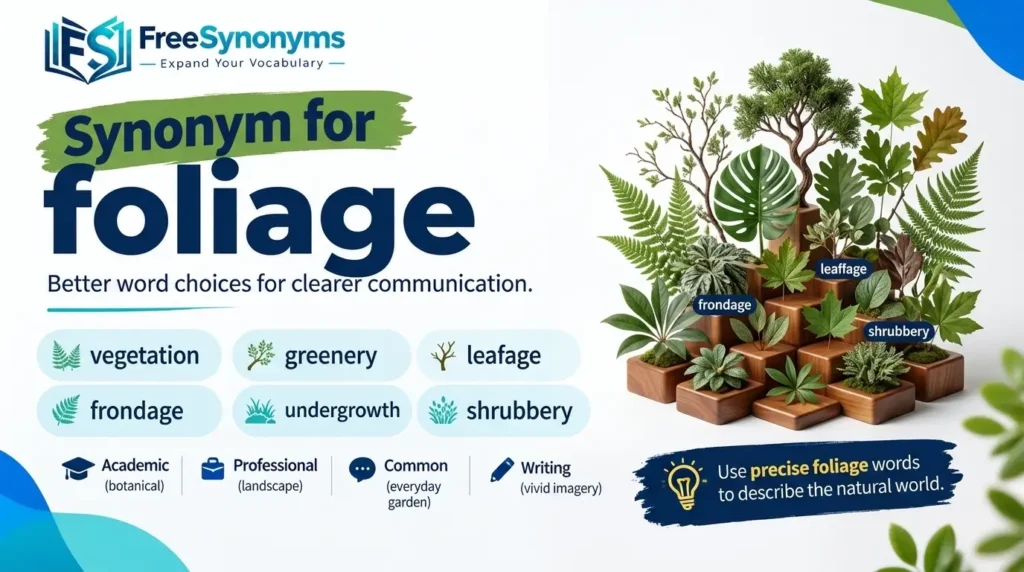
The best foliage synonym depends on what you mean by foliage. In most contexts, the closest alternatives are leaves, greenery, vegetation, leafage, plant life, and plant cover. However, these words are not always interchangeable. Leaves refers specifically to a plant’s leaves, while vegetation can include entire plants, and greenery often emphasizes an attractive or abundant appearance
Understanding these differences helps you choose a word that sounds natural rather than simply replacing foliage with a thesaurus entry.
Quick Answer: What Is a Synonym for Foliage?
Common synonyms and contextual alternatives for foliage include:
- Leaves — the most direct alternative when referring specifically to leaves.
- Greenery — attractive or abundant green plant growth.
- Vegetation — plants collectively, especially over an area.
- Leafage — a more specialized or literary word for leaves.
- Plant life — plants considered collectively.
- Plant cover — vegetation covering a particular area.
- Leaf cover — leaves forming a layer or covering.
- Herbage — herbaceous vegetation, especially grasses and low plants.
- Canopy — an overhead layer formed by trees and their leaves.
- Verdure — lush green vegetation, usually with a literary or formal tone.
For everyday American English, leaves, greenery, and vegetation are usually the most useful choices, but the right word depends heavily on the sentence.
What Does Foliage Mean?
Foliage is a noun referring collectively to the leaves of a plant or group of plants. It can describe the leaves of an individual tree, shrubs and plants in a garden, or the leafy growth covering a landscape.
For example:
The trees had dense foliage that blocked much of the sunlight.
Here, foliage means the mass of leaves on the trees.
The word can also describe leaves in terms of their appearance, abundance, arrangement, or seasonal color:
The mountain was covered in autumn foliage.
In this sentence, foliage refers to the colorful leaves of trees during the fall.
This distinction matters because foliage does not simply mean “plant.” It generally focuses on leaves or leafy growth.
Foliage as a Collective Noun
Unlike leaf, which usually identifies an individual structure, foliage commonly describes leaves collectively.
Compare:
- A leaf fell from the tree.
- The foliage was thick and green.
You would not normally replace foliage with leaf in the second sentence because the meaning is collective rather than singular.
The Closest Foliage Synonyms
1. Leaves
Leaves is often the closest and simplest alternative to foliage when the subject is specifically the leaves of plants or trees.
Example:
The dense foliage covered the forest floor.
Alternative:
The dense leaves covered the forest floor.
The second sentence is understandable, although foliage sounds more natural when describing a mass of leaves as a visual or environmental feature.
Best for: everyday writing, descriptions of trees and plants, straightforward explanations.
Formality: neutral
Important difference: leaves can refer to individual leaves or groups of leaves, while foliage more strongly suggests leaves collectively.
2. Greenery
Greenery refers to green plants or plant growth, particularly when emphasizing their fresh, attractive, or abundant appearance.
Example:
The patio was surrounded by lush foliage.
Possible alternative:
The patio was surrounded by lush greenery.
Here, greenery works naturally because the sentence focuses on the visual presence of plants.
However, greenery is broader in some contexts. It can include leafy plants and other green vegetation rather than strictly referring to leaves.
Best for: gardens, landscaping, interior decoration, scenic descriptions, informal and general writing.
Formality: neutral
Tone: often pleasant or positive
3. Vegetation
Vegetation refers collectively to plant growth in a particular area.
Example:
Thick foliage made it difficult to see the trail.
A more ecological or geographical version might be:
Dense vegetation made it difficult to see the trail.
The two words overlap, but they are not identical. Vegetation can include trees, shrubs, grasses, vines, and other plants—not merely their leaves.
Best for: scientific, environmental, geographical, and descriptive writing.
Formality: neutral to formal
Important difference: vegetation is generally broader than foliage.
4. Leafage
Leafage is a noun referring to leaves collectively or the arrangement and abundance of leaves.
It is closely related to foliage, but it is considerably less common in ordinary American English.
Example:
The branches were hidden beneath thick leafage.
Because leafage is uncommon, foliage or leaves will usually sound more natural in everyday writing.
Best for: literary, descriptive, or specialized contexts.
Formality: literary or specialized
Interchangeability: relatively high in contexts specifically concerning leaves, but less natural in everyday speech.
5. Plant Life
Plant life refers collectively to plants in a particular environment.
Example:
The region is known for its dense foliage.
Depending on the intended meaning:
The region is known for its diverse plant life.
This changes the meaning slightly. Foliage highlights leafy growth, whereas plant life encompasses plants more generally.
Best for: educational writing, environmental descriptions, general explanations.
Formality: neutral
6. Plant Cover
Plant cover describes vegetation covering the ground or another area.
Example:
Dense foliage provided cover for small animals.
In an ecological context:
Dense plant cover provided shelter for small animals.
Plant cover is especially useful when the important idea is that vegetation forms a physical layer over an area.
Best for: ecology, geography, environmental science, land descriptions.
Formality: neutral to formal
Common Foliage Synonyms at a Glance
| Word | Core Meaning | Formality | Best Used When |
| Leaves | Leaves of plants or trees | Neutral | You mean leaves specifically |
| Greenery | Green plant growth | Neutral | Appearance or abundance matters |
| Vegetation | Plants growing in an area | Neutral/Formal | Discussing plant growth broadly |
| Leafage | Leaves collectively | Literary/Specialized | A precise or literary leaf-related term is wanted |
| Plant life | Plants collectively | Neutral | Discussing plants as living organisms |
| Plant cover | Vegetation covering an area | Neutral/Formal | Describing environmental coverage |
| Leaf cover | A layer or mass of leaves | Neutral | Leaves form a covering |
| Herbage | Herbaceous plants and vegetation | Formal/Literary | Referring to grasses and low-growing plants |
| Canopy | Overhead layer of branches and leaves | Neutral/Technical | Referring to the upper layer of a forest |
| Verdure | Lush green vegetation | Literary/Formal | A vivid literary description is appropriate |
Foliage vs. Leaves
Foliage and leaves are closely related, but they are not always interchangeable.
Leaves is the ordinary word for the flat, usually green structures growing from stems or branches.
Foliage treats leaves as a collective mass, often with attention to their visual appearance or density.
Compare:
The tree has large leaves.
This focuses on the individual leaves.
The tree has dense foliage.
This focuses on the overall mass of leaves.
Another example:
She brushed a leaf from her coat.
You would not normally use foliage here because the sentence concerns one individual leaf.
But:
The garden’s foliage was beginning to turn yellow.
Here, foliage naturally describes the collective appearance of the leaves.
When “Leaves” Is Better Than “Foliage”
Choose leaves when:
- referring to individual leaves
- using everyday language
- describing the physical characteristics of leaves
- explaining plant anatomy
- writing for children or beginning English learners
Choose foliage when:
- describing leaves collectively
- emphasizing density or appearance
- describing a landscape
- discussing seasonal leaf color
- writing in a descriptive or professional style
Foliage vs. Greenery
Greenery is one of the most useful alternatives to foliage, especially when the sentence has an aesthetic or descriptive purpose.
Consider:
The hotel lobby was decorated with tropical foliage.
This emphasizes leafy plant material.
The hotel lobby was decorated with tropical greenery.
This sounds more like a description of the overall green plant decoration.
The words overlap, but greenery can refer to green plants more broadly, while foliage has a stronger connection to leaves.
Examples
Foliage:
The dense foliage created a cool, shaded environment.
Greenery:
The greenery around the entrance made the building feel more welcoming.
The first sentence emphasizes the leafy mass. The second emphasizes the visual presence of plants.
Foliage vs. Vegetation
These words are particularly easy to confuse.
Foliage focuses primarily on leaves or leafy growth.
Vegetation refers to plants collectively.
Therefore, vegetation is generally the broader term.
For example:
The trail disappeared beneath thick vegetation.
This could refer to grasses, shrubs, vines, young trees, and other plants.
If you write:
The trail disappeared beneath thick foliage.
the reader is more likely to picture a dense mass of leaves.
A Simple Rule
If you are asking:
“Am I talking specifically about leaves?”
Use foliage or leaves.
If you are asking:
“Am I talking about plant growth in general?”
Use vegetation.
Other Contextual Alternatives for Foliage
Not every useful alternative is a true synonym. Some words describe a particular type or arrangement of foliage.
Leaf Cover
Leaf cover is useful when leaves form a physical layer over a surface.
A thick layer of leaf cover protected the soil from direct sunlight.
It is more specific than foliage and is especially useful in environmental or ecological contexts.
Canopy
A canopy is the upper layer formed by the branches and foliage of trees, particularly in a forest.
Sunlight filtered through the forest canopy.
Canopy is not a direct synonym for foliage. A canopy can include branches as well as leaves, and its defining feature is its position or structure.
So:
The forest had dense foliage.
and:
The forest had a dense canopy.
are related but not identical statements.
Herbage
Herbage generally refers to herbaceous vegetation, especially grasses and other low-growing plants.
The cattle grazed on the fresh herbage.
It should not normally be used as a general replacement for foliage when you mean tree leaves.
Verdure
Verdure refers to lush green vegetation and is often associated with literary or elevated descriptive writing.
The valley was surrounded by rich verdure.
It creates a more poetic tone than ordinary words such as greenery or vegetation.
Because it is uncommon in everyday American English, it should be chosen for style rather than simplicity.
Foliage in Different Contexts
The most natural alternative changes according to what the sentence is trying to communicate.
For Trees
When describing the leaves of trees, leaves, foliage, and sometimes canopy can work.
The trees had thick foliage.
Trees had thick leaves.
The trees formed a dense canopy.
The first focuses on the leafy mass, the second on the leaves, and the third on the overhead structure.
For Gardens
Greenery is often a natural choice when discussing attractive plants in gardens or landscaped spaces.
The courtyard was surrounded by lush greenery.
Foliage also works when the emphasis is specifically on leaves.
The courtyard was surrounded by lush tropical foliage.
For Forests
Foliage, vegetation, and canopy can all work, but they highlight different aspects.
Dense foliage obscured the path.
Dense vegetation covered the hillside.
The forest canopy blocked the sunlight.
These are not interchangeable in every situation.
For Autumn Descriptions
Foliage is particularly natural when discussing the changing colors of leaves.
We drove through the mountains to see the fall foliage.
You could say:
We drove through the mountains to see the fall leaves.
That is understandable and natural, but fall foliage is a particularly established expression in American English for seasonal displays of changing leaves.
Foliage Synonyms by Tone and Purpose
Choosing an alternative is easier when you first decide what kind of writing you are doing.
Neutral and Everyday Alternatives
For ordinary writing and conversation, these are generally the safest choices:
- leaves
- greenery
- vegetation
- plant life
Example:
The house was surrounded by dense foliage.
Possible alternatives:
The house was surrounded by dense greenery.
The house was surrounded by dense vegetation.
The first alternative preserves the visual quality of the original. The second broadens the meaning from leafy growth to plant growth generally.
Formal or Technical Alternatives
In environmental, scientific, geographic, or professional writing, vegetation, plant cover, and leaf cover may be more precise depending on the subject.
Researchers measured the density of vegetation across the region.
Here, foliage would not necessarily communicate the same scope because the researchers may be considering all plant growth rather than leaves alone.
Literary Alternatives
For creative or highly descriptive writing, verdure, leafage, and carefully chosen descriptive phrases can create a different effect.
The hillside was covered in verdure.
This sounds markedly more literary than:
The hillside was covered in greenery.
A literary alternative should be chosen because it suits the voice of the writing, not simply because it is listed as a synonym.
How to Choose the Right Foliage Synonym
Before replacing foliage, identify the exact idea you want to preserve.
If You Mean “Leaves”
Use leaves.
The foliage on the tree was unusually thick.
→ The leaves on the tree were unusually thick.
If You Mean “Green Plants”
Use greenery.
The room was filled with foliage.
→ The room was filled with greenery.
This works particularly well when discussing decorative plants.
If You Mean “Plants in an Area”
Use vegetation.
The area has dense foliage.
→ The area has dense vegetation.
This is appropriate when the subject is overall plant growth.
If You Mean “An Overhead Layer of Trees and Leaves”
Use canopy.
The dense foliage blocked the sunlight.
→ The dense canopy blocked the sunlight.
The meaning shifts slightly because canopy describes the overhead structure rather than leaves alone.
If You Want a Literary Word for Lush Green Growth
Consider verdure.
The valley was surrounded by lush foliage.
→ The valley was surrounded by lush verdure.
This creates a more elevated, literary tone.
Words That Are Related to Foliage but Are Not Exact Synonyms
A strong vocabulary resource should not treat every related plant term as a synonym. Several words belong in the same semantic field but describe different things.
Flora
Flora refers to the plants of a particular region, environment, period, or category.
The region has a diverse flora.
This is much broader than foliage. Flora includes the plants themselves, not simply their leaves.
Canopy
A canopy is the upper layer formed by vegetation, particularly trees.
It may contain foliage, branches, and other structures.
Forest
A forest is an ecosystem or area dominated by trees. It is not a synonym for foliage.
Shrubbery
Shrubbery refers to shrubs collectively or an area planted with shrubs.
Some shrubbery has dense foliage, but the words describe different things.
Vegetation
Vegetation is often close to foliage, but it can include many kinds of plant growth.
Greenery
Greenery overlaps strongly with foliage, especially in landscaping and descriptive contexts, but it can refer to green plants generally.
Common Mistakes When Using Foliage Synonyms
Mistake 1: Treating Vegetation as Meaning Only Leaves
This is the most important distinction to remember.
Dense vegetation covered the hillside.
The sentence may describe grasses, bushes, vines, trees, and other plants.
If you specifically mean leaves, foliage is more precise.
Mistake 2: Using Canopy as a Universal Replacement
A canopy is not simply another word for leaves.
The forest canopy was dense.
This tells the reader about the upper layer of the forest.
The forest foliage was dense.
This focuses on the leaves.
Both sentences can be appropriate, but they communicate slightly different information.
Mistake 3: Using Verdure in Ordinary Conversation
Verdure is a legitimate word, but it is uncommon and literary.
For everyday communication, saying:
The park was full of greenery.
will usually sound more natural than:
The park was full of verdure.
Mistake 4: Assuming “Leaves” Always Sounds Identical to “Foliage”
In some sentences, replacing foliage with leaves can make the wording less polished or change the emphasis.
Compare:
The landscape was transformed by brilliant fall foliage.
with:
The landscape was transformed by brilliant fall leaves.
Both are understandable, but fall foliage has a broader descriptive quality and is particularly natural for discussing seasonal landscapes.
More Ways to Say Foliage
The best alternative to foliage depends on whether you are describing individual leaves, a mass of plant growth, a landscape, or the visual quality of greenery. Some alternatives are close enough for ordinary rewriting, while others work only in specific settings.
Leaves
Leaves is the clearest alternative when the meaning is specifically the leaves of a plant or tree.
The tree’s foliage was beginning to turn yellow.
The tree’s leaves were beginning to turn yellow.
This substitution works well because both sentences focus on the leaves. However, leaves can sound more concrete and less collective.
Greenery
Greenery is useful when the focus is on the presence or appearance of green plants.
The apartment was decorated with tropical foliage.
The apartment was decorated with tropical greenery.
The second version sounds natural in descriptions of interior decoration, landscaping, patios, gardens, and other settings where plants are being discussed aesthetically.
Vegetation
Vegetation is preferable when the subject is plant growth across an area.
Dense foliage covered the slopes.
Dense vegetation covered the slopes.
The substitution works, but it broadens the meaning. Vegetation can include leaves, grasses, shrubs, vines, and other plants.
Plant Life
Plant life is a broad, accessible alternative when discussing plants collectively.
The island has unusually dense foliage.
The island has unusually diverse plant life.
This version changes the emphasis. Foliage highlights leafy growth, while plant life highlights the plants themselves.
Leafage
Leafage is closely related to foliage and specifically concerns leaves collectively. It can work in descriptive or literary writing, but it is much less common than foliage.
The branches disappeared beneath thick leafage.
For most everyday American English, foliage or leaves would be more natural.
Stronger and More Specific Alternatives
Sometimes the best replacement is not a one-word synonym. A short descriptive phrase can communicate the intended meaning much more precisely.
Instead of:
The forest had beautiful foliage.
you might write:
- lush greenery
- dense leafy growth
- thick tree cover
- a dense canopy of leaves
- brilliant fall leaves
- thick vegetation
- lush plant growth
The choice depends on what the original sentence is trying to emphasize.
Lush Greenery
Lush greenery emphasizes abundant, healthy-looking green plant growth.
The resort was surrounded by lush greenery.
This has a strongly visual and generally positive tone.
Dense Leafy Growth
It is useful when you want to make it unmistakably clear that you mean leaves rather than all vegetation.
Dense leafy growth blocked the windows.
This is less concise than foliage, but it can be useful when precision matters.
Tree Cover
Tree cover refers to the extent to which an area is covered by trees and their crowns. It is more specific to trees and land cover than foliage.
The hillside has extensive tree cover.
This should not be treated as a direct synonym because the concept includes the trees and their coverage, not merely their leaves.
Tree Leaves
When simplicity is more important than style, tree leaves can be an effective alternative.
The path was covered with fallen tree leaves.
This is more specific than foliage and works particularly well when the sentence concerns leaves that have fallen from trees.
Foliage Synonyms for Different Writing Situations
In Academic Writing
Academic writing usually benefits from precision rather than decorative vocabulary.
Depending on the subject, useful terms include:
- vegetation
- plant cover
- leaf cover
- tree cover
- plant growth
- foliage
For example:
The study examined changes in forest foliage over the growing season.
If the research concerns all plant growth rather than leaves specifically, vegetation may be more accurate:
The study examined changes in forest vegetation over the growing season.
The second sentence has a broader scope.
In Professional Writing
Professional writing often benefits from straightforward language.
Instead of unnecessarily replacing foliage with an unusual word, consider whether leaves, greenery, or vegetation communicates the idea more clearly.
For example:
The property’s mature trees provide extensive foliage and shade.
A landscaping description might instead say:
The property’s mature trees provide abundant greenery and shade.
The choice depends on whether the writer wants to emphasize leaves or the overall visual presence of plants.
In Creative Writing
Creative writing gives you more freedom to choose words based on imagery and rhythm.
Sunlight slipped through the dense foliage.
Possible alternatives include:
Sunlight slipped through the thick leaves.
It filtered through the leafy canopy.
Sunlight flickered across the lush greenery.
These sentences are related but create different images.
Foliage is compact and descriptive. Leaves is more concrete. Canopy emphasizes the overhead structure. Greenery emphasizes the visual presence of plants.
In Casual Conversation
People often use leaves or greenery rather than more specialized alternatives.
For example:
The trees have a lot of leaves this year.
is a natural conversational sentence.
The trees have a lot of foliage this year.
is also possible, particularly when discussing a landscape or the overall appearance of the trees, but it sounds somewhat more descriptive.
Positive Alternatives to Foliage
When foliage appears in a sentence describing something attractive, the best replacement may need to preserve that positive tone.
Useful options include:
- greenery
- lush greenery
- lush vegetation
- verdure
- leafy growth
- vibrant leaves
For example:
The garden was surrounded by beautiful foliage.
Could become:
The garden was surrounded by lush greenery.
This version makes the attractive quality more explicit.
“Lush” and “Foliage”
The adjective lush frequently appears with foliage because it conveys abundance and healthy growth.
Examples include:
lush foliage
dense foliage
tropical foliage
vibrant foliage
thick foliage
colorful foliage
autumn foliage
These combinations are often more useful to a writer than replacing foliage with a single synonym.
Foliage Words for Seasonal Descriptions
One of the most familiar uses of foliage in American English concerns seasonal changes, especially autumn.
Fall Foliage
Fall foliage refers to the colorful leaves displayed by deciduous trees during autumn.
We planned a weekend trip to see the fall foliage.
Possible alternatives include:
- fall leaves
- autumn leaves
- autumn colors
- seasonal colors
- colorful leaves
The alternatives do not all carry exactly the same meaning.
Fall leaves specifically identifies the leaves.
Autumn colors emphasizes the colors rather than the leaves themselves.
Seasonal colors is broader and less specific.
Colorful Foliage
When discussing plants with striking leaves, colorful leaves may be the simplest alternative.
The garden contains plants with colorful foliage.
The garden contains plants with colorful leaves.
The second sentence is especially accessible to general readers.
Foliage in Landscaping and Gardening
In gardening and landscaping, foliage can refer to the leaves of ornamental plants and to the visual contribution those leaves make to a landscape.
For example:
The designer selected plants for their colorful foliage.
Here, leaves is technically possible:
The designer selected plants for their colorful leaves.
But foliage sounds more natural in a landscaping context because the concern is the overall visual character of the plants.
Other context-specific expressions include:
- ornamental foliage
- decorative greenery
- leafy growth
- plant cover
- green plant material
- dense greenery
Again, these are not all exact synonyms. Some describe the purpose, appearance, or broader category of the foliage.
Foliage in Nature and Environmental Writing
Environmental writing often requires greater precision because different terms describe different levels of plant structure.
Consider these terms:
| Term | What It Emphasizes |
| Foliage | Leaves collectively |
| Vegetation | Plant growth generally |
| Plant cover | Vegetation covering an area |
| Tree cover | Area covered by trees |
| Canopy | Upper layer of forest vegetation |
| Leaf litter | Fallen leaves accumulated on the ground |
| Flora | Plants of a region or environment |
These distinctions prevent imprecise substitutions.
Foliage vs. Leaf Litter
Leaf litter is not a synonym for foliage.
It refers to fallen leaves and other plant material accumulating on the ground.
The forest floor was covered with leaf litter.
This is different from:
The forest had dense foliage.
The first describes material on the ground. The second describes leaves attached to living plants.
Foliage vs. Flora
Flora is another word that can appear in discussions of plants, but it should not normally replace foliage.
The region has unusual flora.
This means the region has a distinctive collection of plant species.
The region has unusual foliage.
This focuses on the appearance or characteristics of its leaves.
A forest can have diverse flora while having relatively sparse foliage, depending on the plants and season.
Foliage vs. Plant Cover
Plant cover is useful when the important feature is how much of a surface or area is covered by vegetation.
For example:
Dense plant cover reduced erosion.
Here, the emphasis is on the protective layer formed by vegetation.
Compare:
Dense foliage reduced visibility.
The second sentence emphasizes leaves and their visual obstruction.
The terms overlap in some environmental contexts, but they should not be treated as interchangeable in every sentence.
Foliage vs. Canopy
These words frequently occur together but describe different concepts.
Foliage = leaves collectively.
Canopy = an upper covering or layer, especially one formed by trees.
For example:
The dense foliage made the forest floor dark.
The leaves are the focus.
The dense canopy made the forest floor dark.
The overhead layer is the focus.
A canopy can consist of branches and leaves, while foliage specifically refers to the leafy component.
Foliage vs. Greenery: Which Should You Choose?
A useful way to distinguish them is to ask what the reader should picture.
Choose foliage when the reader should picture leaves.
Choose greenery when the reader should picture green plants or attractive plant growth.
Compare:
The room was decorated with lush foliage.
This suggests leafy plants.
The room was decorated with lush greenery.
This emphasizes the overall green plant decoration.
Both can be natural, but the second is often more suitable when discussing décor or landscaping.
Foliage vs. Vegetation: Which Should You Choose?
Choose foliage when the subject is mainly leaves.
Choose vegetation when the subject is plant growth generally.
Compare:
The dense foliage blocked the view.
The reader imagines leaves.
Dense vegetation blocked the trail.
The reader can imagine shrubs, grasses, vines, and trees.
This is one of the most important distinctions for accurate vocabulary use.
How to Replace Foliage Without Changing the Meaning
When editing a sentence, do not simply substitute the first word that appears in a synonym list. First identify the semantic focus.
Ask:
- Is the sentence about leaves specifically?
- Is it about plants generally?
- Is appearance important?
- Is the writing technical or conversational?
- Is the vegetation above the ground forming a canopy?
- Is the sentence about seasonal color?
- Is the word being used literally or descriptively?
Then choose the appropriate alternative.
Example 1: Leaves
Original:
The tree’s dense foliage provided shade.
Possible revision:
The tree’s dense leaves provided shade.
This preserves the basic meaning, although foliage sounds more collective.
Example 2: Greenery
Original:
The entrance was surrounded by foliage.
Possible revision:
The entrance was surrounded by greenery.
This works particularly well when describing landscaping.
Example 3: Vegetation
Original:
The hillside was covered with thick foliage.
Possible revision:
The hillside was covered with thick vegetation.
This works if the hillside contains various types of plant growth, not simply leaves.
Example 4: Canopy
Original:
The hikers walked beneath dense foliage.
Possible revision:
The hikers walked beneath a dense canopy.
This is a natural change if the intended image is an overhead layer of trees and leaves.
Example 5: Fall Leaves
Original:
Tourists traveled to see the region’s fall foliage.
Possible revision:
Tourists traveled to see the region’s colorful fall leaves.
This is clear and natural, though fall foliage has a particularly concise descriptive quality.
When Not to Replace Foliage
Sometimes foliage is already the best word.
Do not replace it merely to avoid repetition if the alternatives would make the sentence less precise.
For example:
The plant is valued for its unusual foliage.
Replacing this with:
The plant is valued for its unusual vegetation.
would change the meaning and sound unnatural.
Similarly:
The landscape is famous for its spectacular fall foliage.
does not necessarily need a synonym. The phrase is already concise, natural, and precise.
A good vocabulary choice is not always the most unusual word. Sometimes the strongest edit is keeping the original word.
Foliage Synonyms in Sentence Examples
Seeing alternatives in complete sentences is often more useful than memorizing a list. The examples below show how the meaning or tone can change depending on the word selected.
Foliage → Leaves
Original:
The trees had thick foliage after several weeks of rain.
Alternative:
The trees had thick leaves after several weeks of rain.
The second sentence is understandable, but foliage sounds more natural when describing the collective leafy appearance of trees.
Foliage → Greenery
Original:
The courtyard was surrounded by lush foliage.
Alternative:
The courtyard was surrounded by lush greenery.
Greenery works especially well when the visual appearance of plants is important.
Foliage → Vegetation
Original:
Dense foliage covered the hillside.
Alternative:
Dense vegetation covered the hillside.
The alternative is broader because vegetation can include trees, shrubs, grasses, vines, and other plants.
Foliage → Canopy
Original:
Sunlight filtered through the dense foliage.
Alternative:
Sunlight filtered through the dense canopy.
Canopy changes the focus from the leaves themselves to the overhead layer formed by trees and their foliage.
Foliage → Verdure
Original:
The valley was surrounded by lush foliage.
Alternative:
The valley was surrounded by lush verdure.
Verdure gives the sentence a more literary and elevated tone.
Foliage Synonyms for Descriptive Writing
When describing a landscape, the best alternative often depends on the image you want the reader to form.
To Emphasize Abundance
Use expressions such as:
- lush greenery
- dense foliage
- thick vegetation
- abundant plant growth
- heavy leaf cover
Example:
The garden was filled with lush greenery.
This emphasizes abundance and visual appeal.
To Emphasize Density
Use:
- dense foliage
- thick leaves
- dense vegetation
- heavy leaf cover
- thick leafy growth
Example:
Dense foliage obscured the cabin from view.
Here, dense foliage efficiently communicates that the leaves are thick enough to obstruct visibility.
To Emphasize Beauty
Use:
- lush greenery
- colorful leaves
- vibrant foliage
- ornamental foliage
- verdure
Example:
The garden was known for its vibrant foliage.
The phrase suggests that the leaves themselves are visually striking.
To Emphasize Seasonal Change
Use:
- fall foliage
- autumn leaves
- fall leaves
- seasonal colors
- changing leaves
Example:
The park attracts visitors during the fall foliage season.
If the purpose is to emphasize the colors rather than the leaves, autumn colors can be more appropriate.
Formality Guide for Foliage Alternatives
Not every synonym belongs in every type of writing.
| Alternative | Typical Tone | Common Context |
| Leaves | Neutral | Everyday and general writing |
| Greenery | Neutral, often positive | Gardens, décor, landscapes |
| Vegetation | Neutral/Formal | Environmental and geographic writing |
| Plant life | Neutral | General educational writing |
| Plant cover | Technical/Neutral | Ecology and land descriptions |
| Leaf cover | Neutral/Technical | Environmental descriptions |
| Canopy | Neutral/Technical | Forests and tree structure |
| Leafage | Literary/Uncommon | Descriptive writing |
| Verdure | Literary/Formal | Poetic landscape descriptions |
| Herbage | Literary/Technical | Grasses and herbaceous plants |
For most readers, leaves, greenery, and vegetation are the most practical alternatives.
Best Foliage Synonyms for Specific Situations
When Writing About Trees
Use:
leaves, foliage, canopy, tree cover
But remember the distinctions.
The tree’s leaves were turning brown.
The tree had dense foliage.
The forest canopy blocked the sunlight.
The region has extensive tree cover.
Each sentence describes a different aspect of the trees.
When Writing About Gardens
Use:
greenery, foliage, plant growth, ornamental foliage
Example:
The garden’s colorful foliage complemented the flowers.
A more general version would be:
The garden’s colorful greenery complemented the flowers.
The first specifically emphasizes the leaves; the second emphasizes green plant material more generally.
When Writing About Forests
Use:
foliage, vegetation, canopy, tree cover
Example:
Thick vegetation covered the forest floor.
Here, vegetation may include ferns, grasses, shrubs, and other plants.
The dense canopy kept the forest floor cool.
Here, the focus is the upper layer.
The trees had thick foliage.
Here, the focus is the leaves.
When Writing About Fall
Use:
fall foliage, fall leaves, autumn leaves, autumn colors
Example:
The region is famous for its fall foliage.
This is one of the contexts in which foliage has a particularly recognizable and natural use in American English.
Can “Greenery” Always Replace Foliage?
No.
Although greenery is a close alternative, it can be broader than foliage.
Consider:
The plant has unusual foliage.
This means its leaves have unusual characteristics, such as shape, color, texture, or arrangement.
Replacing it with:
The plant has unusual greenery.
is possible in some contexts but does not communicate the same level of precision.
If the subject is specifically the characteristics of leaves, foliage is usually the better choice.
Can “Vegetation” Always Replace Foliage?
No.
Vegetation is broader because it refers to plant growth generally.
For example:
The researchers examined the foliage of several tree species.
This specifically concerns leaves.
The researchers examined the vegetation of the region.
This could involve many types of plants.
The two words may overlap in landscape descriptions, but they should not be treated as exact equivalents.
Can “Flora” Replace Foliage?
Usually, no.
Flora refers to the plants of a particular region, habitat, period, or category.
For example:
The region has a diverse flora.
This concerns the variety of plant life.
By contrast:
The region has dense foliage.
This concerns the abundance of leaves or leafy growth.
If you are writing about plant species, flora may be appropriate. If you are describing leaves, foliage is more precise.
Is “Leafage” a Good Synonym for Foliage?
Leafage is a legitimate word closely associated with foliage, but it is not usually the first choice for everyday American English.
It can be useful when:
- you specifically mean leaves collectively
- you want a literary tone
- the surrounding writing already has an elevated style
- repetition of foliage needs to be avoided without broadening the meaning
For ordinary writing, leaves is usually clearer.
Is “Greenery” More Natural Than “Foliage”?
It depends on the context.
For landscaping:
The property is surrounded by lush greenery.
sounds very natural.
For describing leaf characteristics:
The plant is prized for its unusual foliage.
is more precise.
For autumn:
The mountains are famous for their fall foliage.
is particularly natural.
There is therefore no single “best” replacement in every sentence.
Foliage Synonyms: A Practical Selection Guide
Use this quick guide to choose the most accurate word for your context:
- For individual leaves, use leaves.
- When referring to leaves collectively, foliage is the natural choice.
- Greenery works well for attractive or abundant green plant growth.
- For plants growing in a particular area, consider vegetation.
- The broader term plant life can describe plants collectively.
- Plant cover is useful when referring to vegetation that covers a specific area of land.
- An overhead layer formed by trees in a forest is known as the canopy.
- Leaf cover can describe leaves that form a covering or layer.
- For grasses and low herbaceous plants, herbage is a more specific term.
- In literary or descriptive writing, verdure can convey the idea of lush green growth.
- When discussing the plants native to or found in a particular region, flora is often appropriate.
This approach is more reliable than selecting a synonym simply because it appears in a thesaurus. The surrounding context should always determine which word fits best.
Frequently Asked Questions About Foliage Synonyms
What is the closest synonym for foliage?
Leaves is generally the closest everyday alternative when foliage specifically means the leaves of a plant or group of plants. Leafage is also closely related, but it is much less common. Greenery and vegetation can be appropriate alternatives in broader contexts, but they do not always have exactly the same meaning.
What is a simple word for foliage?
The simplest word is usually leaves. Depending on context, greenery or plants may also work.
For example:
The tree has dense foliage.
can become:
The tree has lots of leaves.
The second version is especially accessible in everyday English.
What is another word for foliage in a forest?
Depending on the intended meaning, you can use leaves, vegetation, greenery, canopy, or tree cover.
However, these words describe different aspects of a forest. Foliage focuses on leaves, vegetation covers plant growth more broadly, and canopy refers to the upper layer of the forest.
What is a synonym for lush foliage?
Possible alternatives include lush greenery, dense greenery, abundant leafy growth, thick vegetation, and verdure.
The best option depends on whether you want to emphasize visual beauty, density, general plant growth, or literary style.
Is vegetation a synonym for foliage?
Vegetation is a contextual synonym, but not an exact synonym. Foliage primarily refers to leaves or leafy growth, whereas vegetation refers to plants collectively or plant growth in an area. Vegetation therefore has a broader meaning.
Is greenery a synonym for foliage?
Greenery is a close contextual synonym. Both can describe abundant green plant growth, but greenery can refer to green plants more broadly, while foliage specifically emphasizes leaves.
Is flora a synonym for foliage?
No. Flora refers to plant life or the plants found in a particular region or environment. Foliage refers primarily to leaves collectively.
What is the opposite of foliage?
There is no single exact antonym for foliage. Depending on the intended contrast, you might describe a plant as leafless, bare, without leaves, or defoliated.
For example:
The tree had dense foliage.
could contrast with:
The tree was completely bare.
The appropriate opposite depends on the sentence and context.
What is a synonym for autumn foliage?
Common alternatives include fall leaves, autumn leaves, fall colors, autumn colors, and changing leaves. Fall foliage itself is a natural American English expression for the colorful leaves of deciduous trees during autumn.
Final Takeaway
The best foliage synonym is determined by the exact meaning of the sentence. Leaves is the closest straightforward choice when you specifically mean leaves. Greenery works well for attractive or abundant plant growth, while vegetation is better when referring to plants across an area. Canopy describes an overhead layer, plant cover emphasizes coverage, and verdure provides a literary alternative for lush green growth.
The key distinction is simple: foliage focuses on leaves, while vegetation and greenery can describe plant growth more broadly. Choosing the word that matches that distinction will make your writing more precise, natural, and effective.

Emily Carter
Emily Carter writes clear, accessible English vocabulary guides for students, professionals, and everyday readers. Her work explores synonyms, antonyms, word usage, and example sentences to help readers expand their vocabulary and express their ideas with confidence.