
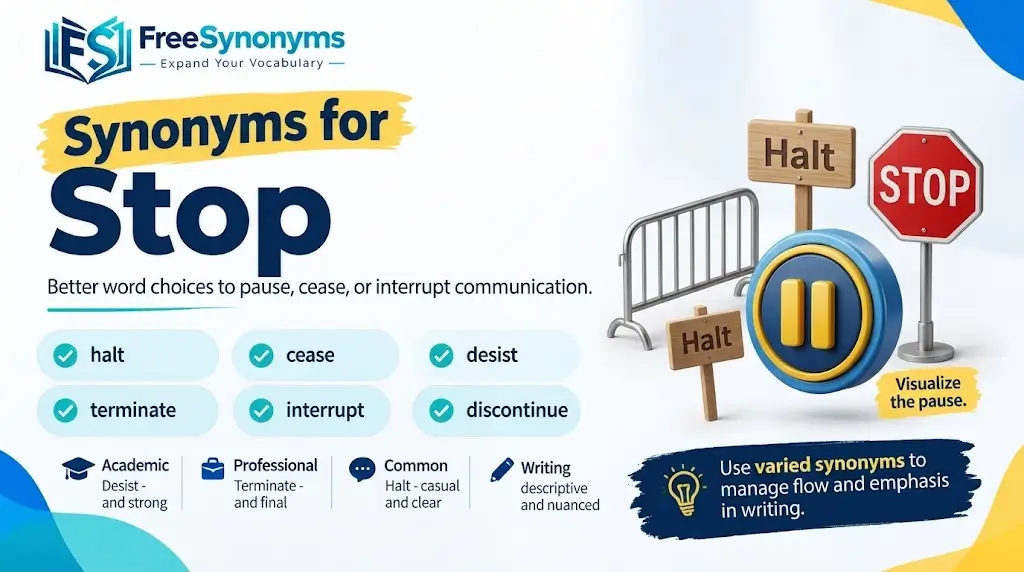
The best synonyms for stop depend on what you mean. Halt, cease, pause, quit, discontinue, end, prevent, block, restrain, and finish can all relate to “stop,” but they are not interchangeable in every sentence. For example, you can stop a car, pause a conversation, quit a job, cease an activity, or prevent a problem. Choosing the right alternative makes your writing more precise and natural.
Quick Answer: Synonyms for Stop
Here are some of the most useful synonyms for stop:
- Halt — stop an action or movement, often suddenly or firmly.
- Cease — stop completely, usually in formal writing.
- Pause — stop temporarily and usually intend to continue.
- End — bring something to a conclusion.
- Quit — stop doing something, especially an activity, job, or habit.
- Discontinue — stop providing, producing, or using something, often formally.
- Terminate — officially bring something to an end.
- Prevent — stop something from happening.
- Block — stop movement, access, communication, or progress.
- Restrain — hold someone or something back.
- Suspend — temporarily stop an activity or service.
- Break off — stop something before it is completed.
- Abandon — stop doing something and leave it unfinished.
- Desist — stop an action, especially after being told to do so.
- Curb — reduce or control something undesirable.
Therefore, the most natural replacement depends on the sentence, the intended meaning, and the level of formality.
What Does “Stop” Mean?
The verb stop has several meanings in American English. Because of that range, no single synonym works in every situation.
First, stop can mean to end an action. For example, “Please stop talking” means to cease the activity of talking.
It can also mean to interrupt movement. In “The driver stopped the car,” the vehicle was brought to a halt.
In addition, stop can mean to prevent something. For example, “The lock stopped the door from opening” means the lock prevented the action.
The word can also describe a temporary break. “We stopped for lunch” usually means we paused our journey or activity before continuing.
Finally, stop can mean to leave or discontinue something. “She stopped smoking” means she no longer engages in that habit.
As a result, identifying the intended meaning should come before choosing a synonym.
The Closest Synonyms for Stop
Some alternatives are close to stop, but each has its own nuance. The following words are useful when you want to replace “stop” without changing the basic idea too much.
| Synonym | Main nuance | Formality | Best used when |
|---|---|---|---|
| Halt | Bring movement or activity to a stop | Neutral/Formal | Movement, operations, actions |
| Cease | Stop completely | Formal | Activities, practices, processes |
| Pause | Stop temporarily | Neutral | Conversations, work, media, activities |
| End | Bring to a conclusion | Neutral | Events, activities, situations |
| Quit | Stop doing something | Neutral | Jobs, habits, activities |
| Discontinue | Stop using, producing, or providing | Formal | Products, services, practices |
| Terminate | Officially bring to an end | Formal | Contracts, agreements, services |
| Suspend | Stop temporarily | Formal | Services, activities, privileges |
| Desist | Stop an action | Formal | Unwanted or prohibited behavior |
However, these words should not be treated as a simple thesaurus list. Their grammatical patterns and meanings can differ significantly.
Halt
Halt means to bring movement or activity to a stop. It often sounds stronger than the everyday word “stop.”
For example:
The police ordered the driver to halt.
You can also use halt for processes or operations:
The company halted production because of a safety issue.
In contrast, pause usually suggests a temporary interruption rather than a firm termination.
Cease
Cease means to stop completely. It is more formal than “stop,” so it commonly appears in professional, legal, academic, and official writing.
For example:
The factory agreed to cease operations.
You might also write:
The noise finally ceased.
However, “cease” can sound overly formal in casual conversation. Most people would naturally say “stop” in everyday speech.
Pause
Pause means to stop temporarily, with the expectation that something will continue.
For example:
She paused the video to answer the phone.
Similarly:
The speaker paused for a moment before answering.
The temporary nature of pause is important. Therefore, “pause” is usually inappropriate when you mean that an activity has ended permanently.
End
End means to bring something to a conclusion.
For example:
The meeting ended at noon.
You can also use it transitively:
The manager ended the discussion.
Unlike pause, “end” normally suggests completion rather than a temporary interruption.
Quit
Quit means to stop doing something. It is particularly common for jobs, activities, habits, and repeated behaviors.
For example:
Maria quit her job last month.
You can also say:
He quit smoking.
In American English, quit is natural and common. However, it does not always work where “stop” describes physical movement or prevention.
Temporary Alternatives to Stop
When you mean “stop for a while,” choose a word that preserves the idea of continuation.
Pause
Pause is usually the clearest choice. It works well for videos, conversations, work, meetings, and activities.
Let’s pause the discussion until tomorrow.
The sentence suggests that the discussion may continue later.
Take a Break
Take a break is a natural conversational alternative when someone temporarily stops working or participating.
I need to take a break from studying.
This expression is especially common in everyday American English.
Suspend
Suspend means to temporarily stop something. It often sounds more official than “pause.”
The service was suspended during maintenance.
In addition, suspend can describe temporary restrictions:
The school suspended the student for three days.
Because of its formal or institutional tone, it is not always a natural replacement for “pause.”
Interrupt
Interrupt means to stop something temporarily by breaking its continuity.
The phone call interrupted our conversation.
Notice the grammatical difference. You normally interrupt something, while you pause something intentionally.
Formal Synonyms for Stop
Formal writing often benefits from more precise alternatives. Nevertheless, the most formal word is not automatically the best choice.
Cease
Use cease when you want to emphasize complete discontinuation.
The organization decided to cease operations.
Discontinue
Discontinue means to stop using, producing, selling, or providing something.
For example:
The manufacturer discontinued the old model.
It is particularly useful in business and product-related writing.
Terminate
Terminate means to officially bring something to an end.
For example:
Either party may terminate the agreement with written notice.
It commonly appears in legal, contractual, employment, and technical contexts.
Desist
Desist means to stop doing something. It is quite formal and often appears in warnings or official language.
The company was ordered to desist from the practice.
Therefore, “desist” is usually not the best everyday alternative to “stop.”
Synonyms for Stop Doing Something
Sometimes “stop” means no longer performing an action. In that case, the best alternatives include quit, cease, discontinue, abandon, desist, and give up.
Quit
Use quit for habits, jobs, activities, or actions.
She quit drinking coffee.
He quit his job to start a business.
Give Up
Give up is informal and often suggests voluntarily abandoning an activity, effort, or attempt.
I gave up trying to fix the old computer.
It can also describe ending a habit:
He gave up smoking.
However, “give up” can carry an additional sense of surrender that “stop” does not necessarily have.
Abandon
Abandon means to stop doing something before completion and leave it behind.
The team abandoned the project after funding disappeared.
As a result, abandon is stronger than a simple “stop.” It often suggests that something will not be resumed.
Desist
Desist focuses on stopping a particular action, especially one that is unwanted or inappropriate.
The notice instructed the company to desist from using the trademark.
Because it is formal, it works better in official or legal contexts than in casual speech.
Synonyms for Stop Moving
When stop refers to movement, alternatives such as halt, come to a standstill, pull over, brake, and stay may be appropriate.
Halt
The train halted outside the station.
This emphasizes that movement has stopped.
Come to a Standstill
Come to a standstill describes something that stops moving or progressing.
Traffic came to a standstill after the accident.
It is especially useful for traffic, negotiations, projects, and other situations involving progress.
Pull Over
Pull over is specifically associated with a vehicle moving to the side of a road and stopping.
The driver pulled over to check the tire.
Therefore, it cannot replace “stop” in every context.
Brake
Brake means to slow or stop a vehicle by using its braking system.
The driver braked suddenly.
Technically, brake describes the action used to slow or stop rather than simply the resulting state.
Synonyms for Stop Something From Happening
A different group of words applies when stop means prevent.
Prevent
Prevent means to make something impossible or less likely to happen.
Regular maintenance can prevent costly repairs.
This is one of the most useful alternatives when “stop” means avoiding an event.
Block
Block means to prevent movement, access, communication, or progress.
The security system blocked unauthorized access.
Similarly, a road closure can block traffic.
Prohibit
Prohibit means officially or legally forbid something.
The policy prohibits employees from sharing confidential information.
Because it refers to rules or restrictions, prohibit is more specific than “stop.”
Deter
Deter means to discourage someone from doing something.
Strong penalties may deter people from breaking the rules.
Unlike prevent, deterrence does not necessarily make an action impossible. Instead, it reduces the likelihood that someone will choose to do it.
Restrain
Restrain means to hold something or someone back.
The security guard restrained the suspect.
It can also describe controlling behavior or growth:
The company is trying to restrain unnecessary spending.
Synonyms for Stop Talking
When someone stops speaking, several alternatives are possible, but they carry different tones.
Be Quiet
Be quiet is a direct everyday expression. Depending on the context, it can sound neutral, firm, or rude.
Please be quiet while the teacher is speaking.
Fall Silent
Fall silent is more descriptive and often appears in narrative or literary writing.
The room fell silent after the announcement.
Remain Silent
Remain silent is more formal and emphasizes continued silence.
The witness chose to remain silent.
Keep Quiet
Keep quiet can mean to remain silent or not reveal information.
She promised to keep quiet about the surprise.
Therefore, context matters. “Keep quiet” may refer to secrecy, while “be quiet” usually concerns noise or speech.
Synonyms for Stop Working
The best replacement depends on whether a person or a machine stops working.
Quit Working
For a person, quit working can mean simply stopping work.
I quit working at six o’clock.
However, quit may also suggest leaving employment, so the surrounding sentence should make the meaning clear.
Retire
Retire means permanently stop working, usually after reaching a certain stage of a career.
My father retired last year.
It is not a general synonym for “stop working.”
Break Down
For machines, break down means stop functioning because of a problem.
The printer broke down during the presentation.
This expression describes an equipment failure rather than an intentional decision to stop.
Shut Down
Shut down means to stop operating a machine, system, business, or process.
The technician shut down the server.
It can also describe a system stopping automatically:
The computer shut down unexpectedly.
Synonyms for Stop a Problem
When you want to describe dealing with a problem, the alternatives depend on the desired meaning.
Prevent works when the problem has not happened yet.
Good planning can prevent delays.
Address means deal with a problem rather than necessarily eliminate it.
The manager addressed the customer complaint.
Resolve means solve a problem or dispute.
The team resolved the issue quickly.
Control means keep a problem within manageable limits.
The new measures helped control costs.
Eliminate means remove something completely.
The update eliminated the software error.
As a result, these words should not be treated as identical. A company can address a problem without fully resolving it, for example.
Casual Alternatives to Stop
Everyday conversation often favors simple expressions.
Quit
Quit bothering your brother.
Cut It Out
Cut it out means stop doing something annoying or unwanted. It is informal.
Cut it out! You’re distracting everyone.
Knock It Off
Knock it off is another informal way to tell someone to stop an annoying action.
Knock it off and get back to work.
Hold On
Hold on can mean wait or stop temporarily.
Hold on a second; I need to check something.
However, it does not normally mean permanently stop an activity.
Slow Down
Slow down means reduce speed rather than stop completely.
Slow down before the intersection.
Therefore, it is only an appropriate alternative when the intended meaning involves reduced speed.
Stronger Alternatives to Stop
Sometimes “stop” does not fully express the force of the intended action.
Halt can sound firm and immediate:
The officer ordered the crowd to halt.
Terminate emphasizes official completion:
The company terminated the contract.
Eliminate emphasizes complete removal:
The update eliminated the error.
Prohibit emphasizes an official rule:
The law prohibits the practice.
Suppress can mean forcibly prevent something from spreading, appearing, or continuing:
The medication suppressed the symptoms.
However, these stronger words should be used carefully. A dramatic alternative can change the meaning rather than simply improve the sentence.
Choosing the Right Synonym for Stop
The easiest way to select the right word is to identify what exactly is stopping.
| If you mean… | Consider… | Example |
|---|---|---|
| Stop temporarily | Pause | Pause the video. |
| Stop permanently | Cease, end | The service ceased. |
| Stop doing an activity | Quit | She quit smoking. |
| Stop a product or service | Discontinue | They discontinued the product. |
| Officially end something | Terminate | They terminated the contract. |
| Stop movement | Halt | The vehicle halted. |
| Stop something from happening | Prevent | The rule prevents errors. |
| Stop access or movement | Block | The gate blocked traffic. |
| Reduce something harmful | Curb | The policy curbed spending. |
| Hold something back | Restrain | The measures restrained growth. |
| Forbid something | Prohibit | The rules prohibit entry. |
| Discourage an action | Deter | Fines may deter violations. |
First, identify the action. Next, decide whether the stopping is temporary or permanent. Then, consider whether the action is voluntary, forced, official, physical, or preventive.
That process usually produces a more natural choice than selecting the first synonym in a thesaurus.
Stop vs. Halt
Stop is the broader and more common word. Halt often sounds firmer or more formal.
Compare:
The car stopped at the light.
The troops halted near the border.
Both sentences describe an interruption of movement. However, “halt” gives the second sentence a more formal or deliberate tone.
In everyday conversation, stop is usually the natural choice. Meanwhile, halt works well in commands, formal descriptions, and situations involving organized movement or operations.
Stop vs. Pause
The main difference is duration and expectation.
Pause normally means temporary interruption:
Pause the movie while I make dinner.
Stop can mean temporary or permanent:
Stop the movie.
The second sentence is ambiguous without context. It could mean stop it now, or it could imply that the viewer should no longer watch it.
Therefore, use pause when you want to clearly communicate that something will continue later.
Stop vs. Quit
Stop is more general, while quit commonly describes ending an activity, habit, or job.
I stopped working at 5 p.m.
This normally describes ending work for the day.
I quit my job.
That sentence normally means the person left the job.
Likewise:
She stopped smoking.
She quit smoking.
Both can communicate that she no longer smokes. However, quit can place slightly more emphasis on the decision to give up the habit.
Stop vs. Cease
Both can mean to stop completely, but their style differs.
Stop is everyday and flexible:
The rain stopped.
Cease is formal:
Hostilities ceased overnight.
Consequently, “cease” fits official, legal, academic, and formal prose better than casual conversation.
Stop vs. Prevent
These words have different grammatical meanings.
Stop can mean cause an ongoing action to end:
The guard stopped the fight.
Prevent means keep an action or event from happening:
The guard prevented a fight.
The first sentence suggests that a fight had begun. The second suggests that the fight did not happen.
This distinction is especially important in professional and academic writing.
Stop vs. End
End focuses on bringing something to a conclusion, while stop has a broader range of meanings.
The meeting ended at 4 p.m.
The speaker stopped talking at 4 p.m.
The first sentence focuses on the meeting as an event. The second focuses on the speaker’s action.
Therefore, use end when the subject is an event, process, period, or situation that reaches its conclusion.
Common Mistakes With Synonyms for Stop
Using a synonym correctly requires more than matching basic dictionary meanings. Several common substitutions can make a sentence unnatural or change its meaning.
Using “Pause” for a Permanent Ending
Incorrect or misleading:
The company paused the product permanently.
Better:
The company discontinued the product.
Pause suggests that something may resume. For a permanent business decision, discontinue is clearer.
Using “Quit” for Physical Movement
Awkward:
The car quit at the intersection.
Although “quit” can sometimes describe a machine or engine failing in informal American English, it is not the clearest general replacement for “stop.”
Better:
The car stopped at the intersection.
Using “Prevent” After Something Has Already Happened
Consider:
The firefighters prevented the fire from spreading.
This is correct because the spreading was stopped before it occurred.
However:
The firefighters prevented the fire after it spread.
The intended meaning is probably different. If the fire had already spread, contained, controlled, or stopped may be more accurate.
Using “Terminate” in Casual Conversation
Saying:
I terminated my dinner.
would sound unnatural.
A natural alternative is:
I stopped eating.
Formal vocabulary is useful only when it fits the context.
Treating “End” and “Stop” as Identical
These words overlap, but they emphasize different things.
The meeting stopped.
This can sound like the meeting was interrupted.
The meeting ended.
This normally means the meeting reached its conclusion.
Therefore, end is often preferable when completion is the main idea.
How to Use Stop in Different Types of Writing
The right alternative also depends on your audience.
Everyday Writing
Use familiar words such as stop, pause, quit, end, and give up.
I decided to stop checking my phone.
These choices sound natural and direct.
Professional Writing
Professional documents may benefit from discontinue, suspend, prevent, restrict, terminate, or cease, depending on the exact meaning.
The company suspended the service during maintenance.
This is clearer than using an unnecessarily complicated expression.
Academic Writing
Academic writing often favors precise verbs rather than dramatic vocabulary.
For example:
The treatment reduced the symptoms.
If you actually mean that something prevented an outcome, write:
The intervention prevented the symptoms from worsening.
Precision matters more than formality.
Legal or Official Writing
Terms such as terminate, prohibit, cease, suspend, and desist can be appropriate because they describe formal actions and restrictions.
The agreement may be terminated under certain conditions.
However, legal language should be selected according to the specific legal meaning intended rather than simply because it sounds formal.
Synonyms for Stop in Different Sentences
The following examples show why context matters.
Stop Talking
Please stop talking.
Possible alternatives:
Please be quiet.
Please remain silent.
Please cease talking.
The first is ordinary. The second is direct and conversational. The third sounds formal.
Stop the Car
Stop the car.
Possible alternatives:
Halt the vehicle.
Pull over.
Bring the vehicle to a stop.
Here, pull over changes the meaning slightly because it normally means moving a vehicle to the side of the road.
Stop the Project
They stopped the project.
Possible alternatives:
They abandoned the project.
They discontinued the project.
They terminated the project.
Each choice adds nuance. “Abandoned” suggests leaving it unfinished, while “terminated” sounds more official.
Stop the Problem
The new system stopped the problem.
Possible alternatives:
The new system prevented the problem.
The new system eliminated the problem.
The new system resolved the problem.
These alternatives should not be swapped automatically. Prevention happens before an event, elimination removes it, and resolution addresses a problem successfully.
Synonyms for Stop by Tone
Tone can affect which word sounds natural.
| Tone | Useful alternatives |
|---|---|
| Neutral | Stop, end, pause |
| Casual | Quit, give up, cut it out |
| Firm | Halt, stop, knock it off |
| Formal | Cease, desist, discontinue |
| Official | Terminate, suspend, prohibit |
| Preventive | Prevent, deter, block |
| Restrictive | Restrain, curb, limit |
| Permanent | End, cease, discontinue, terminate |
For most everyday situations, stop remains the safest and most flexible choice.
In contrast, specialized contexts benefit from more precise vocabulary. A contract can be terminated, a service can be suspended, and an unwanted event can be prevented.
Words Related to Stop That Are Not Exact Synonyms
Some words are connected to the idea of stopping but should not be presented as direct synonyms.
Limit means restrict the amount, degree, or extent of something.
Reduce means make something smaller or less intense.
Control means manage or keep something within a desired range.
Delay means make something happen later.
Interrupt means break the continuity of something.
Avoid means stay away from something or prevent contact with it.
Resist means oppose or withstand something.
Contain means keep something within limits or prevent it from spreading.
These words can overlap with “stop” in particular sentences. Nevertheless, each has a distinct core meaning.
Frequently Asked Questions
What is the best synonym for stop?
There is no single best synonym for every use of “stop.” Halt works well for movement, pause for temporary interruptions, quit for activities or habits, cease for complete stopping, and prevent when something is stopped from happening.
What is a formal word for stop?
Common formal alternatives include cease, discontinue, terminate, suspend, and desist. The appropriate choice depends on the context. For example, “terminate” is common in contractual language, while “cease” can describe an activity coming to an end.
What is another word for stop doing something?
Depending on the context, you can use quit, cease, discontinue, abandon, desist, or give up. “Quit” is common in everyday American English, while “desist” is considerably more formal.
What is a synonym for stop temporarily?
Pause is usually the clearest choice. Other possibilities include suspend, interrupt, and take a break, although each has a slightly different meaning.
What is another word for stop permanently?
Depending on the context, use end, cease, discontinue, terminate, or abandon. “Abandon” often suggests leaving something unfinished, while “terminate” emphasizes an official ending.
What is a synonym for stop someone from doing something?
Useful choices include prevent, restrain, deter, prohibit, block, and discourage. The correct word depends on whether you mean physically stopping someone, making an action impossible, officially forbidding it, or merely reducing the likelihood of it happening.
What is a synonym for stop in professional writing?
Discontinue, suspend, terminate, cease, prevent, and halt can work well in professional writing. However, the simplest accurate word is often better than a more formal alternative.
Is “halt” stronger than “stop”?
Often, yes. Halt can sound more abrupt, firm, or deliberate than the everyday word “stop.” The difference depends on context and sentence construction.
Are “stop” and “quit” interchangeable?
Not always. Quit commonly refers to ending a job, habit, or activity, while stop has many additional meanings, including ending movement and preventing events.
Are “stop” and “cease” the same?
They overlap when they mean ending an activity, but cease is more formal and often emphasizes complete stopping. In casual American English, stop is usually more natural.
Conclusion
The most useful synonyms for stop include halt, pause, cease, end, quit, discontinue, terminate, prevent, block, suspend, restrain, and desist. However, each word carries its own meaning, tone, or grammatical use.
Use pause for a temporary interruption, quit for ending an activity or habit, and halt for stopping movement or an operation. For formal contexts, cease, discontinue, terminate, and desist may be appropriate. When the meaning is to keep something from happening, choose prevent, block, deter, or prohibit instead.
Ultimately, the strongest synonym is not necessarily the most sophisticated one. The best word is the one that communicates your exact meaning naturally, clearly, and appropriately for your audience.

Emily Carter
Emily Carter writes clear, accessible English vocabulary guides for students, professionals, and everyday readers. Her work explores synonyms, antonyms, word usage, and example sentences to help readers expand their vocabulary and express their ideas with confidence.