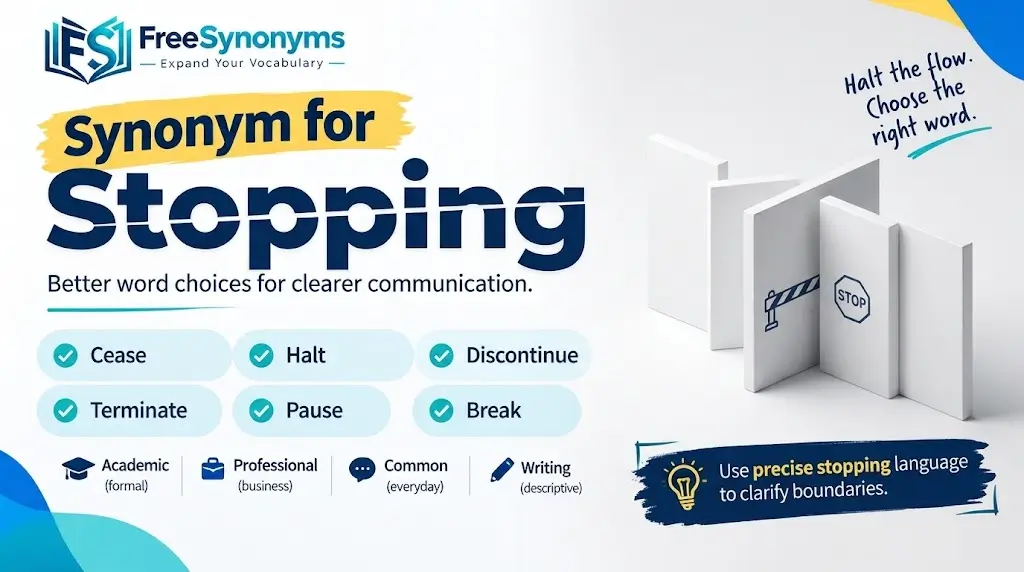
The best stopping synonym depends on what you mean by “stopping.” You might mean ending an activity, pausing temporarily, quitting a habit, preventing something, or bringing movement to a halt. Useful alternatives include ending, halting, pausing, ceasing, quitting, discontinuing, interrupting, preventing, blocking, and terminating. These words are related, but they are not interchangeable in every sentence.
Common Stopping Synonyms
Here are some of the most useful alternatives to “stopping,” along with the situations where they sound natural.
| Synonym | Main meaning | Formality | Best used when |
|---|---|---|---|
| Ending | Bringing something to an end | Neutral | An activity, event, or situation finishes |
| Halting | Bringing movement or activity to a stop | Neutral/Formal | Something is deliberately brought to a stop |
| Pausing | Stopping temporarily | Neutral | The activity will continue later |
| Ceasing | Stopping completely | Formal | An activity or process ends |
| Quitting | Stopping voluntarily | Neutral | Someone leaves a job or abandons an activity |
| Discontinuing | Stopping something that has been ongoing | Formal | A service, product, or practice is stopped |
| Interrupting | Breaking the continuity of something | Neutral | Something is stopped before completion |
| Preventing | Keeping something from happening | Neutral | The focus is on stopping an event before it occurs |
| Blocking | Preventing movement, access, or progress | Neutral | Something is physically or figuratively obstructed |
| Terminating | Officially bringing something to an end | Formal | Contracts, services, employment, or processes |
| Abandoning | Giving up an activity or plan | Neutral/Formal | Someone stops pursuing something |
| Withdrawing | Removing oneself or one’s involvement | Formal | Someone leaves a situation or activity |
The closest choice depends on the sentence. For example, pausing suggests that something will resume, while ceasing usually suggests a complete stop.
Likewise, preventing describes stopping something from happening, whereas ending describes bringing something that is already happening to a close.
Stopping Synonyms for Ending Something
When “stopping” means ending an activity, process, event, or situation, several alternatives work well.
Ending
Ending is one of the most general alternatives. It means bringing something to a conclusion.
- We are ending the meeting at 4 p.m.
- The company is ending the program next month.
- She decided to end the discussion.
This word is neutral and works in casual, professional, and academic writing.
Halting
Halting means bringing an activity or movement to a stop. It can suggest a deliberate or forceful interruption.
- The company is halting production temporarily.
- Heavy rain caused the construction work to be halted.
- Officials ordered the project to halt.
In comparison with “ending,” halting often emphasizes the act of bringing something to a stop rather than simply reaching its natural conclusion.
Ceasing
Ceasing means stopping completely. It is more formal than “stopping” or “ending.”
- The factory is ceasing operations.
- The noise finally ceased.
- The organization announced that it would cease providing the service.
Because it has a formal tone, ceasing is particularly useful in business, legal, academic, and official writing.
Discontinuing
Discontinuing means stopping something that has been provided, used, or carried out over time.
- The company is discontinuing the product.
- The clinic is discontinuing the old system.
- We are discontinuing this service at the end of the year.
For products, services, programs, and established practices, “discontinuing” can be more precise than simply saying “stopping.”
Stopping Synonyms for Temporary Pauses
Sometimes “stopping” does not mean ending something permanently. Instead, the activity stops for a short period and may resume later.
Pausing
Pausing is the clearest choice when something stops temporarily.
- Let’s pause the presentation for a few minutes.
- She paused before answering.
- The team is pausing the project until funding is available.
The key distinction is that a pause normally leaves the possibility of continuation.
Interrupting
Interrupting means breaking the continuity of an activity, conversation, process, or event.
- The phone call interrupted our meeting.
- Please don’t interrupt while she is speaking.
- The storm interrupted the game.
Unlike “pausing,” interruption often implies that something else caused the activity to stop or that the normal flow was broken.
Suspending
Suspending means temporarily stopping something, often by an official decision or deliberate action.
- The school suspended classes because of the weather.
- The company suspended the service during maintenance.
- His account was suspended temporarily.
As a result, “suspending” is especially useful for rules, services, operations, activities, and official decisions.
Stopping Synonyms for Quitting
When stopping means choosing not to continue, words such as “quitting,” “abandoning,” and “withdrawing” may be more accurate.
Quitting
Quitting usually means voluntarily stopping an activity, job, habit, or attempt.
- She is quitting her job.
- He finally quit smoking.
- I thought about quitting the project.
The word is common in everyday American English. However, it can sound more casual than alternatives such as “resigning” or “withdrawing.”
Abandoning
Abandoning means giving something up completely or leaving it behind.
- The team abandoned the original plan.
- They abandoned the project after several delays.
- She decided to abandon her attempt to repair the machine.
The word can carry a stronger sense of giving up than “stopping.” In some contexts, it can also suggest leaving something without intending to return.
Withdrawing
Withdrawing emphasizes removing yourself or your participation from something.
- The company is withdrawing from the agreement.
- She withdrew from the competition.
- Several investors are withdrawing their support.
Therefore, “withdrawing” is often better than “quitting” when the focus is on leaving a group, competition, agreement, or activity.
Stopping Synonyms for Preventing Something
“Stopping” can also mean preventing an event from happening. In that case, “ending” is usually not the right replacement.
Preventing
Preventing means taking action so that something does not happen.
- The new rule is intended to prevent accidents.
- Security cameras may help prevent theft.
- She acted quickly to prevent the argument from escalating.
The important distinction is timing. Prevention normally occurs before the unwanted event happens.
Blocking
Blocking means preventing movement, access, communication, or progress.
- A fallen tree was blocking the road.
- The software is blocking unauthorized access.
- Fear was blocking his progress.
The word works for both physical and abstract obstacles.
Restraining
Restraining means holding something back or preventing someone or something from acting freely.
- The police were restraining the suspect.
- She had difficulty restraining her anger.
- The policy is designed to restrain excessive spending.
Because of its specific sense of holding back, “restraining” should not automatically replace every use of “stopping.”
Formal Alternatives to Stopping
Professional, legal, and academic writing may require a more precise or formal alternative.
Terminating
Terminating means officially bringing something to an end.
- The company is terminating the contract.
- The employer terminated his employment.
- The service will be terminated after the final billing cycle.
It is common in legal, employment, technical, and business contexts.
Discontinuing
As noted earlier, discontinuing works particularly well for products, services, programs, and established practices.
For example:
- The manufacturer is discontinuing the older model.
- The university is discontinuing the program.
- The company plans to discontinue the service.
This choice sounds professional without necessarily implying that something was abruptly stopped.
Ceasing
Ceasing is formal and often emphasizes complete cessation.
- The company agreed to cease operations.
- The parties ordered the organization to cease using the material.
- The equipment was shut down, ceasing production.
In legal or official language, “cease” can be more appropriate than the everyday word “stop.”
Casual Stopping Synonyms
Everyday conversations usually favor short, familiar words.
Quit
“Quit” is a natural casual choice when someone voluntarily stops doing something.
- I quit the gym.
- She quit complaining.
- He quit the game after an argument.
However, “quit” does not fit every context. Saying that a machine “quit” may be possible in informal speech, but “stopped working” is often clearer.
Stop
Sometimes the best synonym for “stopping” is simply stop itself in a different grammatical construction.
- Please stop talking.
- The car stopped suddenly.
- We should stop the process.
There is no requirement to replace a word merely because a synonym exists. If “stop” is the clearest and most natural choice, keep it.
Give Up
Give up means stop trying, pursuing, or doing something.
- Don’t give up on your goal.
- He gave up trying to fix the computer.
- She gave up the idea after several failed attempts.
This expression is more personal and often suggests that continued effort has ended.
Professional Alternatives to Stopping
In workplace writing, the best word depends on what is being stopped.
For a service, choose “discontinue,” “suspend,” or “terminate” based on whether the change is temporary or permanent.
When discussing a project, terms such as “pause,” “suspend,” “cancel,” or “abandon” may fit. Each word communicates a different outcome.
A contract usually calls for “terminate” because the term clearly describes formally bringing an agreement to an end.
In a business operation, “halt,” “suspend,” “discontinue,” or “cease” can work depending on the circumstances.
When an employee leaves a job voluntarily, “resign” is more specific than “stop working.”
For example:
- Casual: She quit her job.
- Professional: She resigned from her position.
- Formal: Her employment was terminated.
These sentences are not interchangeable because they describe different circumstances.
Stronger and Weaker Alternatives
Not every synonym has the same intensity.
Mild or Temporary
Words such as pause, interrupt, and suspend can describe a temporary or limited stop.
- The meeting was paused.
- The broadcast was interrupted.
- Operations were suspended.
These choices do not necessarily indicate that something has ended permanently.
Complete or Permanent
Words such as cease, terminate, and discontinue can suggest a more complete ending.
- The company ceased production.
- The contract was terminated.
- The product was discontinued.
The exact implication still depends on context. For instance, “cease” can describe an activity that stops without necessarily explaining whether it might resume later.
Stronger Sense of Giving Up
Abandoning and giving up can communicate a stronger decision not to continue.
- They abandoned the project.
- He gave up his attempt to solve the problem.
These expressions focus more on the decision to stop pursuing something than on the physical act of stopping.
Stopping Synonyms by Context
The following guide can help you select a word quickly.
| Situation | Natural choice | Why it fits |
|---|---|---|
| Stop a meeting temporarily | Pause | The meeting can continue later |
| End a meeting | End | The meeting is finished |
| Stop factory production | Halt | Emphasizes bringing production to a stop |
| Stop a product permanently | Discontinue | Common for products and services |
| Stop a contract officially | Terminate | Formal and precise |
| Stop trying | Give up | Emphasizes ending an effort |
| Leave a job voluntarily | Quit or resign | Describes voluntary departure |
| Leave a competition | Withdraw | Focuses on removing participation |
| Stop an event before it happens | Prevent | Describes prevention |
| Stop access | Block | Describes restricting entry or movement |
| Stop a habit | Quit or cease | Indicates ending a repeated behavior |
| Stop someone physically | Restrain | Emphasizes holding someone back |
The right choice becomes much easier when you first identify what is being stopped and whether the stop is temporary, permanent, voluntary, forced, or preventive.
Stopping Synonyms in Example Sentences
Context often reveals differences that a synonym list cannot show.
Stopping a machine
Original:
The technician stopped the machine.
Possible alternatives:
The technician halted the machine.
The technician shut down the machine.
The technician switched off the machine.
“Halting” emphasizes bringing the machine to a stop. “Shut down” often suggests deliberately turning off an operation, while “switched off” focuses more directly on the power or control.
Stopping an activity
Original:
We stopped the discussion.
Possible alternatives:
We ended the discussion.
We paused the discussion.
We interrupted the discussion.
The first means the discussion finished. The second suggests that it may resume. The third emphasizes a break in its normal flow.
Stopping a product
Original:
The company is stopping production of the product.
A more precise version is:
The company is discontinuing production of the product.
Here, “discontinuing” communicates that the company is ending an established production activity.
Stopping an unwanted event
Original:
The guard stopped the intruder from entering.
A more precise version is:
The guard prevented the intruder from entering.
In this case, “prevented” works because the guard kept an event from occurring.
Common Mistakes When Choosing a Stopping Synonym
Using “pause” for a permanent ending
A pause normally suggests that something may continue.
Incorrect or misleading:
The company paused the product permanently.
Better:
The company discontinued the product.
If the activity will not resume, “discontinued” or another permanent-ending term may communicate the idea more clearly.
Using “prevent” after something has already happened
“Prevent” normally describes stopping something before it happens.
For example:
The warning prevented an accident.
The warning helped ensure that the accident did not happen.
If the accident already occurred, “prevent” would not describe ending it. A word such as “stop” or “halt” may be appropriate depending on the sentence.
Using “terminate” in casual conversation
“Terminate” is grammatically correct in many situations, but it can sound unnecessarily formal.
Casual:
We decided to end the meeting.
Formal:
The organization decided to terminate the proceedings.
The more formal word is not automatically better. Choose the level of formality that matches your audience.
Treating “quit” and “resign” as exact synonyms
Both can describe leaving employment, but their usage differs.
Quit is common and informal:
She quit her job yesterday.
Resign is more professional and specifically describes voluntarily leaving a position:
She resigned from her position yesterday.
Therefore, “resign” is often preferable in professional correspondence.
Using “cease” when “stop” sounds more natural
“Cease” is valid, but it has a formal tone.
Natural:
Please stop making that noise.
Formal or official:
The company was ordered to cease operations.
For ordinary conversation, simpler wording is usually better.
How to Choose the Right Stopping Synonym
Start by asking what kind of stopping you mean.
When something finishes completely, use end, cease, or conclude.
A temporary interruption is better expressed with pause, interrupt, or suspend.
For a person who voluntarily stops an activity, quit, give up, or abandon may work, depending on the context.
Organizations can use discontinue when they permanently stop offering a service or product.
When an official agreement or arrangement comes to an end, terminate is often more precise.
Something that prevents an action from happening may prevent or block it.
For someone leaving a group, competition, or activity, withdraw may be the most appropriate choice.
This approach is more reliable than selecting a word from a long synonym list without considering context.
Stopping vs. Ending
“It” and “ending” overlap, but they can emphasize different ideas.
Stopping often focuses on the action of bringing something to a halt.
The driver stopped the car.
Ending often focuses on the completion of something.
The driver ended the journey.
The distinction becomes clearer with ongoing activities. A meeting can be stopped unexpectedly, while a meeting can be ended because its planned business is complete.
However, the two words can overlap in many everyday sentences.
Stopping vs. Halting
“Halting” is close to “stopping,” but it often sounds more deliberate or formal.
- The train stopped at the station.
- The company halted production.
The first is ordinary everyday language. The second highlights a deliberate decision to bring production to a standstill.
In addition, “halt” is particularly common with movement, operations, development, production, and activities.
Stopping vs. Pausing
The main difference is duration.
A pause is generally temporary:
The speaker paused to answer a question.
A stop does not tell the reader whether the action will resume.
The speaker stopped talking.
That sentence could mean the speaker paused or finished speaking completely. Context determines the intended meaning.
Stopping vs. Ceasing
“Ceasing” usually has a more formal tone and can emphasize complete cessation.
- The noise stopped.
- The noise ceased.
Both sentences can be correct. However, “ceased” sounds more formal and literary.
Similarly:
- The company stopped operations.
- The company ceased operations.
The second version is more formal and may fit an official statement better.
Stopping vs. Quitting
“Quitting” generally involves a person making a voluntary decision to stop.
- She stopped working.
- She quit her job.
The first sentence does not explain why the work ended. The second strongly suggests that she chose to leave her employment.
For that reason, “quit” is not a universal replacement for “stop.”
Related Words That Are Not Exact Synonyms
Several words are associated with stopping but should not automatically be listed as direct synonyms.
Cancel means deciding that a planned event, order, service, or activity will not happen or continue.
Close can mean ending a business, facility, account, discussion, or period of operation.
Finish means completing something rather than necessarily bringing it to an abrupt stop.
Conclude means bringing something to an end, often after completion or consideration.
Resign specifically means voluntarily leaving a position or job.
Retire means leaving employment or stopping regular work, usually under particular circumstances.
Shut down often means stopping the operation of a machine, computer, business, or system.
These words are useful alternatives in particular contexts, but their meanings are narrower than the general verb “stop.”
Frequently Asked Questions
What is the best stopping synonym?
There is no single best synonym for every sentence. Ending, halting, pausing, ceasing, quitting, discontinuing, and preventing each fit different meanings. Choose the word according to whether the action is temporary, permanent, voluntary, official, or preventive.
What is a synonym for stopping temporarily?
Pausing is usually the clearest choice. Interrupting and suspending can also work, depending on the situation. “Pause” strongly suggests that the activity may resume later.
What is a formal word for stopping?
Common formal alternatives include ceasing, terminating, discontinuing, halting, and suspending. The appropriate choice depends on the type of activity being stopped.
What is another word for stopping an activity?
You can use ending, halting, ceasing, discontinuing, suspending, or interrupting. However, each word has a different nuance. “Ending” is general, while “interrupting” emphasizes a break in continuity.
What is another word for stopping someone?
Depending on the situation, you might use preventing, blocking, restraining, detaining, or intercepting. These words are not interchangeable, so the exact context matters.
What is a synonym for stopping a habit?
Quitting is common, especially in everyday American English. Ceasing is more formal, while giving up can emphasize the personal decision to stop.
For example:
He is quitting smoking.
He is giving up smoking.
He is ceasing the habit.
The first two sound more natural in ordinary conversation.
What is another word for stopping work?
The answer depends on the intended meaning. Pausing work means taking a temporary break. Quitting work may mean leaving a job. Resigning means voluntarily leaving a position, while retiring means leaving employment under retirement circumstances.
Is “ceasing” the same as “stopping”?
“Ceasing” is a close synonym of “stopping,” particularly when an activity ends completely. However, “ceasing” is more formal and may sound unnatural in casual conversation.
Is “halting” the same as “stopping”?
“Halting” is a close synonym, especially when something is deliberately brought to a stop. It is commonly used for movement, production, construction, operations, and other ongoing activities.
What is the opposite of stopping?
Common opposites include starting, beginning, continuing, proceeding, resuming, and restarting. The appropriate opposite depends on what kind of stopping is involved.
For example, the opposite of pausing is often resuming, while the opposite of ending may be starting or beginning.
Conclusion
The right stopping synonym depends on the exact meaning you want to express. Use ending for a general conclusion, pausing for a temporary break, halting for deliberately bringing activity to a stop, and ceasing for a more formal sense of complete stopping.
For voluntary decisions, quitting, giving up, or abandoning may be more precise. In professional contexts, discontinuing and terminating can provide greater accuracy. Meanwhile, preventing and blocking are better choices when the goal is to keep something from happening.
Rather than choosing the most sophisticated word, choose the one that communicates the intended meaning naturally. In vocabulary and professional writing, precision matters more than complexity.

Michael Reed
Michael Reed focuses on improving the clarity, accuracy, and usefulness of English vocabulary content. He helps readers explore word relationships, understand context-dependent meanings, and discover natural alternatives for academic writing, creative projects, and everyday communication.