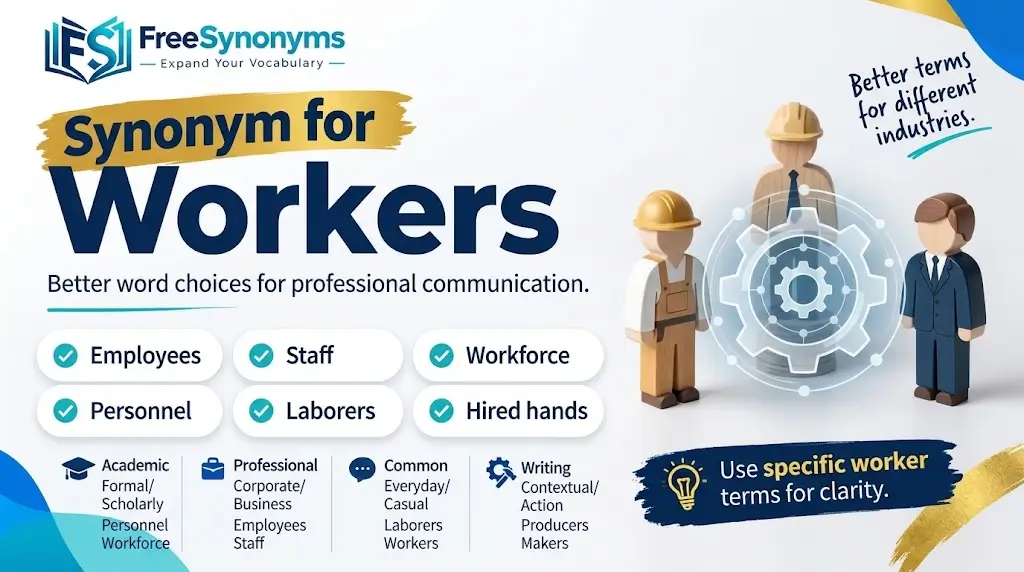
The best workers synonym depends on what you mean by “workers.” Common alternatives include employees, staff, personnel, laborers, employees, workforce, team members, associates, professionals, and staff members. However, these words are not always interchangeable. Some describe people employed by an organization, while others emphasize physical labor, professional expertise, membership in a workforce, or a particular workplace relationship.
For example, employees is usually the safest general alternative when you mean people hired by a company. Staff works well when referring collectively to people who work for an organization. Laborers is more specific and often suggests physical or manual work. Meanwhile, professionals emphasizes specialized knowledge or qualifications rather than employment itself.
Workers Synonyms at a Glance
The following alternatives can help you choose a more precise word.
| Synonym | Main meaning or nuance | Formality | Best used when |
|---|---|---|---|
| Employees | People hired by an organization | Neutral | General workplace writing |
| Staff | People working for an organization | Neutral | Referring to a group within an organization |
| Personnel | Employees or members of an organization | Formal | Policies, administration, business writing |
| Workforce | The collective group of people who work | Neutral/Formal | Discussing workers as a group |
| Team members | People who work as part of a team | Neutral | Collaborative workplaces |
| Staff members | Individual people employed by an organization | Neutral | Professional and organizational writing |
| Laborers | People who perform manual work | Neutral/Formal | Construction and physical labor |
| Employees | Hired workers | Neutral | Employment-related contexts |
| Associates | People working for an organization | Neutral | Business and customer-facing settings |
| Professionals | People with specialized knowledge or training | Formal/Neutral | Skilled occupations |
| Operatives | People performing practical or operational work | Formal | Industrial or operational contexts |
| Crew | A group working together | Casual/Neutral | Transportation, production, service work |
| Team | A group working toward a shared goal | Neutral | Collaborative settings |
| Contractors | Independent workers hired for specific work | Formal | Contract-based employment |
| Freelancers | Independent workers serving clients | Neutral | Project-based or independent work |
Because “workers” has a broad meaning, the most natural replacement depends on the sentence.
Closest Synonyms for Workers
Employees
Employees is often the closest general synonym for workers when the people in question are hired by a company or organization.
- Workers received new benefits.
- Employees received new benefits.
The second sentence is especially appropriate when the subject is an employer-employee relationship. It also sounds natural in business, human resources, and workplace communication.
However, employees should not automatically replace “workers” when the original sentence refers to independent contractors, volunteers, or people who work without being formally employed.
Staff
Staff refers collectively to the people who work for an organization, business, institution, or department.
For example:
The workers attended a training session.
can become:
The staff attended a training session.
The word is especially natural for schools, hospitals, offices, hotels, restaurants, and other organizations.
One important difference is grammatical. Staff often functions as a collective noun, while employees clearly refers to individual people. Therefore, the choice can depend on whether you are emphasizing the group or its individual members.
Personnel
Personnel is a more formal alternative to “workers” or “staff.” It commonly appears in administrative, military, corporate, technical, and policy-related writing.
For example:
Only authorized workers may enter the facility.
could become:
Only authorized personnel may enter the facility.
Here, personnel sounds more official and institutional. It is useful when the identity or role of the people matters less than their status as authorized members of an organization.
Workforce
Workforce refers to workers collectively rather than usually describing one individual.
For example:
The company employs 500 workers.
can become:
The company has a workforce of 500 people.
Likewise, workforce is useful when discussing labor markets, employment trends, demographics, productivity, training, or economic conditions.
It is not normally a direct replacement for “worker” when referring to one person.
Professional Alternatives to Workers
Sometimes “workers” is too broad for professional writing. In those cases, a more specific term can communicate the person’s role or level of expertise.
Professionals
Professionals emphasizes specialized knowledge, training, experience, or qualifications.
For example:
Skilled workers helped develop the new system.
could become:
Skilled professionals helped develop the new system.
However, the two sentences are not identical. “Skilled workers” may include experienced tradespeople or technicians, whereas “professionals” often suggests a recognized profession or specialized occupation.
Team Members
Team members emphasizes collaboration rather than employment status.
For example:
Workers contributed ideas during the meeting.
could become:
Team members contributed ideas during the meeting.
This alternative works particularly well when the people are organized around a project, department, or shared objective.
Associates
Associates can be used in some business environments as a workplace term for employees or colleagues.
For example:
The store’s workers completed their training.
might become:
The store’s associates completed their training.
The word is particularly common in retail and customer-service contexts. However, it may sound less natural in some industries, so context matters.
Staff Members
Staff members provides a slightly more explicit version of “staff.”
For example:
Workers should report problems to their supervisor.
could become:
Staff members should report problems to their supervisor.
This phrase is useful when you want to make it clear that you are referring to individual people rather than using “staff” as a collective term.
Formal Synonyms for Workers
Formal writing often benefits from a more precise noun.
Personnel
As noted above, personnel is one of the strongest formal alternatives. It works particularly well in policies, regulations, notices, and organizational documents.
Workers must wear protective equipment.
A formal version could be:
Personnel must wear protective equipment.
The wording sounds official and concise.
Workforce
Workforce is also common in formal business, economic, and academic writing.
The organization is training its workers.
could become:
The organization is training its workforce.
This version treats the workers as a collective labor group.
Labor Force
Labor force is useful when discussing employment from an economic or statistical perspective.
For example:
More workers entered the job market.
could become:
More people entered the labor force.
The terms are related, but they are not identical in every context. “Labor force” has a specific economic meaning, so it should not be used merely as a stylistic replacement for every occurrence of “workers.”
Operatives
Operatives can describe people who perform operational, practical, or technical work. The word appears more often in industrial or specialized contexts.
For example:
Factory workers monitored the equipment.
might become:
Factory operatives monitored the equipment.
This alternative is more specialized, so it should be used only when the context supports it.
Synonyms for Manual or Physical Workers
If “workers” refers specifically to people performing physical or manual labor, broader terms such as “employees” may lose important information.
Laborers
Laborers usually refers to people who perform physical or manual work.
For example:
Construction workers cleared the site.
could become:
Construction laborers cleared the site.
The second version highlights the physical nature of the work.
Manual Workers
Manual workers is a direct descriptive phrase for people whose jobs involve substantial physical labor.
For example:
The company provides training for manual workers.
This phrase can be useful when distinguishing physical occupations from office-based or administrative roles.
Tradespeople
Tradespeople refers to people who work in skilled trades, such as electrical work, plumbing, carpentry, or similar occupations.
Therefore, it is more specific than “workers.”
Skilled workers repaired the building.
could become:
Tradespeople repaired the building.
The second sentence suggests specialized trade skills and should not be used when the workers’ particular trade is unknown.
Crew
Crew refers to a group of people working together, especially in transportation, production, construction, entertainment, or service environments.
For example:
The workers prepared the equipment.
could become:
The crew prepared the equipment.
This change emphasizes the group working together rather than their employment status.
Casual Alternatives to Workers
Everyday writing does not always require a formal synonym. Depending on the context, simple expressions can sound more natural.
Team
Team works when people are collaborating toward a shared objective.
The workers finished the project early.
could become:
The team finished the project early.
The meaning changes slightly because “team” emphasizes cooperation rather than simply being employed.
Crew
Crew is another natural group-oriented term.
The workers arrived at the site at 7 a.m.
could become:
The crew arrived at the site at 7 a.m.
This is particularly natural when referring to a recognizable group performing a specific job.
People on the Team
In conversational writing, people on the team can sound more natural than a formal workplace term.
Workers can contact their supervisor with questions.
could become:
People on the team can contact their supervisor with questions.
This phrasing is less concise, however, so it is best used when a conversational tone is desirable.
Workers Synonyms by Context
The right alternative often becomes obvious once you identify the situation.
In a Business Context
For ordinary corporate writing, these choices are usually useful:
- Employees
- Staff
- Personnel
- Team members
- Staff members
- Associates
- Workforce
For example:
Workers should complete the annual training.
Depending on the intended meaning, you could write:
Employees should complete the annual training.
or:
Staff members should complete the annual training.
The first emphasizes employment. The second emphasizes membership in the organization’s staff.
In Academic Writing
Academic writing generally benefits from precise terminology.
Useful choices include:
- Employees
- Workforce
- Labor force
- Personnel
- Workers
- Laborers
- Professionals
The best choice depends on the field. For example, a paper about employment patterns may use workforce or labor force, while a study of workplace conditions may appropriately use workers or employees.
Avoid replacing “workers” with an unnecessarily complicated word simply to sound academic. Precision is more important than formality.
In Construction
Construction contexts may use:
- Construction workers
- Laborers
- Tradespeople
- Crew
- Contractors
- Employees
These terms are not identical. A contractor may be a company or independent professional hired to perform a specific job, while a laborer generally emphasizes manual work.
In Retail
Retail contexts commonly use:
- Employees
- Staff
- Associates
- Team members
- Sales staff
For example:
Store workers helped customers.
could become:
Store associates helped customers.
The latter may sound natural within a retail organization, but “employees” remains more broadly understood.
In Healthcare
Healthcare contexts often use role-specific terms such as:
- Staff
- Healthcare professionals
- Personnel
- Employees
- Medical staff
- Care team members
Here, specificity matters. A nurse, physician, technician, administrator, and cleaner may all be workers, but they perform very different roles.
In Education
Useful terms include:
- Staff
- Faculty
- Employees
- Educators
- Teachers
- School personnel
However, these are not interchangeable. Faculty usually refers to teaching staff in an educational institution, while staff can include administrative and support employees.
Workers vs. Employees
Workers and employees are closely related, but they can carry different meanings.
Worker is broader. It can describe almost anyone who performs work.
Employee is more specific because it normally refers to someone employed by an organization or person.
Compare:
The workers completed the project.
The employees completed the project.
The first sentence focuses on people doing the work. The second emphasizes their employment relationship.
Therefore, employees is often the best choice when discussing company policies, salaries, benefits, hiring, or employment contracts.
Workers vs. Staff
Staff usually refers to a group of people working for an organization.
The workers attended the meeting.
The staff attended the meeting.
The second sentence makes the group affiliation more prominent.
However, “staff” is especially natural in institutional settings. A hospital may have medical staff and support staff, while a school may have teaching and administrative staff.
Workers vs. Personnel
The difference is primarily one of tone and context.
Workers is broad and straightforward.
Personnel is more formal and organizational.
Compare:
Workers must wear identification badges.
Personnel must wear identification badges.
The second sentence has a more official or administrative tone. As a result, “personnel” often fits policies, security notices, and formal procedures.
Workers vs. Laborers
These words differ mainly in specificity.
Workers can refer to people in almost any occupation.
Laborers usually suggests manual or physical work.
For example:
The company hired 50 workers.
This could include office employees, technicians, managers, or production staff.
By contrast:
The company hired 50 laborers.
strongly suggests people hired for physical labor.
Therefore, “laborers” should not be used as a universal replacement.
Workers vs. Workforce
The grammatical difference is important.
Workers can refer to individuals or groups.
Workforce normally refers to the collective body of workers.
For example:
The company employs 2,000 workers.
is natural.
The company has a workforce of 2,000.
is also natural.
However, this would sound awkward:
One workforce completed the installation.
If you mean one person, use “worker,” “employee,” or another individual noun.
Positive and Neutral Alternatives
The word “workers” is generally neutral. Still, a more specific term can create a different emphasis.
For a professional tone, consider:
- Employees
- Professionals
- Team members
- Staff members
- Associates
Organizational tone, consider:
- Personnel
- Workforce
- Staff
For a physical-labor context, consider:
- Laborers
- Manual workers
- Tradespeople
- Crew
Independent-work context, consider:
- Contractors
- Freelancers
- Independent professionals
Remember that these terms describe different relationships or roles. A more positive-sounding word is not necessarily a more accurate word.
Stronger and More Specific Alternatives
Sometimes the goal is not to find a direct synonym but to make the writing more precise.
Instead of:
Workers built the structure.
you could write:
Construction crews built the structure.
Instead of:
Workers repaired the electrical system.
you could write:
Electricians repaired the electrical system.
Instead of:
Workers designed the software.
you could write:
Software engineers designed the software.
These replacements provide more information because they identify the occupation rather than simply describing the people as workers.
How to Choose the Right Workers Synonym
Start by asking what “workers” means in your sentence.
1. Are they employed by a company?
Use employees when the employment relationship matters.
Employees receive paid vacation.
2. Are you referring to an organization’s group?
Use staff or staff members.
Staff members attended the orientation.
3. Are you writing a formal policy?
Consider personnel.
Authorized personnel may enter the laboratory.
4. Are you discussing workers collectively?
Use workforce.
The company expanded its workforce.
5. Are they performing manual labor?
Consider laborers or manual workers.
Manual workers received additional safety training.
6. Are they qualified specialists?
Consider professionals, or better yet, identify the specific profession.
Medical professionals reviewed the records.
7. Are they independent rather than employees?
Consider contractors or freelancers, depending on the arrangement.
Independent contractors completed the project.
This approach is more reliable than selecting a synonym based only on how similar two words look.
Common Mistakes When Replacing Workers
Using Workforce for One Person
“Workforce” normally describes a collective group.
Incorrect or awkward:
The workforce completed the repair alone.
if you mean one employee.
Better:
The worker completed the repair alone.
Using Laborers for All Employees
“Laborers” emphasizes physical work. Therefore, it can be inaccurate for office employees, managers, researchers, or other occupations.
Instead, use “employees” when the broader employment relationship is what matters.
Treating Staff and Employees as Identical
Although the words overlap, their emphasis can differ.
“Employees” focuses on people who are employed.
“Staff” focuses on people who make up an organization’s staff.
Choose according to the point of the sentence.
Using Professionals Too Broadly
“Professionals” often implies specialized expertise. Therefore, it may not accurately describe every person who works for an organization.
If you simply mean people employed by a business, “employees” is usually clearer.
Choosing a Formal Word When Simpler Language Works
A sentence does not become better merely because it uses a more formal synonym.
For example:
Personnel should submit their documents.
may be appropriate for a formal policy.
In an ordinary workplace email, however:
Employees should submit their documents.
may sound more direct and natural.
Workers Synonyms in Example Sentences
Here are several examples showing how context changes the best choice.
Original:
The workers received new safety equipment.
Employees:
The employees received new safety equipment.
This emphasizes their employment relationship.
Staff:
The staff received new safety equipment.
This treats them as an organizational group.
Laborers:
The laborers received new safety equipment.
This emphasizes manual work.
Personnel:
The personnel received new safety equipment.
This gives the sentence a formal, institutional tone.
Crew:
The crew received new safety equipment.
This suggests a specific group working together.
Professionals:
The professionals received new safety equipment.
This emphasizes specialized expertise, so it is appropriate only when that distinction matters.
Frequently Asked Questions
What is the best synonym for workers?
Employees is often the closest general alternative when “workers” means people hired by a company or organization. However, “staff,” “personnel,” “workforce,” and “laborers” may be more accurate in specific contexts.
What is a professional word for workers?
Personnel, employees, staff members, and workforce can all work in professional writing. The best option depends on whether you mean individual employees, an organizational group, or the collective labor force.
What is another word for workers in a company?
Common choices include employees, staff, personnel, team members, staff members, and associates. “Employees” is generally the clearest when the employment relationship is the focus.
What is a synonym for workers in a factory?
Depending on their roles, you could use employees, factory workers, production workers, operatives, laborers, or staff. A specific occupational title is preferable when it is known.
What is the difference between workers and employees?
“Workers” is broader and can refer to people who perform work generally. “Employees” usually refers specifically to people employed by an organization or employer.
Is workforce a synonym for workers?
“Workforce” is a related collective term, but it is not always a direct synonym. “Workers” can refer to individuals, whereas “workforce” generally refers to workers collectively.
Is staff the same as workers?
“Staff” overlaps with “workers,” but it usually refers to people working for a particular organization or institution. It often emphasizes group membership rather than work in general.
Is laborer a synonym for worker?
Yes, but laborer is more specific. It generally refers to someone performing physical or manual labor, while “worker” can describe people in many different occupations.
What is a synonym for skilled workers?
Depending on the context, possibilities include skilled professionals, tradespeople, specialists, technicians, craft workers, or a specific occupational title. The most accurate choice depends on the type of skill involved.
What is a synonym for workers in an academic paper?
The best term depends on the subject. Workers, employees, workforce, labor force, personnel, and laborers can all be appropriate when their meanings match the research context.
Conclusion
The most useful synonym for workers depends on the exact meaning you want to convey. Employees is a strong general choice for people hired by an organization, while staff emphasizes an organizational group. Personnel creates a more formal tone, and workforce describes workers collectively. For physical labor, laborers may be more precise, while professionals, tradespeople, technicians, or another occupational title can identify specialized work more clearly.
Rather than replacing “workers” with the first similar word you find, consider the relationship, occupation, tone, and context. That small distinction can make workplace, academic, business, and everyday writing much more precise.

Michael Reed
Michael Reed focuses on improving the clarity, accuracy, and usefulness of English vocabulary content. He helps readers explore word relationships, understand context-dependent meanings, and discover natural alternatives for academic writing, creative projects, and everyday communication.