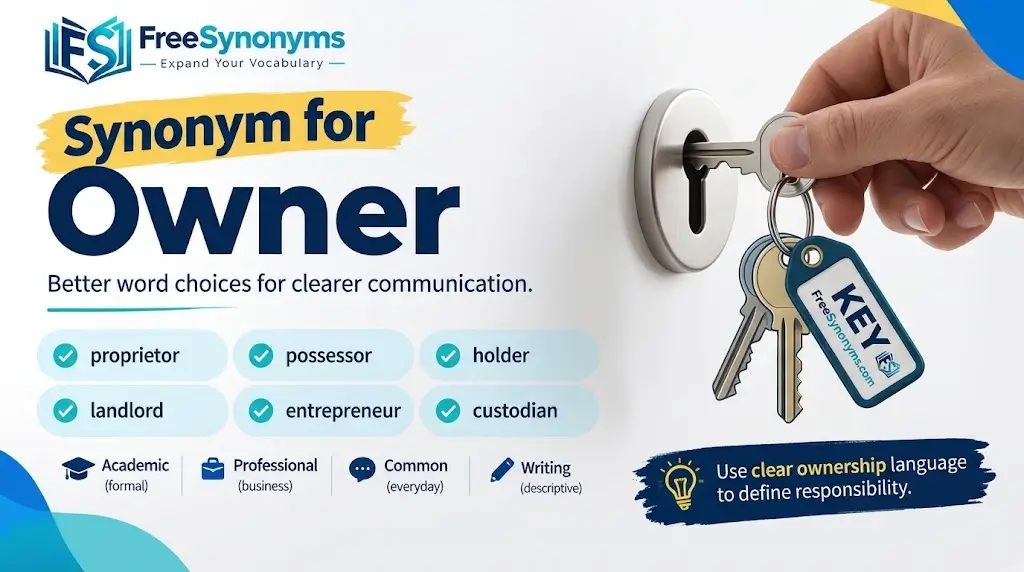

The best owner synonym depends on what someone owns and the context in which the word is used. Common alternatives include proprietor, possessor, holder, landlord, founder, operator, controller, and titleholder. However, these words are not interchangeable in every sentence. For example, proprietor often refers to a business owner, while landlord specifically refers to someone who rents out property.
Common Owner Synonyms
Here are some of the most useful alternatives to owner, along with the situations where they fit naturally:
| Synonym | Meaning or Nuance | Formality | Best Used When |
|---|---|---|---|
| Proprietor | A person who owns a business or establishment | Formal | Business writing |
| Possessor | Someone who has or possesses something | Formal | Property or legal contexts |
| Holder | A person who has legal or official possession of something | Neutral/Formal | Rights, titles, accounts, documents |
| Proprietary holder | Someone with ownership rights | Formal | Legal or technical writing |
| Landlord | A person who owns and rents out property | Neutral | Rental housing or real estate |
| Property owner | Someone who owns real estate or other property | Neutral | Real estate |
| Proprietor | Someone who owns and often operates a business | Formal | Shops, restaurants, firms |
| Founder | A person who establishes an organization or business | Neutral | Companies and organizations |
| Operator | A person responsible for running a business or facility | Neutral | Businesses and services |
| Titleholder | Someone who legally holds a title or ownership interest | Formal | Property, legal, or competitive contexts |
| Stakeholder | A person or group with an interest in something | Formal | Organizations and projects |
| Controller | A person or entity with controlling authority | Formal | Companies, assets, or organizations |
| Master | A person in control or possession, usually in specific expressions | Context-specific | Traditional or specialized usage |
| Keeper | Someone responsible for or in charge of something | Neutral | Animals, facilities, possessions |
| Custodian | A person responsible for caring for or protecting something | Formal | Assets, records, property |
The closest alternative depends on the exact meaning of owner. Therefore, replacing the word mechanically can change the meaning of a sentence.
What Does Owner Mean?
Owner is a noun that generally means a person, organization, or entity that legally possesses or has control over something.
The thing being owned could be almost anything: a house, car, business, website, company, piece of land, intellectual property, or personal possession.
For example:
- Maria is the owner of the restaurant.
- He is the owner of the property.
- The company is the owner of the trademark.
- She became the owner of a new car.
In each case, owner identifies the person or entity with ownership rights.
However, ownership and responsibility are not always identical. Someone may operate, manage, control, or care for something without legally owning it.
Closest Synonyms for Owner
Some alternatives are close to owner, but each has a particular use.
Proprietor
Proprietor is one of the closest formal synonyms for owner, particularly when referring to a business.
For example:
- The proprietor welcomed the customers.
- She is the proprietor of a small bookstore.
In addition, proprietor often suggests that the person owns and is personally involved with a business.
It works especially well in formal business writing. However, it can sound less natural than owner in everyday conversation.
Possessor
Possessor refers to someone who possesses or has something.
For example:
- The possessor of the property must provide proof of ownership.
- He was the legal possessor of the document.
This word is more formal and is often associated with legal, philosophical, or technical language.
Importantly, possessor does not always mean legal owner. A person can possess something without owning it. Therefore, use this alternative carefully.
Holder
Holder can refer to someone who possesses a right, title, account, document, or other recognized item.
Examples include:
- The holder of the account must verify their identity.
- She is the current title holder.
- The cardholder may request a replacement.
Because holder emphasizes possession or status, it is not always a direct replacement for owner.
For example, copyright holder may be more precise than copyright owner in certain contexts, depending on the rights involved.
Owner Synonyms for a Business
When discussing someone who owns a business, several alternatives can work.
Business Proprietor
Proprietor is particularly useful for an individual who owns a business or commercial establishment.
- The proprietor of the café greeted us at the door.
- The hotel proprietor expanded the property.
It has a professional and somewhat traditional tone.
Founder
Founder describes someone who establishes a company, organization, project, or institution.
- She is the founder of the technology company.
- The founder launched the business in 2018.
However, founder does not necessarily mean current owner. A founder may sell the company and no longer have an ownership stake.
Therefore, use founder when the important idea is establishing the organization rather than simply owning it.
Operator
Operator refers to someone who runs or manages a business, facility, service, or system.
- The operator of the restaurant changed the menu.
- A private company operates the facility.
An operator may or may not own the business.
For that reason, operator is a contextual alternative rather than an exact synonym for owner.
Entrepreneur
Entrepreneur describes someone who starts or develops a business, typically with an emphasis on business activity and initiative.
- The entrepreneur launched several online businesses.
- She became a successful entrepreneur.
An entrepreneur can own a business, but the word does not strictly mean owner. Someone can be an entrepreneur without currently owning every company they founded.
Owner Synonyms for Property
Property-related writing often requires more precise alternatives.
Property Owner
Property owner is the clearest alternative when referring to someone who legally owns real estate.
- The property owner is responsible for maintaining the building.
- The city notified the property owner about the violation.
This phrase is useful because it removes ambiguity. The word owner alone could refer to many different kinds of possessions.
Landlord
Landlord specifically describes someone who rents property to another person.
- The landlord repaired the leaking pipe.
- The tenant contacted the landlord about the problem.
A landlord is generally a property owner, but the terms are not identical.
For example, someone may own a vacation home without being a landlord. The term becomes appropriate when the person rents property to tenants.
Titleholder
Titleholder can describe someone who legally holds title to property or another asset.
- The titleholder must complete the transfer documents.
- The registered titleholder signed the agreement.
This term is especially useful in formal or legal contexts.
Owner Synonyms for Legal and Formal Writing
Formal writing often benefits from precise terminology rather than simple substitutions.
Legal Owner
Legal owner emphasizes recognized legal ownership.
- The legal owner must authorize the transfer.
- The document identifies the legal owner of the property.
This phrase is useful when legal ownership needs to be distinguished from possession, management, or beneficial interest.
Possessor
As noted earlier, possessor emphasizes possession rather than necessarily establishing ownership.
For example:
- The possessor of the item was asked to return it.
The sentence does not automatically establish that the person legally owns the item.
Holder
Holder works well with rights, titles, licenses, accounts, and certain forms of property.
For example:
- The license holder must renew the permit.
- The title holder completed the transaction.
Because the precise legal meaning can depend on the subject, formal documents should use the terminology required by the relevant law or agreement.
Controller
Controller describes a person or entity that exercises significant control over something.
- The parent company became the controlling owner.
- The controller of the asset approved the transaction.
Control and ownership can overlap, but they are not automatically the same.
Owner Synonyms for Writing and Vocabulary
If you are replacing owner in ordinary writing, the best choice depends on the object.
Consider these examples:
- Owner of a restaurant → proprietor
- Owner of a rental property → landlord
- Owner of a house → homeowner or property owner
- Owner of a company → business owner, proprietor, founder, or shareholder, depending on the facts
- Owner of a vehicle → registered owner
- Owner of a legal title → titleholder
- Owner of an account → account holder
- Owner of a license → license holder
- Owner of intellectual property → rights holder or intellectual property owner
- Owner of a pet → pet owner or keeper, depending on context
Therefore, the most natural synonym is usually determined by what is owned, not simply by the word owner itself.
Formal Alternatives to Owner
For professional or formal writing, these alternatives may be useful:
- Proprietor
- Possessor
- Titleholder
- Rights holder
- Property owner
- Legal owner
- Registered owner
- Account holder
- Shareholder
- Proprietary holder
However, formality should not come at the expense of accuracy.
For example, proprietor may sound more formal than owner, but it would be inappropriate for a person who owns a house but does not operate a business.
Similarly, shareholder should not replace owner unless the person actually owns shares in a corporation.
Professional Alternatives to Owner
Professional writing often favors specific phrases.
Business Owner
Use business owner when you want a straightforward professional term.
The business owner approved the new hiring plan.
Company Founder
Use company founder when the person established the company.
The company founder spoke at the annual meeting.
Shareholder
Use shareholder when someone owns shares in a corporation.
Several shareholders voted on the proposal.
A shareholder may have an ownership interest, but the word has a specific corporate meaning.
Proprietor
Use proprietor when referring to an individual who owns a business or establishment.
The proprietor reviewed the store’s financial records.
Rights Holder
Use rights holder when the person or organization holds particular legal rights.
The rights holder authorized the publication.
This term is especially useful for intellectual property and licensing discussions.
Casual Alternatives to Owner
Everyday English usually favors simple expressions rather than highly formal substitutes.
Depending on the situation, you might say:
- The person who owns it
- The person in charge
- The business owner
- The homeowner
- The landlord
- The person who runs the place
For example:
I spoke with the owner of the store.
A casual alternative could be:
I spoke with the person who runs the store.
However, the second sentence emphasizes management rather than legal ownership. As a result, it should be used only when that distinction does not matter.
Owner vs Proprietor
Owner is broader and more common, while proprietor is more formal and usually relates to a business.
Compare:
- She is the owner of the house.
- She is the proprietor of the restaurant.
The first sentence sounds natural because proprietor is not normally used for ordinary residential property.
By contrast, owner works for both houses and businesses.
Therefore, use proprietor when business ownership is the central idea and owner when you need the broadest, most neutral term.
Owner vs Possessor
These words overlap, but they emphasize different concepts.
An owner generally has ownership rights. A possessor is someone who has physical or practical possession of something.
For example:
The owner of the car lent it to his friend.
The friend possesses the car temporarily, but the owner retains ownership.
Therefore, possessor should not automatically replace owner in a sentence.
Owner vs Holder
Holder is broader in some contexts and narrower in others.
For example:
- account owner and account holder
- title owner and titleholder
- license owner and license holder
The correct term depends on the type of relationship involved.
In particular, holder often emphasizes possession of a document, right, status, account, or title rather than general ownership.
Owner vs Founder
These words describe different relationships with a business.
An owner currently has an ownership interest.
A founder established the business.
For example, someone could found a company, sell it several years later, and remain its founder without being its current owner.
Therefore, founder is not a universal synonym for owner.
Owner vs Operator
An operator runs something, while an owner owns it.
For example:
The owner hired an operator to manage the restaurant.
Here, the two roles are clearly separate.
Similarly, a company may own a facility while another company operates it. Consequently, operator is appropriate only when the focus is on running or managing the operation.
Owner vs Landlord
A landlord is a particular type of property owner who rents property to tenants.
For example:
The owner renovated the house before selling it.
The person is an owner, but there is no indication that the house is rented.
Compare that with:
The landlord repaired the apartment before the new tenant moved in.
Here, landlord is more specific because the property is being rented.
Owner vs Shareholder
A shareholder owns shares in a corporation.
An owner is a more general term.
For example:
The company’s shareholders approved the proposal.
Replacing shareholders with owners may make the sentence less precise because the corporate ownership structure is relevant.
Conversely, a person who owns a small sole proprietorship would not normally be called a shareholder if the business does not issue shares.
Synonyms for Different Types of Owners
The most natural alternative often changes according to the thing being owned.
House or Home
Use:
- Homeowner
- Property owner
- Homeowner of record
- Property holder in limited formal contexts
Example:
The homeowner contacted the insurance company.
Rental Property
Use:
- Landlord
- Property owner
- Rental property owner
Example:
The landlord sent the tenant a notice.
Business
Use:
- Business owner
- Proprietor
- Founder
- Entrepreneur
- Operator, when referring to management
Example:
The proprietor has operated the restaurant for ten years.
Company
Use:
- Owner
- Shareholder
- Founder
- Controlling shareholder
- Parent company, when an organization owns another company
The correct term depends on the company’s legal and ownership structure.
Vehicle
Use:
- Vehicle owner
- Registered owner
- Car owner
Example:
The registered owner received the notification.
Account
Use:
- Account holder
- Account owner
Example:
Only the account holder can request certain changes.
Intellectual Property
Use:
- Rights holder
- Copyright owner
- Trademark owner
- Intellectual property owner
The specific term should match the right involved.
Pet
Use:
- Pet owner
- Keeper, in some contexts
Example:
The pet owner took the dog to the veterinarian.
Although keeper can be appropriate in some contexts, it does not always carry exactly the same meaning as owner.
Stronger and More Specific Alternatives
Sometimes the goal is not to find a direct synonym but to make the sentence more precise.
Instead of:
The owner contacted us.
You could write:
The property owner contacted us.
Maybe:
The restaurant proprietor contacted us.
Maybe:
The account holder contacted us.
Or:
The registered vehicle owner contacted us.
These alternatives provide more information without unnecessarily repeating owner.
In professional writing, specificity is often more valuable than simply finding a more sophisticated word.
Positive and Neutral Alternatives
Owner itself is usually neutral. The appropriate alternative should preserve that neutral tone unless the context requires something different.
For example:
- Proprietor — neutral/formal
- Business owner — neutral
- Homeowner — neutral
- Property owner — neutral
- Founder — neutral, with emphasis on establishment
- Entrepreneur — neutral, with emphasis on business activity
- Landlord — neutral, with emphasis on renting property
Avoid choosing a word simply because it sounds more impressive.
A precise ordinary word is usually better than an unusual synonym that changes the meaning.
Sentence Examples With Owner Synonyms
Here are practical examples showing how different alternatives work.
Business Context
Original:
The owner of the café opened the doors at 7 a.m.
Alternative:
The proprietor of the café opened the doors at 7 a.m.
The second version is more formal and specifically emphasizes the business owner.
Property Context
Original:
The owner of the apartment contacted the tenant.
Alternative:
The landlord contacted the tenant.
Here, landlord is more specific because the person is renting the apartment to a tenant.
Corporate Context
Original:
The owner of the company announced the change.
Alternative:
The founder announced the change.
This substitution is appropriate only if the person actually founded the company.
Account Context
Original:
The owner of the account must verify the information.
Alternative:
The account holder must verify the information.
In this case, account holder is the more natural expression.
Legal Context
Original:
The owner of the property signed the agreement.
Alternative:
The legal owner of the property signed the agreement.
Adding legal emphasizes the ownership status rather than merely describing possession.
Common Mistakes When Choosing an Owner Synonym
Finding an alternative word is easy. Choosing one that preserves the original meaning requires more care.
Mistake 1: Using Founder for Every Business Owner
A founder establishes a business, but a current owner may have purchased the company later.
Better: Use founder only when the person established the business.
Mistake 2: Using Landlord for Every Property Owner
Not every property owner rents property to tenants.
Better: Use landlord when the owner acts as a lessor or rents property to tenants.
Mistake 3: Using Operator for Owner
An operator manages or runs something. Ownership is a separate concept.
Better: Choose operator only when the person’s management role is relevant.
Mistake 4: Treating Possessor as an Exact Synonym
Possession does not necessarily establish legal ownership.
Better: Use possessor when possession itself is the important idea.
Mistake 5: Using Shareholder for Any Company Owner
Corporate ownership structures can be more specific than the general word owner.
Better: Use shareholder when someone owns shares.
Mistake 6: Choosing a Formal Word That Sounds Unnatural
Words such as proprietor and possessor can be useful, but they may sound unnecessarily formal in casual writing.
Better: Keep owner when it is already clear and natural.
How to Choose the Right Owner Synonym
Start by identifying what is owned.
If it is a house, homeowner may be the natural choice. If it is a rental property, landlord may be more precise. For a small business, proprietor can work well in formal writing.
Next, consider the person’s role.
Someone who founded a company is a founder. who manages it is an operator. whos owns shares is a shareholder. Someone who holds a license is a license holder.
Then consider the tone.
Everyday writing usually favors owner, homeowner, or business owner. Formal documents may require terms such as legal owner, titleholder, or rights holder.
Finally, check whether the replacement preserves the original meaning.
For example:
The owner of the store approved the purchase.
Changing this to:
The founder of the store approved the purchase.
adds a claim that the person founded the store. If that fact is unknown, the substitution is inaccurate.
Quick Reference: Which Owner Synonym Should You Use?
| Situation | Best Term |
|---|---|
| General ownership | Owner |
| Business ownership | Business owner / proprietor |
| House ownership | Homeowner |
| Rental property | Landlord |
| Person who started a company | Founder |
| Person running an operation | Operator |
| Corporate share ownership | Shareholder |
| Legal possession | Legal owner |
| Property title | Titleholder |
| Account | Account holder |
| License | License holder |
| Intellectual property rights | Rights holder |
| Physical possession | Possessor |
| Someone responsible for care | Custodian / keeper |
Frequently Asked Questions
What is the best synonym for owner?
The best synonym depends on the context. Proprietor works well for a business owner, homeowner for someone who owns a home, landlord for someone who rents property to tenants, and account holder for someone who controls an account. In general writing, owner remains the clearest choice.
What is a formal word for owner?
Proprietor, possessor, titleholder, rights holder, and legal owner can work in formal contexts. However, each has a different meaning or area of use. Proprietor is particularly suitable for business ownership, while legal owner emphasizes recognized ownership.
What is another word for business owner?
Common alternatives include proprietor, founder, entrepreneur, and operator. The correct choice depends on the person’s role. A founder started the business, while an operator runs it. A proprietor specifically refers to someone who owns a business or establishment.
What is another word for property owner?
Depending on the situation, you can use homeowner, landlord, property holder, titleholder, or legal owner. Landlord is appropriate when the property is rented to tenants.
Is proprietor the same as owner?
Not always. Proprietor is a close synonym for owner, especially for someone who owns a business or commercial establishment. However, it is not normally used for every kind of ownership.
Is possessor the same as owner?
No. A possessor has possession of something, while an owner generally has ownership rights. Someone can possess an item temporarily without legally owning it.
Is founder another word for owner?
Not exactly. A founder is someone who establishes a company or organization. That person may also be an owner, but they can later sell their ownership interest and remain the founder.
Is operator another word for owner?
Not necessarily. An operator runs or manages something, while an owner has ownership rights. One person or company can own a business while another person or company operates it.
What is a synonym for owner in a legal context?
Depending on the specific situation, terms such as legal owner, titleholder, rights holder, registered owner, or possessor may be appropriate. Legal terminology should be selected according to the specific right or relationship being described.
Conclusion
The most useful owner synonym depends on the object, role, and context. Proprietor is a strong choice for business ownership, landlord fits rental property, homeowner describes residential ownership, and founder identifies someone who established an organization. Meanwhile, holder, titleholder, and rights holder can provide greater precision in formal contexts.
When no special distinction is needed, owner is usually the clearest and most natural word. Instead of replacing it simply to avoid repetition, choose an alternative only when it adds accuracy, clarifies the person’s role, or better matches the tone of the writing.