
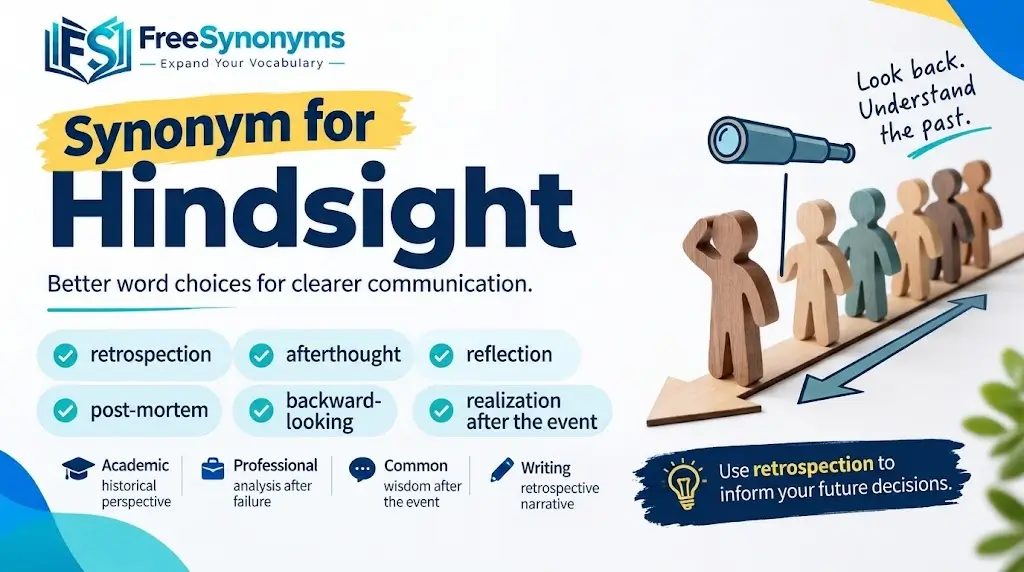
A useful hindsight synonym is retrospection, reflection, or afterthought, depending on the context. However, these words are not always interchangeable. Hindsight specifically describes the ability to understand a past event more clearly after learning what happened, while related words can emphasize remembering, reviewing, reconsidering, or reflecting on the past.
For example, in “With hindsight, I would have taken a different approach,” looking back is a natural alternative. In a formal essay, retrospect may fit better. By contrast, afterthought usually describes something considered later rather than the broader ability to understand a past situation with its outcome already known.
The best choice therefore depends on what you want to emphasize: knowledge gained from experience, reflection on the past, reconsideration, or a later realization.
The closest hindsight synonyms
Several words and phrases can replace hindsight, but each carries a slightly different nuance. The table below separates the closest choices from alternatives that work only in particular contexts.
| Synonym or alternative | Main nuance | Formality | Best used when |
|---|---|---|---|
| Retrospect | Looking back on past events | Formal | Essays, analysis, professional writing |
| Reflection | Thoughtful consideration of the past | Neutral to formal | Personal, academic, and professional writing |
| Looking back | Reviewing a past situation | Neutral | Everyday speech and general writing |
| Retrospection | Formal examination of the past | Formal | Academic or literary contexts |
| Reconsideration | Thinking about a past decision again | Neutral to formal | Decisions, judgments, policies |
| Afterthought | A later thought or realization | Neutral | Casual and general contexts |
| Later realization | Understanding something after the fact | Neutral | Clear explanatory writing |
| Second thought | Reconsidering something | Neutral | Conversational writing |
| Review | Examination of something that happened | Neutral to formal | Business, academic, and professional contexts |
| Backward look | Deliberate examination of the past | Neutral | General or reflective writing |
Retrospect is usually one of the strongest one-word alternatives. For instance, “In retrospect, the warning signs were obvious” conveys the idea that the situation became easier to understand after it unfolded.
Looking back is more conversational. Therefore, it works particularly well when you want your writing to sound natural rather than formal.
Reflection is broader. It can involve thinking deeply about the past without necessarily implying that the outcome changed your understanding.
Retrospect as a hindsight synonym
Retrospect is perhaps the closest formal alternative to hindsight. It refers to looking back on a past event or period, especially after its outcome is known.
Consider these examples:
- “In hindsight, the decision was too risky.”
- “In retrospect, the decision was too risky.”
Both sentences communicate essentially the same idea. However, in retrospect can sound slightly more polished in formal writing.
The noun retrospect is especially common in the phrase in retrospect. For example, “In retrospect, the company should have acted sooner.”
This phrase is useful in essays, reports, memoirs, interviews, and professional commentary. It also avoids the slightly conversational feel that looking back can have.
Reflection and hindsight
Reflection overlaps with hindsight, but the meanings are not identical. Reflection focuses on thoughtful consideration, whereas hindsight emphasizes improved understanding after an event has occurred.
For example:
“Her reflection on the experience helped her identify what went wrong.”
This sentence does not necessarily suggest that the outcome provided new information. Instead, it emphasizes deliberate thought.
By contrast:
“With hindsight, she could see why the original plan failed.”
Here, the outcome helps clarify the earlier situation.
As a result, reflection is a good alternative when your sentence is about thoughtful examination rather than specifically about knowledge gained after the fact.
Formal alternatives to hindsight
Formal writing often benefits from precise alternatives rather than repeated use of hindsight. Depending on the sentence, useful choices include retrospect, retrospection, reflection, reconsideration, and retrospective analysis.
Retrospection
Retrospection means looking back on past events or experiences. It is more formal and less common in everyday conversation than hindsight.
For example:
- “Retrospection revealed several weaknesses in the original strategy.”
- “The report provides a detailed retrospection of the project.”
The word can sound academic or literary. Therefore, use it when the surrounding writing has a similarly formal tone.
Retrospective analysis
Retrospective analysis is useful when discussing a systematic examination of past events. It works particularly well in business, research, medicine, history, and other analytical settings.
For example:
“A retrospective analysis showed that the delays resulted from several interconnected problems.”
This expression is more specific than hindsight. It describes a structured examination rather than simply the ability to recognize something after the fact.
Reconsideration
Reconsideration is appropriate when the focus is on evaluating a past decision again.
For example:
“With the benefit of later information, the committee began a reconsideration of its original decision.”
However, reconsideration should not automatically replace hindsight. It suggests that someone actively reviews a previous judgment, while hindsight describes the perspective gained after events have unfolded.
Casual alternatives to hindsight
In everyday American English, shorter expressions often sound more natural than formal nouns.
Looking back
Looking back is one of the most natural conversational alternatives.
Examples include:
- “Looking back, I should have asked more questions.”
- “Looking back on the experience, we learned a lot.”
- “Looking back, the problem was easier to identify.”
The phrase works because it directly communicates the act of examining the past from the present.
Now that I know
Now that I know can express the practical idea behind hindsight when the speaker has gained new information.
For example:
“Now that I know what happened, I understand why she reacted that way.”
This expression is conversational and direct. However, it cannot replace hindsight in every grammatical position.
After the fact
After the fact emphasizes that something is considered or understood only after an event has happened.
For example:
“It was easy to identify the problem after the fact.”
This phrase can sometimes sound more detached or critical than in hindsight. Therefore, consider the tone before using it.
Professional alternatives for hindsight
Professional writing often requires more precise language. Instead of repeating hindsight, writers can use terms such as retrospective review, post-event analysis, lessons learned, subsequent assessment, or retrospective evaluation.
Retrospective review
A retrospective review examines something that has already happened. The phrase is especially useful for projects, decisions, processes, and organizational performance.
For example:
“The team conducted a retrospective review of the product launch.”
This wording sounds more objective than “The team looked back at the product launch.”
Post-event analysis
Post-event analysis emphasizes examination after an event has finished.
For example:
“The post-event analysis identified several communication gaps.”
This phrase is particularly useful when the purpose is to understand causes, outcomes, and improvements.
Lessons learned
Lessons learned focuses on what experience has taught someone or an organization.
For example:
“The project produced several important lessons learned.”
The expression overlaps with hindsight because both involve knowledge gained after experience. Still, lessons learned emphasizes what should be carried forward rather than merely how the past is now understood.
Academic alternatives to hindsight
Academic writing often benefits from expressions that identify the analytical process more precisely.
Useful choices include:
- In retrospect
- Retrospective analysis
- Retrospective assessment
- Historical reflection
- Subsequent evaluation
- Post hoc analysis
- Reassessment
Post hoc analysis
Post hoc means “after the event” or “after the fact.” It is common in academic and technical contexts, although it can have a more specialized meaning depending on the field.
For example:
“A post hoc analysis identified a relationship that had not been considered initially.”
Because post hoc can carry technical meanings in research and statistics, use it carefully. It should not automatically replace hindsight in general writing.
Retrospective assessment
Retrospective assessment emphasizes evaluating something after it has occurred.
For example:
“The retrospective assessment identified weaknesses in the original methodology.”
This phrase is more precise than hindsight when the writer means a formal evaluation.
Hindsight alternatives by meaning
The right alternative changes according to what hindsight means in your sentence. Therefore, it helps to identify the underlying idea before choosing a replacement.
When hindsight means understanding after an event
Use:
- In retrospect
- Looking back
- With the benefit of experience
- After the fact
- In light of what happened
- Now that we know
- With later knowledge
Example:
“With hindsight, the warning signs were clear.”
Possible alternatives include:
“In retrospect, the warning signs were clear.”
or:
“Looking back, the warning signs were clear.”
These alternatives preserve the original idea closely.
When hindsight means reconsidering a decision
Use:
- Reconsideration
- Reassessment
- Reevaluation
- Review
- Second thought
For example:
“Hindsight made her question the decision.”
A more precise version might be:
“The experience led her to reassess the decision.”
Here, reassessment emphasizes the active process of reviewing the choice.
When hindsight means learning from experience
Use:
- Lessons learned
- Experience
- Reflection
- Learning
- Wisdom gained from experience
For example:
“Hindsight showed him what he should have done differently.”
A professional alternative could be:
“The experience clarified what he should do differently in the future.”
The second version shifts attention from simply recognizing the past to applying the lesson.
Hindsight synonym comparison
Although several alternatives look similar, their differences become clearer when placed side by side.
| Word or phrase | Meaning | Similarity to hindsight | Key difference |
|---|---|---|---|
| In retrospect | Understanding the past after the outcome | Very high | Usually used as a phrase |
| Looking back | Considering the past from the present | Very high | More conversational |
| Retrospect | Examination of the past | Very high | More formal |
| Reflection | Thoughtful consideration | Moderate | Does not require new knowledge from an outcome |
| Reassessment | Evaluating something again | Moderate | Emphasizes active reevaluation |
| Reconsideration | Thinking about a decision again | Moderate | Usually concerns a particular choice |
| Afterthought | A later thought | Moderate | Does not necessarily involve improved understanding |
| Review | Examination of something | Moderate | Can be systematic or procedural |
| Lessons learned | Knowledge gained from experience | Moderate | Emphasizes future application |
| Post hoc analysis | Analysis conducted afterward | Moderate | More technical and specialized |
This distinction matters because replacing a word based only on a dictionary list can produce awkward or inaccurate writing. For example, reflection may sound appropriate in a personal essay, while retrospective analysis may be better in a business report.
Hindsight vs. retrospect
Hindsight and retrospect are extremely close, especially in the expressions with hindsight and in retrospect.
Compare:
“With hindsight, I would have handled the situation differently.”
“In retrospect, I would have handled the situation differently.”
Both sentences indicate that the speaker now understands the past differently because the outcome is known.
The main distinction is stylistic and grammatical. Hindsight is a noun that often appears in phrases such as with hindsight or in hindsight. Retrospect commonly appears in in retrospect.
For most general writing, either can work when the context genuinely concerns understanding gained after an event.
Hindsight vs. reflection
The difference between hindsight and reflection is subtle but important.
Hindsight specifically involves the perspective available after an event. Reflection simply means thoughtful consideration.
For example:
“In hindsight, the decision was clearly a mistake.”
The sentence implies that the later outcome made the mistake easier to recognize.
Now consider:
“Her reflection on the decision helped her understand her priorities.”
This sentence emphasizes thought and self-examination. The person may or may not have gained information from the outcome.
Therefore, reflection is broader than hindsight.
Hindsight vs. afterthought
Afterthought is sometimes listed as a synonym for hindsight, but the two words should not normally be treated as exact equivalents.
An afterthought is a thought that occurs later, often after the main thought or action.
For example:
“Adding a thank-you note was an afterthought.”
The sentence does not involve learning from the outcome. It simply says that the idea came later.
By contrast:
“In hindsight, the decision to delay the launch was a mistake.”
Here, the speaker is reassessing a past situation with knowledge of what happened.
Therefore, afterthought is a contextual alternative, not a universal replacement.
Hindsight vs. foresight
Foresight is the opposite direction of thinking.
Hindsight concerns understanding the past after events have occurred. Foresight concerns anticipating future consequences before they occur.
Compare:
“With hindsight, we could see why the plan failed.”
and:
“With foresight, we could have anticipated the problem.”
The first sentence looks backward. The second looks forward.
For that reason, foresight is not a synonym for hindsight. In fact, the contrast between the two can help clarify the meaning of hindsight.
Positive and negative connotations
Hindsight is usually neutral, but it often appears in sentences that discuss mistakes, missed opportunities, or decisions that seem obvious only later.
For example:
“In hindsight, we should have prepared earlier.”
The expression can therefore carry a mild sense of regret.
However, hindsight does not always have a negative connotation:
“In hindsight, the difficult experience taught me valuable lessons.”
Here, the later perspective leads to a constructive conclusion.
Similarly, retrospection and reflection can sound more neutral or thoughtful, depending on the context. By contrast, after the fact can sometimes suggest criticism because it emphasizes that the understanding came too late.
How to choose the right hindsight synonym
Start by asking what your sentence is actually trying to communicate.
If you mean “I understand this better now,” use in hindsight, in retrospect, or looking back.
If you mean “I am thoughtfully considering the past,” use reflection or retrospection.
If you mean “I am evaluating the decision again,” use reassessment or reconsideration.
If you mean “I am identifying what experience taught me,” use lessons learned.
If you mean “I am analyzing an event after it happened,” use retrospective analysis, retrospective review, or post-event analysis.
This approach produces more precise writing than choosing an alternative simply because it appears in a synonym list.
Sentence examples with hindsight alternatives
Here are several examples showing how different alternatives change the tone or emphasis.
In hindsight
“In hindsight, I should have asked for more information.”
This is natural and conversational. It emphasizes knowledge gained after the decision.
In retrospect
“In retrospect, the warning signs were obvious.”
This has a slightly more formal tone while preserving the core meaning.
Looking back
“Looking back, we handled the situation reasonably well.”
This sounds natural in conversation, interviews, personal writing, and informal commentary.
Reflection
“Her reflection on the experience changed the way she approached future projects.”
This emphasizes thoughtful consideration rather than simply recognizing a past mistake.
Reassessment
“The new evidence prompted a reassessment of the original decision.”
This is appropriate when someone actively evaluates a previous judgment.
Lessons learned
“The project produced several lessons learned that shaped the next phase.”
This emphasizes practical knowledge gained from experience.
Retrospective analysis
“The retrospective analysis revealed several weaknesses in the original process.”
This is suitable for formal reports and analytical writing.
Common mistakes with hindsight synonyms
Choosing a synonym solely because it appears in a thesaurus can create subtle meaning problems. Fortunately, most of these mistakes are easy to avoid.
Treating every alternative as an exact synonym
Words such as reflection, afterthought, and reconsideration overlap with hindsight, but they do not mean exactly the same thing.
Instead, identify the specific idea in your sentence before replacing the original word.
Using overly formal language
A phrase such as retrospective assessment may be accurate in a professional report. However, it can sound unnecessarily technical in an everyday conversation.
For example, instead of:
“In my retrospective assessment, I should have called earlier.”
a natural conversational sentence would be:
“Looking back, I should have called earlier.”
Confusing hindsight with foresight
Because the two words both concern perspective and consequences, writers sometimes confuse them. Remember the basic distinction: hindsight looks backward, while foresight looks forward.
Using afterthought when you mean hindsight
An afterthought is simply a later thought. It does not necessarily involve understanding a past event more clearly.
Therefore, “In hindsight, I understood the problem” and “The solution was an afterthought” communicate different ideas.
Overusing “in hindsight”
Although in hindsight is common and natural, repeating it throughout a piece of writing can become monotonous.
Instead, alternate naturally among in retrospect, looking back, retrospective analysis, reflection, or another contextually accurate expression.
Hindsight synonyms for different writing situations
The best choice often depends on the audience and purpose.
| Writing situation | Natural choice | Why it works |
|---|---|---|
| Everyday conversation | Looking back | Simple and natural |
| Personal essay | In retrospect | Reflective without sounding overly technical |
| Academic essay | Retrospective analysis | Precise and analytical |
| Business report | Retrospective review | Professional and specific |
| Project evaluation | Lessons learned | Focuses on practical outcomes |
| Decision-making discussion | Reassessment | Emphasizes evaluating a decision again |
| Memoir | Reflection | Supports a personal, thoughtful tone |
| Formal analysis | Retrospection | Emphasizes examination of the past |
| Informal explanation | After the fact | Direct and conversational |
| Technical report | Post-event analysis | Clearly identifies when the analysis occurred |
Context should always take priority over variety. A technically different word is not a better synonym simply because it prevents repetition.
Is “in retrospect” the same as “in hindsight”?
In most everyday contexts, in retrospect and in hindsight are very close. Both describe a present understanding of a past situation after the outcome has become known.
For example:
“In hindsight, the decision was risky.”
and:
“In retrospect, the decision was risky.”
Both are natural.
The difference is mostly one of wording and style rather than basic meaning. In retrospect may sound slightly more formal, while in hindsight is extremely common in both conversation and writing.
What is the noun form of hindsight?
Hindsight itself is a noun. It refers to the ability to understand a past situation more clearly after learning how events unfolded.
For example:
“Hindsight made the mistake seem obvious.”
The word does not normally need a separate noun form. Expressions such as retrospect, retrospection, and reflection can serve as related nouns when the intended meaning calls for them.
What is the opposite of hindsight?
The closest conceptual opposite of hindsight is foresight.
Hindsight involves understanding the past after events have occurred. Foresight involves anticipating likely consequences before they occur.
For example:
“Hindsight explains what we now understand about the failure.”
“Foresight could have helped us anticipate the risk.”
The two concepts are therefore useful opposites, even though their grammatical patterns differ.
Can “perspective” replace hindsight?
Sometimes, but perspective is broader.
Perspective refers to a particular way of viewing or understanding something. It does not necessarily involve looking backward after an outcome is known.
For example:
“The experience gave her a new perspective.”
This sentence does not specifically say that she gained insight from a completed event.
By contrast:
“In hindsight, she understood why the decision failed.”
The second sentence clearly describes retrospective understanding.
Therefore, perspective is a related word rather than a direct synonym in most contexts.
Can “insight” replace hindsight?
Usually, insight is related rather than synonymous.
Insight means a deep or clear understanding of something. Hindsight specifically refers to understanding a past event with knowledge of how it turned out.
For example:
“The experience gave him valuable insight.”
This does not necessarily involve looking backward.
However:
“In hindsight, he gained valuable insight into his earlier decision.”
Here, the two concepts naturally appear together.
Can “wisdom” replace hindsight?
Wisdom is broader and usually refers to sound judgment developed through knowledge and experience.
Hindsight may contribute to wisdom, but the two are not equivalent.
For example:
“Hindsight helped her recognize the mistake.”
and:
“Experience gave her the wisdom to avoid repeating it.”
The first sentence focuses on later understanding. The second focuses on mature judgment that can guide future action.
Quick reference: the best hindsight synonym
If you need a fast choice, use this guide:
- Closest formal synonym: retrospect
- Closest everyday phrase: looking back
- Closest reflective alternative: reflection
- For reconsidering a decision: reassessment
- For professional analysis: retrospective review
- For analytical writing: retrospective analysis
- For practical learning: lessons learned
- For a later thought: afterthought
- For future anticipation: foresight — this is an opposite, not a synonym
The most accurate option depends on the sentence. When you simply mean “understanding something better after it happened,” in retrospect and looking back are usually strong alternatives to in hindsight.
Frequently Asked Questions
What is the best hindsight synonym?
Retrospect is one of the closest single-word alternatives, especially in the phrase in retrospect. For casual writing, looking back is often more natural. The best choice depends on context and tone.
What is a formal word for hindsight?
Retrospect, retrospection, and retrospective analysis can provide more formal alternatives. However, retrospective analysis implies a structured examination, so it is not interchangeable with hindsight in every sentence.
What is another way to say “in hindsight”?
You can say in retrospect, looking back, after the fact, with later knowledge, or now that we know. Among these, in retrospect is generally the closest direct replacement.
Is “reflection” a synonym for hindsight?
Not exactly. Reflection means thoughtful consideration, while hindsight specifically involves understanding a past situation from the perspective of later knowledge. The words overlap, but they emphasize different ideas.
Is “afterthought” a synonym for hindsight?
Only in limited contexts. An afterthought is something considered later, whereas hindsight involves understanding a past event more clearly after its outcome is known.
What is the opposite of hindsight?
Foresight is the closest conceptual opposite. Hindsight looks backward with knowledge of what happened, while foresight involves anticipating future consequences.
Is hindsight formal or informal?
Hindsight is a standard, neutral English noun. It works in casual conversation, professional writing, academic prose, and general nonfiction. The surrounding phrase can change the tone; for example, looking back is more conversational, while retrospective analysis is more technical.
What is the difference between hindsight and retrospect?
The meanings are very close. Hindsight emphasizes understanding the past with knowledge gained from subsequent events, while retrospect emphasizes looking back at the past. In many sentences, in hindsight and in retrospect can be used interchangeably.
Conclusion
The strongest hindsight synonym depends on the exact idea you want to express. Retrospect and in retrospect are close formal alternatives, while looking back is a natural everyday choice. Reflection, reassessment, retrospective analysis, and lessons learned can work when the sentence emphasizes a more specific aspect of looking back.
The key distinction is simple: hindsight is about understanding the past more clearly because you now know what happened. Choose retrospect when you want a close formal alternative, looking back for natural conversation, and a more specialized term when your sentence focuses on analysis, reconsideration, or learning from experience.

Michael Reed
Michael Reed focuses on improving the clarity, accuracy, and usefulness of English vocabulary content. He helps readers explore word relationships, understand context-dependent meanings, and discover natural alternatives for academic writing, creative projects, and everyday communication.