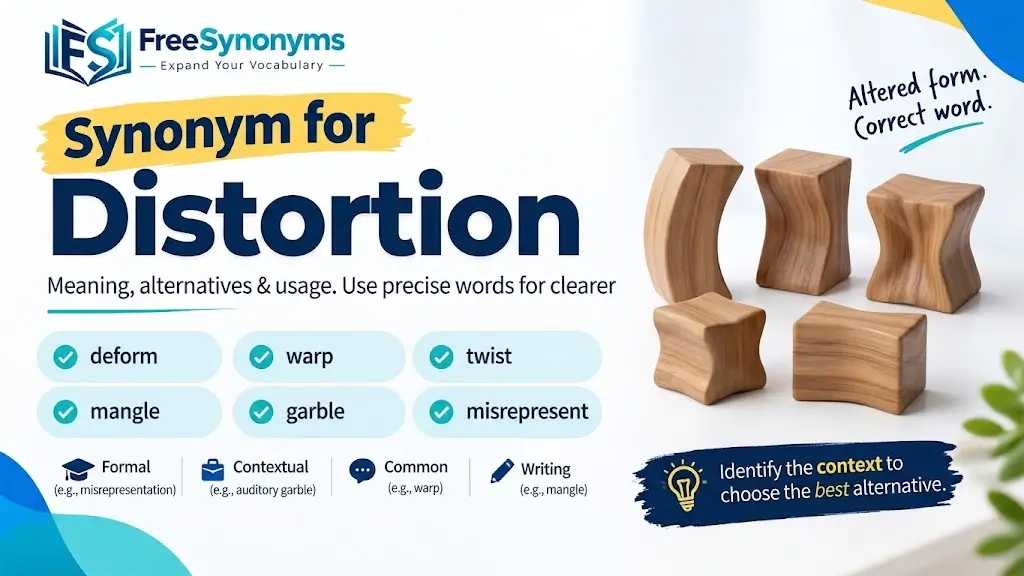
A useful distortion synonym depends on what has been changed and how. For example, misrepresentation, alteration, warping, deformation, and exaggeration can all relate to distortion, but they are not interchangeable in every sentence. The best choice depends on whether you mean a physical change in shape, an inaccurate presentation of information, an exaggerated statement, or a change in perception.
In general, distortion means a change that makes something different from its original, normal, accurate, or intended form. The change can be physical, visual, factual, emotional, or conceptual.
For example:
- The lens caused distortion in the photograph.
- The article contained a distortion of the facts.
- Stress can lead to a distorted perception of events.
- The heat caused distortion of the plastic panel.
Therefore, choosing a synonym requires attention to context rather than simply replacing one word with another.
Closest Distortion Synonyms
The closest alternatives to distortion include alteration, deformation, misrepresentation, warping, perversion, exaggeration, and falsification. However, each word emphasizes a different kind of change.
| Synonym | Main nuance | Formality | Best used for |
|---|---|---|---|
| Alteration | A change from the original | Neutral | General changes |
| Deformation | A change in physical shape | Neutral/Formal | Objects, materials, structures |
| Warping | Bending or changing from a normal form | Neutral | Physical forms, images, perceptions |
| Misrepresentation | An inaccurate presentation | Formal | Facts, people, information |
| Exaggeration | Making something seem greater than it is | Neutral | Claims, descriptions, stories |
| Falsification | Deliberately making something false | Formal | Records, evidence, data |
| Perception | A way something is interpreted or understood | Neutral | Ideas and experiences |
| Disfigurement | A damaging change to appearance | Neutral/Formal | Faces, bodies, objects |
| Manipulation | Deliberately influencing or changing something | Neutral | Information, images, situations |
Because these words emphasize different ideas, misrepresentation may work well for a factual distortion, while deformation is more appropriate for a physical one.
Alteration as a Distortion Synonym
Alteration is one of the broadest alternatives. It simply means a change to something that already exists.
For example:
The alteration of the original design changed its appearance.
The word does not necessarily imply that the change is inaccurate, harmful, or deceptive. As a result, it is less negative than distortion in many contexts.
Use alteration when you want to describe a change without strongly suggesting that the result is misleading or defective.
Deformation as a Distortion Synonym
Deformation focuses on a change in shape, structure, or physical form. It is common in engineering, physics, materials science, medicine, and technical writing.
For example:
The metal showed deformation after the collision.
Similarly, deformation can describe a physical shape that has been changed by pressure, force, heat, or another influence.
It is usually not the best substitute when you are talking about distorted facts or opinions.
Misrepresentation as a Distortion Synonym
Misrepresentation refers to presenting something inaccurately or misleadingly. It is particularly useful for information, statements, people, events, and facts.
For example:
The report was criticized for its misrepresentation of the evidence.
Unlike alteration, the word usually carries an implication of inaccuracy. Depending on the context, that inaccuracy may be intentional or unintentional.
Therefore, misrepresentation is often a strong choice when distortion refers to an inaccurate account of reality.
Distortion Synonyms for Information and Facts
When distortion refers to facts, evidence, statistics, history, or other information, physical alternatives such as warping or deformation usually sound unnatural.
Instead, consider misrepresentation, falsification, manipulation, inaccuracy, exaggeration, or misinterpretation.
Misrepresentation and Falsification
These two words are related, but they are not identical.
Misrepresentation means that something is presented inaccurately. It does not always establish that the person responsible deliberately created a falsehood.
Falsification, by contrast, commonly suggests deliberately making information false or altering evidence, records, or data.
Compare:
- The article contained a misrepresentation of the scientist’s position.
- The investigation uncovered falsification of research data.
The first sentence focuses on inaccurate presentation. The second points toward deliberate creation or alteration of false information.
Manipulation as an Alternative
Manipulation emphasizes deliberate handling or modification to produce a particular effect. It can describe information, photographs, statistics, narratives, or other material.
For example:
The manipulation of the data created a misleading impression.
However, manipulation is broader than distortion. Something can be manipulated without necessarily being distorted in the sense of becoming inaccurate.
Therefore, use manipulation when intentional influence or modification is central to the meaning.
Inaccuracy as a Distortion Alternative
Inaccuracy is useful when the main problem is that information does not correctly represent reality.
For example:
The report contained several inaccuracies about the timeline.
Unlike distortion, the noun inaccuracy directly identifies incorrectness. It is therefore a good choice for straightforward professional or academic writing.
Distortion Synonyms for Exaggeration
Sometimes distortion means that something has been represented as larger, worse, better, more important, or more extreme than it really is. In that context, exaggeration is often the most natural alternative.
For example:
The advertisement was an exaggeration of the product’s capabilities.
Similarly:
His description contained considerable exaggeration.
The distinction matters because exaggeration specifically concerns degree or magnitude. A distorted statement does not necessarily exaggerate; it might instead omit information, change context, or present facts inaccurately.
Embellishment
Embellishment means adding details that make a story or description more interesting, impressive, or elaborate. It can imply exaggeration, but it is often less severe than distortion.
For example:
The story included a few colorful embellishments.
This wording can sound relatively mild. By contrast, distortion usually emphasizes a meaningful departure from the original truth, form, or meaning.
Overstatement
Overstatement refers to expressing something too strongly or making it seem more significant than it is.
For example:
Calling the change a complete failure would be an overstatement.
This term works particularly well in analytical, professional, and academic writing.
Distortion Synonyms for Physical Shape
When something has physically changed shape, useful alternatives include deformation, warping, bending, contortion, disfigurement, and deformation.
The appropriate word depends on the type and severity of the physical change.
Warping
Warping suggests that something has bent, twisted, or changed shape, often because of heat, moisture, pressure, or another physical force.
For example:
Moisture caused the wooden door to warp.
The word can also be used figuratively:
Fear was warping his judgment.
In the first example, warping describes a physical change. In the second, it describes a change in thinking or judgment.
Contortion
Contortion suggests an unusual twisting or bending of a physical form. It is often associated with bodies, faces, limbs, or objects that have been twisted into an abnormal shape.
For example:
The dancer moved her body into an extreme contortion.
The word is more specific and vivid than the general term distortion.
Disfigurement
Disfigurement describes a change that damages or spoils someone’s or something’s appearance.
For example:
The accident resulted in severe facial disfigurement.
Because it carries a strong negative connotation, disfigurement should not be used as a neutral substitute for every physical distortion.
Distortion Synonyms for Images and Sound
Visual and audio contexts require more specialized vocabulary. Depending on the situation, alternatives include warping, deformation, interference, noise, alteration, blur, and modification.
Image Distortion
For photographs, graphics, video, or visual displays, warping and deformation can describe changes in shape.
For example:
The wide-angle lens caused noticeable warping near the edges of the image.
Meanwhile, alteration is broader:
The photograph showed signs of digital alteration.
If the issue is that an image no longer accurately represents the original scene, manipulation may be more appropriate.
Audio Distortion
In audio, distortion often describes an unwanted change in the original sound signal.
Depending on the cause, related terms can include interference, noise, clipping, disruption, or degradation.
For example:
The recording contained distortion caused by an overloaded microphone.
Here, replacing distortion with misrepresentation would obviously change the meaning. Consequently, context is essential when choosing a synonym.
Formal Distortion Synonyms
For formal, professional, or academic writing, the most useful alternatives often include:
- Misrepresentation
- Falsification
- Deformation
- Alteration
- Inaccuracy
- Manipulation
- Exaggeration
- Misinterpretation
However, formality alone does not determine the right word.
For instance, falsification sounds formal but should be reserved for situations involving false information or deliberate alteration. Likewise, deformation is technical and formal, but it is usually associated with physical shape.
A professional writer should therefore choose the word that communicates the intended meaning most precisely.
Negative and Neutral Distortion Alternatives
The word distortion often has a negative implication because it suggests that something has moved away from an accurate, normal, or original state.
Nevertheless, some alternatives are more neutral.
Alteration is generally neutral. It indicates change without necessarily judging the result.
Modification is also relatively neutral and often suggests an intentional adjustment.
Transformation can even have a positive or neutral sense because it emphasizes a substantial change rather than an inaccurate one.
By contrast, falsification, misrepresentation, and disfigurement carry stronger negative implications.
Distortion vs. Modification
Consider these examples:
The software introduced a modification to the image.
The software introduced a distortion in the image.
The first sentence simply describes a change. The second suggests that the change affected the image’s intended or original appearance.
Therefore, modification is not always a true synonym. It is better understood as a contextual alternative.
Distortion Synonyms by Context
The following guide can help you choose a word quickly.
| Context | Strong alternatives | Important distinction |
|---|---|---|
| Facts | Misrepresentation, inaccuracy | Focuses on incorrect presentation |
| Data | Manipulation, falsification | May imply deliberate alteration |
| Stories | Exaggeration, embellishment | Focuses on added or overstated details |
| Physical objects | Deformation, warping | Describes changes in shape |
| Images | Warping, alteration, manipulation | Depends on the type of visual change |
| Sound | Interference, degradation | Depends on the technical cause |
| Opinions | Misrepresentation, misinterpretation | Focuses on meaning or understanding |
| Memory | Misremembering, alteration | Refers to inaccurate recollection |
| Appearance | Disfigurement, deformation | Often emphasizes visible change |
| Judgment | Warping, bias, misinterpretation | Often describes altered perception |
As a result, there is no single synonym that replaces distortion naturally in every situation.
Distortion vs. Similar Words
Several words are close to distortion, yet their meanings differ in important ways.
Distortion vs. Misrepresentation
Distortion can refer to physical, visual, conceptual, or factual changes. Misrepresentation specifically concerns inaccurate presentation or description.
- The heat caused distortion in the plastic.
- The article contained a misrepresentation of the study.
Therefore, misrepresentation cannot normally replace distortion when describing physical deformation.
Distortion vs. Exaggeration
Exaggeration means making something seem greater or more extreme than it really is.
Distortion has a broader meaning. Something can be distorted by exaggerating it, but it can also be distorted by omission, selective presentation, or structural change.
For example:
The speaker’s exaggeration made the problem sound worse.
The word distortion would suggest a broader departure from an accurate representation.
Distortion vs. Deformation
Deformation primarily describes a change in physical shape or structure.
Distortion can describe physical shape, but it also applies to information, sound, images, opinions, and perceptions.
Consequently, deformation is more specialized.
Distortion vs. Alteration
Alteration simply means a change. It does not necessarily suggest that the result is inaccurate or defective.
Distortion, on the other hand, often suggests that the change interferes with the original form, meaning, or accuracy.
For that reason, these words are interchangeable only in some contexts.
Distortion vs. Misinterpretation
Misinterpretation means understanding or explaining something incorrectly.
For example:
The disagreement resulted from a misinterpretation of the instructions.
Distortion can involve misinterpretation, but it can also occur without anyone misunderstanding something. A person might deliberately distort accurate information, for example.
Stronger and Weaker Alternatives to Distortion
The strength of a synonym depends on what you want to imply.
For a relatively mild change, consider:
- Alteration
- Modification
- Variation
- Adjustment
- Embellishment
For a stronger suggestion of inaccuracy, consider:
- Misrepresentation
- Misinterpretation
- Exaggeration
- Manipulation
For an especially serious or deliberate falsification, falsification may be appropriate when the evidence supports that meaning.
Meanwhile, disfigurement is strong in physical contexts because it suggests substantial damage to appearance.
These differences make synonym selection a matter of precision rather than simply finding a more sophisticated word.
How to Choose the Right Distortion Synonym
Start by asking what exactly has changed.
If the shape has changed, try deformation or warping.
If facts or information have been presented inaccurately, consider misrepresentation or inaccuracy.
If a statement has been made more extreme, exaggeration or overstatement may fit better.
If information has been deliberately altered, manipulation or falsification may be more precise, depending on the evidence and context.
If the problem involves understanding, use misinterpretation.
Finally, if you only mean that something has changed, without suggesting that the change is inaccurate or harmful, alteration or modification may be better.
Sentence Examples With Distortion Synonyms
Seeing alternatives in complete sentences makes their differences easier to recognize.
Distortion → Misrepresentation
Original:
The article contained a distortion of the research findings.
Alternative:
The article contained a misrepresentation of the research findings.
The alternative emphasizes inaccurate presentation of the research.
Distortion → Exaggeration
Original:
His description was a distortion of what happened.
Alternative:
His description was an exaggeration of what happened.
The second sentence specifically suggests that the event was made to seem more extreme.
Distortion → Warping
Original:
The heat caused distortion in the plastic.
Alternative:
The heat caused warping in the plastic.
Here, warping gives a more specific physical description.
Distortion → Alteration
Original:
The image showed signs of distortion.
Alternative:
The image showed signs of alteration.
The alternative is broader. It indicates that the image was changed but does not necessarily say that the visual result was defective.
Distortion → Falsification
Original:
The investigation uncovered distortion of the records.
Alternative:
The investigation uncovered falsification of the records.
The alternative is much stronger because falsification implies that the records were made false or inaccurate, often deliberately.
Common Mistakes With Distortion Synonyms
One common mistake is treating every related word as a direct replacement. Although many words overlap with distortion, their meanings can differ significantly.
Another mistake is using falsification whenever information is inaccurate. Inaccuracy alone does not establish falsification. The stronger word should be used only when the context supports it.
Similarly, exaggeration should not replace every use of distortion. A distorted account may be inaccurate without making something larger or more extreme.
A third mistake involves physical contexts. Misrepresentation describes inaccurate communication, so it is not normally a substitute for physical distortion.
Finally, avoid choosing a synonym simply because it sounds more formal. A precise everyday word is often better than an impressive but inaccurate alternative.
Frequently Asked Questions
What is the best synonym for distortion?
There is no single best synonym for every context. Misrepresentation works well for inaccurate information, deformation for physical changes in shape, warping for bent or altered forms, and exaggeration for statements that overstate reality.
What is a simple word for distortion?
Change is the simplest broad alternative, although it is less precise. Alteration is another relatively simple choice when you want to describe a change from the original.
What is a synonym for distortion of facts?
Useful alternatives include misrepresentation, inaccuracy, misinterpretation, manipulation, and, in appropriate circumstances, falsification.
The correct choice depends on whether the problem is inaccurate presentation, misunderstanding, deliberate influence, or deliberate creation of false information.
What is another word for distorted information?
Depending on the situation, you could say misrepresented information, inaccurate information, misleading information, or manipulated information. These phrases are not identical, so the surrounding context matters.
Is “exaggeration” a synonym for distortion?
Sometimes. Exaggeration is a type of distortion when something is represented as greater, more serious, more impressive, or more extreme than it actually is. However, distortion has a broader meaning.
Is “misrepresentation” the same as distortion?
Not exactly. Misrepresentation is a specific type of distortion involving inaccurate presentation or description. Physical distortion, for example, can occur without any misrepresentation.
What is the opposite of distortion?
Possible opposites include accuracy, fidelity, clarity, authenticity, truthfulness, and preservation, depending on the context.
For physical shape, accuracy of form or undistorted may be appropriate. For information, accuracy or truthful representation is usually more natural.
Is distortion always negative?
Not necessarily. The word often carries a negative implication because it suggests departure from an original, accurate, or normal state. However, technical contexts can use distortion descriptively without making a moral judgment about it.
Conclusion
The right distortion synonym depends on what has been changed and what aspect of that change matters. Misrepresentation is useful for inaccurate information, exaggeration for overstated claims, deformation for physical changes in shape, and warping for bent or altered forms.
For a neutral description of change, alteration or modification may be more appropriate. Meanwhile, falsification should be reserved for situations where information or records have actually been made false, particularly when deliberate action is supported by the context.
Ultimately, precise synonym choice comes from matching the word to the meaning, tone, and situation. A shorter, more familiar alternative is often preferable when it communicates the idea more accurately.

Emily Carter
Emily Carter writes clear, accessible English vocabulary guides for students, professionals, and everyday readers. Her work explores synonyms, antonyms, word usage, and example sentences to help readers expand their vocabulary and express their ideas with confidence.