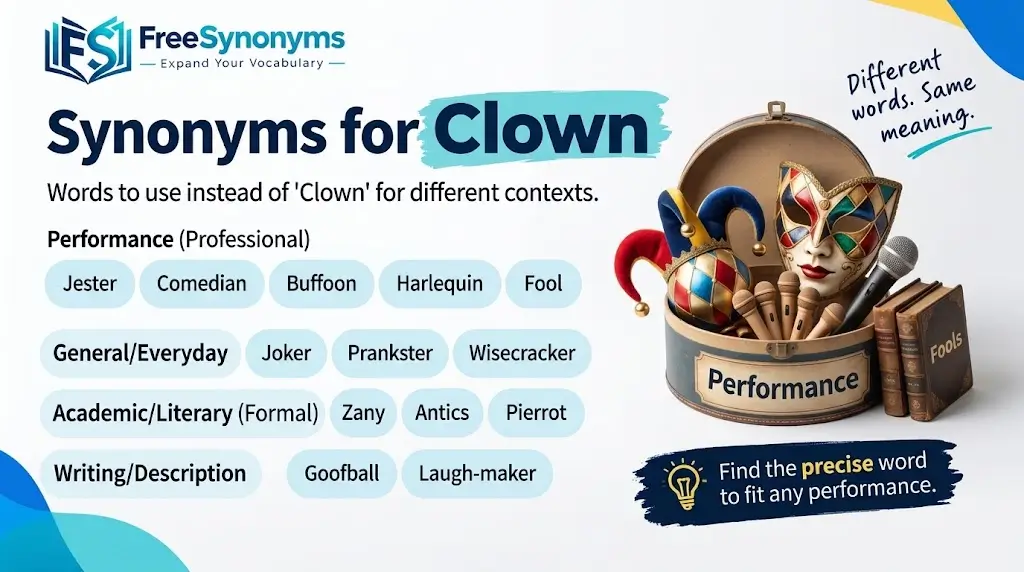
A useful clown synonym depends on what you mean by clown. The word can describe a professional entertainer, a silly or foolish person, someone who behaves ridiculously, or a person who makes a spectacle of themselves. Because those meanings differ, no single alternative works in every sentence.
For a professional entertainer, comedian, comic, or circus performer may fit. For someone acting foolishly, fool, buffoon, goof, or silly person can be more appropriate. In an insulting context, words such as idiot or ridiculous person may convey stronger criticism, although they are not exact synonyms.
The table below provides a quick guide to common alternatives.
| Synonym or alternative | Meaning / nuance | Formality | Best used when |
|---|---|---|---|
| Fool | A person who acts unwisely or lacks good judgment | Neutral | Describing foolish behavior |
| Buffoon | A ridiculous person who behaves foolishly | Neutral to formal | Stronger criticism of foolish behavior |
| Foolish person | Someone who behaves without good judgment | Neutral | Clear, direct descriptions |
| Goof | A silly or clumsy person | Casual | Friendly or informal contexts |
| Goofball | A person who behaves in a silly, playful way | Casual | Lighthearted situations |
| Joker | Someone who jokes or does not act seriously | Casual | Informal descriptions |
| Comedian | A person who performs comedy | Neutral | Professional or intentional humor |
| Comic | A comedian or comic performer | Neutral | Entertainment contexts |
| Entertainer | Someone whose work is to amuse an audience | Neutral | Broad professional contexts |
| Circus performer | A person performing at a circus | Neutral | Literal circus contexts |
| Prankster | Someone who plays practical jokes | Neutral | Mischievous behavior |
| Clownish person | Someone whose behavior resembles a clown’s | Neutral | Describing manner or behavior |
| Mimic | Someone who imitates people or actions for entertainment | Neutral | Imitation-based humor |
| Jester | A historical court entertainer or humorous person | Literary / historical | Historical or figurative writing |
| Buffoonery | Foolish or ridiculous behavior | Neutral to formal | Discussing behavior rather than a person |
| Nitwit | A foolish or unintelligent person | Informal | Mild insult |
| Blockhead | A foolish or dull person | Informal | Traditional insult |
| Dunce | A person regarded as slow to understand | Neutral to formal | Criticism of poor understanding |
| Laughingstock | A person or thing widely mocked | Neutral | Describing public ridicule |
| Amateur | An inexperienced or unskilled person | Neutral | Lack of skill, not necessarily foolishness |
Closest Clown Synonyms
The closest alternative depends on the sense you have in mind. In particular, buffoon, fool, goof, and comedian overlap with clown, but each emphasizes something different.
Buffoon
Buffoon is one of the strongest general alternatives when clown means a person who behaves in a ridiculous or foolish way.
The manager looked like a clown during the meeting.
A possible alternative is:
The manager looked like a buffoon during the meeting.
The second sentence sounds more critical and somewhat more formal. Therefore, buffoon is often a better choice in serious writing when you want to emphasize ridiculous behavior.
Fool
Fool is broader than clown. It usually refers to someone who acts unwisely, imprudently, or without good judgment.
Don’t be a clown and ignore the warning.
Could become:
Don’t be a fool and ignore the warning.
Here, fool focuses more on poor judgment than comic behavior. As a result, it works well when the speaker is criticizing someone’s decision.
Goof
Goof is a casual alternative for a silly, awkward, or sometimes amusing person.
He’s a lovable clown who keeps making everyone laugh.
A casual variation might be:
He’s a lovable goof who keeps making everyone laugh.
Unlike buffoon, goof can sound affectionate rather than insulting. For that reason, it works especially well in friendly conversations.
Comedian
Comedian is appropriate when clown refers to someone whose purpose is to entertain people through humor.
The clown entertained the children at the party.
If the person is actually a comedy performer, you could say:
The comedian entertained the audience at the show.
However, comedian is not a substitute for every meaning of clown. A comedian is specifically associated with performing comedy, while a clown may be a circus performer or simply a foolish person.
Synonyms for a Foolish Person
When clown describes someone who behaves foolishly, several alternatives are available. The right choice depends on how harsh or playful you want the description to sound.
Buffoon and Dunce
Buffoon emphasizes ridiculous behavior. Dunce, by contrast, emphasizes a person’s perceived lack of understanding or intelligence.
He made a clown of himself during the presentation.
A stronger formal-style alternative is:
He made a buffoon of himself during the presentation.
If the intended meaning is specifically that he failed to understand something, dunce may be more precise:
He felt like a dunce after misunderstanding the instructions.
These words should not be treated as interchangeable in every situation.
Nitwit and Blockhead
Nitwit and blockhead are informal terms for a foolish person. They can sound humorous, old-fashioned, or mildly insulting depending on the sentence.
You clown, you forgot your keys again.
Possible alternatives include:
You nitwit, you forgot your keys again.
or:
You blockhead, you forgot your keys again.
Both alternatives are more personal than simply describing the person’s behavior as clownish. Therefore, use them carefully in professional or formal communication.
Goofball
Goofball usually has a playful tone. It can describe someone who acts silly without suggesting serious wrongdoing or lack of intelligence.
My brother is a complete clown sometimes.
A warmer version could be:
My brother is a complete goofball sometimes.
The second sentence is more likely to sound affectionate. Thus, goofball is useful when the speaker is teasing rather than attacking someone.
Alternatives for a Person Who Acts Ridiculously
Sometimes clown refers less to intelligence and more to someone’s behavior. In that case, words such as buffoon, joker, and show-off may work depending on the situation.
Joker
Joker can describe someone who treats a serious situation as a joke.
Stop acting like a clown and pay attention.
You might instead write:
Stop acting like a joker and pay attention.
The meaning shifts slightly. Joker suggests excessive joking, while clown can suggest generally ridiculous behavior.
Show-Off
Show-off is appropriate when the person is deliberately trying to attract attention or impress others.
He was acting like a clown in front of the guests.
If attention-seeking is the important detail, this may be clearer:
He was acting like a show-off in front of the guests.
However, show-off does not necessarily imply foolishness. A person can show off without behaving like a clown.
Attention-Seeker
Attention-seeker is another contextual alternative. It focuses specifically on the desire to attract notice.
His clownish behavior annoyed everyone.
A more precise description might be:
His attention-seeking behavior annoyed everyone.
As a result, this alternative is useful when the motivation or behavior involves attracting attention rather than simply being funny.
Professional and Formal Alternatives
A professional writer should usually avoid calling someone a clown unless the informal tone is intentional. Instead, describe the specific behavior.
Foolish Person
Foolish person is direct and relatively neutral compared with stronger insults.
The article described him as a clown.
A more restrained version is:
The article described him as a foolish person.
This phrasing is less vivid, but it can be more suitable for formal writing.
Buffoon
Buffoon can work in formal or literary prose when the writer intentionally wants a strong description of ridiculous behavior.
The character appears as a political clown in the novel.
A literary alternative could be:
The character appears as a political buffoon in the novel.
Because buffoon is pointed and evaluative, it should still be used deliberately rather than as a neutral professional term.
Comic Figure
Comic figure is useful when the person is presented as a source of humor, particularly in literature, entertainment, or cultural analysis.
The character is portrayed as a clown.
A more analytical version is:
The character is portrayed as a comic figure.
The latter focuses on the character’s role in the work rather than directly insulting the person.
Casual Clown Synonyms
Casual conversations allow more playful alternatives. Goof, goofball, joker, and silly person are common choices when the intended tone is light.
Goof and Goofball
Both words can describe someone who frequently behaves in a silly way.
You’re such a clown.
Depending on the relationship, you could say:
You’re such a goof.
or:
You’re such a goofball.
The tone is usually friendlier than a direct insult. For that reason, these choices can work well between friends or family members.
Joker
Use joker when the person is constantly joking or refusing to take something seriously.
He’s a clown who never takes meetings seriously.
A natural casual alternative is:
He’s a joker who never takes meetings seriously.
Still, joker emphasizes joking rather than general foolishness.
Synonyms for a Professional Clown
When clown means the entertainer who performs in a circus, children’s show, party, or similar setting, many supposed synonyms become inaccurate.
Circus Performer
Circus performer is a broad and accurate description of someone who performs at a circus.
The clown performed for the children.
You could write:
The circus performer performed for the children.
However, the second sentence loses the specific information that the performer was a clown. It is therefore a broader category, not an exact synonym.
Entertainer
Entertainer is even broader. It can refer to a clown, magician, musician, comedian, dancer, or other performer.
The clown entertained the children.
can become:
The entertainer entertained the children.
Although grammatically possible, the repeated entertainer / entertained sounds less natural. A better sentence might be:
The entertainer kept the children laughing throughout the show.
Comedian
Comedian works when the person primarily performs comedy. However, it should not automatically replace clown when discussing circus skills, makeup, costumes, juggling, or traditional clown performance.
For example:
The clown juggled three balls.
should not normally become:
The comedian juggled three balls.
The second sentence changes the person’s role.
Clownish, Foolish, and Ridiculous: What’s the Difference?
The adjective clownish is related to clown, but it does not simply mean funny. It often describes behavior that seems silly, ridiculous, undignified, or poorly judged.
Consider these examples:
His clownish behavior disrupted the ceremony.
Here, the emphasis is on inappropriate or ridiculous conduct.
Her playful behavior made everyone laugh.
This sentence is more positive. It describes amusement without necessarily suggesting foolishness.
His foolish decision caused a major problem.
Now the emphasis is on poor judgment rather than comic behavior.
Therefore, choosing among clownish, playful, foolish, and ridiculous requires attention to the writer’s intended meaning.
Stronger and Milder Alternatives
Not every alternative has the same emotional force. Some words are relatively gentle, while others can be openly insulting.
| Word | Typical tone | What it emphasizes |
|---|---|---|
| Goof | Mild, playful | Silly behavior |
| Goofball | Playful | Amusing silliness |
| Joker | Casual | Excessive joking |
| Fool | Critical | Poor judgment |
| Dunce | Critical | Perceived lack of understanding |
| Buffoon | Strongly critical | Ridiculous behavior |
| Nitwit | Informal, insulting | Foolishness |
| Idiot | Strong insult | Perceived lack of intelligence |
| Laughingstock | Critical | Being publicly mocked |
The strongest choice is not necessarily the most accurate one. Instead, select the word that identifies the specific behavior you want to describe.
Positive and Playful Alternatives
In friendly contexts, clown can be affectionate rather than insulting. In those cases, goof, goofball, class clown, or joker may preserve the playful meaning.
Class Clown
A class clown is a student who frequently makes jokes or behaves humorously in class, often to attract laughter or attention.
Marcus was the class clown who kept everyone laughing.
This term is context-specific. It should not be treated as a general synonym for every use of clown.
Goofball
As noted earlier, goofball can describe someone who behaves in an amusingly silly manner.
My cousin is a lovable goofball.
The adjective lovable makes the positive intention especially clear. Without such context, however, tone can depend on the relationship between the speakers.
Negative Alternatives to Clown
When clown is intended as an insult, alternatives should be chosen carefully. Buffoon, fool, nitwit, and blockhead all convey criticism, but they target slightly different qualities.
Buffoon vs. Fool
A buffoon is ridiculous in behavior or manner. A fool is generally someone who acts unwisely.
The speaker behaved like a buffoon during the debate.
This emphasizes the speaker’s ridiculous conduct.
The speaker was a fool for ignoring the evidence.
Here, the focus is poor judgment.
Therefore, these words are related but not interchangeable in every sentence.
Fool vs. Idiot
Fool and idiot can both function as insults, but idiot is generally more direct and harsh. It also specifically attacks perceived intelligence.
For professional writing, it is often better to describe the observable behavior instead of using either insult.
Instead of:
The employee was a clown.
you could write:
The employee behaved unprofessionally during the meeting.
That revision communicates a specific criticism without relying on a vague insult.
Words Related to Clown but Not Exact Synonyms
Some words are strongly associated with clown without being true synonyms. Understanding this distinction helps prevent awkward substitutions.
Jester is associated with humorous entertainment, particularly in historical or literary settings. A jester, however, is not simply another word for a modern circus clown.
Prankster describes someone who plays practical jokes. A clown may play jokes, but being a prankster is not part of every clown’s role.
Mime is a performer who communicates through gestures and movement. A mime may resemble a clown in some performances, but the terms describe different performance traditions.
Comedian performs comedy, while a clown can perform physical comedy, circus skills, or character-based entertainment.
Entertainer is a broad category that includes many types of performers. Consequently, it is a contextual alternative rather than a direct synonym.
How to Choose the Right Clown Synonym
Start by identifying what clown means in your sentence. Then choose the alternative that preserves that meaning.
For a Professional Performer
Use clown, circus performer, or entertainer when referring to someone who performs for an audience.
If comedy is the central activity, comedian or comic may be appropriate.
For Silly Behavior
Choose goof, goofball, or clownish person when the behavior is silly and relatively harmless.
These choices work particularly well in casual speech.
For Foolish Behavior
Use fool or buffoon when the main idea is poor judgment or ridiculous conduct.
The choice depends on whether you want to emphasize bad decisions or comic foolishness.
For Formal Writing
In professional or academic writing, consider describing the specific behavior instead of using an insult.
For example:
The speaker behaved irresponsibly.
is more precise than:
The speaker was a clown.
Similarly, ridiculous behavior, unprofessional conduct, or poor judgment may communicate the intended criticism more accurately.
Clown Synonyms in Sentences
Seeing alternatives in context makes their differences easier to understand.
Fool
He felt like a fool after forgetting the appointment.
This emphasizes his mistake or poor judgment.
Buffoon
The character behaves like a buffoon throughout the play.
Here, buffoon emphasizes ridiculous behavior.
Goofball
She’s a goofball who can make everyone laugh.
The tone is affectionate and playful.
Joker
Stop being a joker and finish your work.
The word emphasizes joking or a lack of seriousness.
Comedian
The comedian performed for a sold-out audience.
This is a professional entertainment context.
Circus Performer
The circus performer balanced on a large ball.
This alternative identifies a broader professional category without claiming that every circus performer is a clown.
Laughingstock
The failed project became a laughingstock within the company.
Here, the word refers to something that becomes an object of ridicule. It cannot normally replace clown when describing an individual entertainer.
Common Mistakes With Clown Synonyms
The biggest mistake is assuming that every related word can replace clown in every sentence. Meaning and context matter.
Mistake 1: Using Comedian for Every Clown
A clown may entertain people without being a comedian in the conventional sense. Therefore, comedian is appropriate only when comedy performance is the relevant meaning.
Mistake 2: Using Idiot When You Mean Silly
Idiot is much harsher than goof or goofball. If the speaker is being affectionate, an insulting term can completely change the tone.
Mistake 3: Using Buffoon in Friendly Conversation
Although buffoon can be humorous, it often sounds strongly critical. A casual alternative such as goof may be more natural when teasing a friend.
Mistake 4: Treating Entertainer as an Exact Synonym
An entertainer can be a singer, magician, comedian, dancer, clown, or other performer. Thus, the word is broader than clown.
Mistake 5: Using Laughingstock for a Person’s Behavior
Laughingstock describes someone or something that becomes an object of widespread ridicule. It does not simply mean a silly person.
Frequently Asked Questions
What is the closest synonym for clown?
Buffoon is one of the closest alternatives when clown means a person who behaves foolishly or ridiculously. However, fool, goof, and joker may be more accurate depending on the intended tone and context.
What is a polite synonym for clown?
For a professional performer, entertainer or circus performer can be appropriate. For a silly person in a friendly context, goof or goofball is usually less harsh.
What is a synonym for clown as an insult?
Depending on the intended meaning, buffoon, fool, nitwit, or blockhead can work. These words differ in tone, so they should not be treated as interchangeable.
Is buffoon a synonym for clown?
Buffoon is a contextual synonym when clown refers to a ridiculous or foolish person. It is not normally a synonym when clown means a professional circus entertainer.
Is comedian a synonym for clown?
Sometimes, but only in an entertainment context. A comedian performs comedy, whereas a clown may also perform circus skills or represent a particular comic character.
What is a synonym for a funny person?
Depending on the meaning, comedian, comic, joker, goof, or goofball may work. The best choice depends on whether the person is a professional performer, a habitual joker, or simply playful.
What is the opposite of clown?
There is no single exact opposite. Depending on the context, possible contrasts include serious person, professional, dignified person, or serious performer. The appropriate opposite changes with the meaning of clown.
Conclusion
The best clown synonym depends on the meaning you want to preserve. Buffoon works well for ridiculous behavior, fool emphasizes poor judgment, goof and goofball create a playful tone, and comedian fits professional comedy contexts.
For formal writing, a precise description of the person’s behavior is often clearer than an insult. Instead of automatically replacing clown, identify whether the sentence is about entertainment, silliness, foolishness, joking, attention-seeking, or ridicule. Then choose the alternative that matches that specific meaning and tone.

Michael Reed
Michael Reed focuses on improving the clarity, accuracy, and usefulness of English vocabulary content. He helps readers explore word relationships, understand context-dependent meanings, and discover natural alternatives for academic writing, creative projects, and everyday communication.