
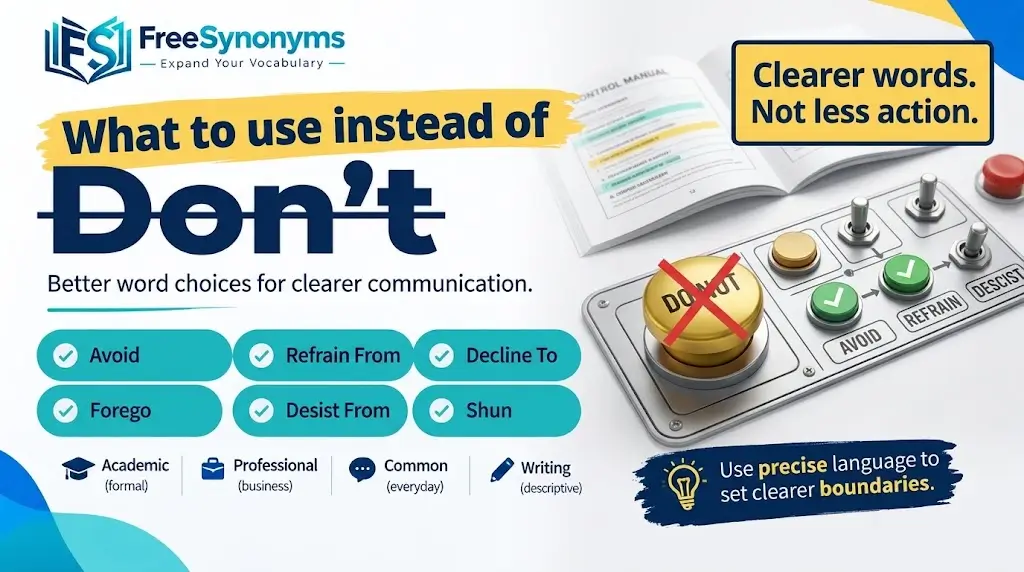
A useful don’t synonym depends on what you mean and how formal the sentence needs to sound. Common alternatives include do not, avoid, refrain from, should not, must not, never, decline to, and choose not to. However, these expressions are not interchangeable in every context. Some preserve the exact meaning of “don’t,” while others add ideas such as obligation, prohibition, advice, refusal, or deliberate choice.
Common Don’t Synonyms
The most direct synonym for don’t is do not. It has the same basic meaning but sounds more formal and is often preferred in professional, academic, and instructional writing.
Other alternatives work in particular contexts:
| Alternative | Main meaning or nuance | Formality | Example |
|---|---|---|---|
| Do not | Direct negative instruction or statement | Formal/neutral | Do not open the door. |
| Avoid | Stay away from an action or situation | Neutral/formal | Avoid using unclear language. |
| Refrain from | Deliberately choose not to do something | Formal | Please refrain from using your phone. |
| Should not | Advice or recommendation against an action | Neutral/formal | You should not ignore the warning. |
| Must not | Strong prohibition or requirement | Formal/strong | Visitors must not enter this area. |
| Never | At no time | Neutral/strong | Never share your password. |
| Choose not to | Deliberate decision not to act | Neutral | She chose not to respond. |
| Decline to | Politely or deliberately refuse to do something | Formal | He declined to comment. |
| Refuse to | Intentionally reject an action | Neutral/strong | She refused to sign the document. |
| Refrain | Hold yourself back from an action | Formal | He refrained from responding. |
Therefore, the best replacement depends on the sentence rather than on the word alone.
Do Not: The Closest Formal Alternative
Do not is usually the safest replacement when you want to preserve the meaning of don’t without changing the sentence structure.
For example:
- Don’t touch the equipment.
- Do not touch the equipment.
The meaning remains essentially the same. The second version simply sounds more formal or deliberate.
In instructions, notices, policies, and professional communication, do not is especially natural:
Do not submit the form until all required fields are complete.
Likewise, academic or technical writing may favor do not when a direct negative statement is appropriate:
Researchers do not assume that correlation proves causation.
Because do not is a direct grammatical equivalent of don’t, it is usually preferable when you do not want to introduce a different nuance.
Avoid as a Don’t Synonym
Avoid is one of the most useful alternatives when the intended meaning is “do not engage in” or “stay away from.”
For example:
- Don’t use unnecessary jargon.
- Avoid unnecessary jargon.
The second sentence is concise and natural. It tells the reader to stay away from a particular practice.
However, avoid does not always mean exactly the same thing as don’t. The verb usually suggests preventing contact with, steering clear of, or choosing not to engage in something.
Compare:
- Don’t make mistakes.
- Avoid mistakes.
The first is a direct instruction. The second focuses on preventing mistakes.
Similarly:
- Don’t discuss personal information.
- Avoid discussing personal information.
Both can work, although avoid sounds less like a direct command.
Refrain From as a Formal Alternative
Refrain from means deliberately hold yourself back from doing something. It is more formal than don’t and frequently appears in instructions, policies, notices, and professional communication.
Examples include:
- Please refrain from using flash photography.
- Visitors should refrain from entering restricted areas.
- Employees are asked to refrain from discussing confidential matters.
The construction is important: refrain from + noun or gerund.
Correct:
Please refrain from talking during the presentation.
Less natural:
Please refrain to talk during the presentation.
Use refrain from when you want a polite but formal way to tell someone not to perform an action.
Should Not for Advice
Should not is appropriate when don’t expresses advice rather than a strict command.
Compare these sentences:
- Don’t skip breakfast.
- You should not skip breakfast.
The first can sound like a direct instruction. The second presents the idea as advice or a recommendation.
For example:
You should not rely on a single source when researching a complex topic.
This does not necessarily mean that the action is forbidden. Instead, it communicates that the action is considered unwise or inappropriate.
That distinction matters. Should not is therefore a contextual alternative rather than an exact replacement for every use of don’t.
Must Not for Strong Prohibitions
Must not expresses a strong prohibition.
For example:
Employees must not disclose confidential information.
This is stronger than:
Employees should not disclose confidential information.
The first sentence indicates that disclosure is prohibited. The second may express a rule, recommendation, or expectation depending on context.
Similarly:
- Don’t enter this room.
- You must not enter this room.
The second version makes the prohibition more explicit.
For safety instructions, regulations, policies, and formal rules, must not can be more precise than don’t.
Never as a Strong Don’t Alternative
Never means “not at any time.” It is useful when the negative action applies universally or repeatedly.
Examples:
- Don’t share your password.
- Never share your password.
The second sentence is stronger and more absolute.
Another example:
Never assume that two synonyms have exactly the same meaning.
Here, never emphasizes that the action should be avoided in every relevant situation.
However, do not replace every instance of don’t with never. Doing so can make a statement much stronger than the original.
Choose Not to
Choose not to emphasizes a deliberate decision.
For example:
- She didn’t attend the meeting.
- She chose not to attend the meeting.
The first sentence simply states that she did not attend. The second suggests that attendance was possible but she deliberately decided against it.
This distinction makes choose not to useful when writing about decisions, preferences, or personal behavior.
Examples:
Some employees choose not to work remotely.
He chose not to answer the question.
The company chose not to renew the contract.
In each case, the phrase highlights intentional choice.
Decline to
Decline to is a formal alternative when someone politely refuses or elects not to do something.
Examples:
The spokesperson declined to comment.
She declined to answer the question.
The applicant declined to provide additional information.
Unlike don’t, decline to normally describes a person’s refusal or decision not to participate. It is therefore more specific.
For professional, journalistic, legal, and business writing, decline to can be a precise alternative when the context involves a refusal.
Refuse to
Refuse to is stronger than decline to because it suggests an active rejection.
Compare:
He declined to answer.
with:
He refused to answer.
The first can sound neutral or diplomatic. The second suggests a stronger rejection.
Therefore, refuse to should not be used automatically as a synonym for don’t. It adds a sense of resistance or unwillingness.
Don’t Synonyms by Context
The best alternative changes according to the purpose of the sentence.
For Instructions
Use:
- do not
- avoid
- refrain from
- make sure not to
Examples:
Do not remove the cover.
Avoid touching the exposed wires.
Please refrain from using the equipment without authorization.
Make sure not to leave the door unlocked.
These alternatives vary in tone, but all can communicate a negative instruction.
For Advice
Use:
- should not
- ought not to
- avoid
- it is best not to
Examples:
You should not ignore the warning signs.
It is best not to make assumptions.
Avoid making decisions without enough information.
Here, the emphasis is usually on good judgment rather than prohibition.
For Rules and Policies
Use:
- must not
- may not
- are prohibited from
- are not permitted to
Examples:
Employees must not share their login credentials.
Visitors may not enter restricted areas.
Unauthorized users are prohibited from accessing the system.
Children are not permitted to use the equipment without supervision.
These expressions are stronger and more formal than ordinary don’t.
For Personal Decisions
Use:
- choose not to
- decide not to
- decline to
- refuse to
- elect not to
Examples:
She chose not to participate.
The company decided not to proceed.
The witness declined to answer.
He refused to cooperate.
The board elected not to pursue the proposal.
The right choice depends on whether the decision is neutral, polite, deliberate, or resistant.
Casual Alternatives to Don’t
In everyday American English, don’t is already the natural conversational form of do not. You often do not need another synonym.
For example:
Don’t worry about it.
Natural alternatives include:
No need to worry about it.
You don’t have to worry about it.
Try not to worry about it.
These are related expressions, but their meanings are slightly different. No need to worry reassures the listener. You don’t have to worry removes an obligation. Try not to worry gives advice.
Likewise:
Don’t forget your keys.
can become:
Remember your keys.
The second sentence removes the negative construction altogether. In some situations, rewriting the sentence with a positive verb creates more natural prose than searching for a direct synonym.
Professional Alternatives to Don’t
Professional writing often benefits from precise wording rather than simply replacing don’t with a more complicated phrase.
For example:
Don’t send incomplete forms.
could become:
Please do not submit incomplete forms.
A more formal policy version could be:
Incomplete forms should not be submitted.
Or, when the rule is strict:
Incomplete forms must not be submitted.
Each version communicates a slightly different level of authority.
Similarly:
Don’t share this information.
could become:
Please do not share this information.
For a policy:
This information must not be shared outside the organization.
Therefore, professional writing should focus on the intended level of obligation rather than on making every sentence sound more formal.
Academic Alternatives to Don’t
Academic writing often uses do not, should not, avoid, and carefully phrased negative constructions.
Examples:
Researchers should not assume that the findings apply to every population.
The analysis does not establish a causal relationship.
Authors should avoid making unsupported claims.
The results do not necessarily indicate that the intervention was effective.
In academic prose, do not is often preferable to an unnecessarily elaborate substitute.
For example, this sentence is clear:
The study does not examine long-term outcomes.
A more complicated construction would not necessarily improve it.
Stronger and Weaker Alternatives
Not every synonym has the same strength.
A rough progression might look like this:
Do not → direct negative statement or instruction
Should not → advice or recommendation
Avoid → instruction to stay away from an action
Must not → strong prohibition
Never → absolute negative statement
Refuse to → strong personal rejection
These expressions should not be treated as interchangeable.
Consider:
You don’t need to respond.
This means a response is unnecessary.
Compare:
You should not respond.
This advises against responding.
Then:
You must not respond.
This prohibits responding.
Finally:
You refused to respond.
This says that the person actively rejected the opportunity to respond.
The basic negative idea is related, but the meanings are clearly different.
Positive Rewrites Instead of Don’t
Sometimes the best alternative to don’t is not another negative phrase. A positive construction can make a sentence shorter and clearer.
For example:
Don’t forget to attach the file.
can become:
Remember to attach the file.
Likewise:
Don’t be late.
can become:
Please arrive on time.
And:
Don’t make assumptions.
can become:
Check the facts first.
These rewrites can sound more constructive because they tell the reader what to do rather than only what to avoid.
However, a positive rewrite is not always equivalent. Don’t touch the equipment and Handle the equipment carefully do not impose exactly the same restriction.
Don’t Synonyms for Polite Writing
When a negative instruction could sound abrupt, a polite construction may work better.
Instead of:
Don’t interrupt.
consider:
Please wait until the speaker has finished.
Instead of:
Don’t send another message.
consider:
Please wait for a response before sending another message.
Instead of:
Don’t use informal language.
consider:
Please use formal language in this document.
These alternatives preserve the practical purpose while changing the tone.
The most effective professional writing often combines a polite expression with a clear instruction.
Don’t vs. Do Not
The difference between don’t and do not is primarily grammatical and stylistic.
Don’t is the contraction of do not. It is common in conversation, informal writing, dialogue, personal messages, and friendly instructions.
Do not is the uncontracted form. It is common in formal writing, official notices, policies, academic prose, and emphatic statements.
Compare:
Don’t forget the meeting.
Do not forget the meeting.
Both are grammatical. The second sounds more formal and potentially more emphatic.
In ordinary conversation, however, replacing every don’t with do not can make the writing sound stiff.
Don’t vs. Avoid
Don’t directly tells someone not to perform an action.
Avoid tells someone to stay away from an action, behavior, or situation.
Compare:
Don’t use unnecessary technical terms.
Avoid unnecessary technical terms.
The second is concise and natural in writing advice.
However, avoid normally takes a noun or gerund:
Avoid distractions.
Avoid making unsupported claims.
Avoid using vague language.
Therefore, it cannot replace every grammatical use of don’t.
Don’t vs. Should Not
These expressions differ mainly in force.
Don’t change the settings.
sounds like a direct instruction.
You should not change the settings.
sounds like advice or a recommendation.
If the action is prohibited, must not may be more appropriate:
You must not change the settings.
Consequently, choose the expression according to whether you mean prohibition, advice, or a simple negative statement.
Don’t vs. Never
Never is stronger because it means “at no time.”
Compare:
Don’t call me after midnight.
This could apply to a particular situation or instruction.
Never call me after midnight.
This establishes a more absolute rule.
Therefore, never should be used only when the intended meaning supports that level of strength.
Don’t vs. Refuse to
These expressions describe different things.
I don’t want to answer.
describes a current preference or desire.
I refuse to answer.
describes active rejection.
Similarly:
She didn’t sign the agreement.
only tells us what happened.
She refused to sign the agreement.
adds the idea that she deliberately rejected signing it.
Because refuse introduces a stronger implication, it is not a neutral replacement for don’t.
Grammar of Don’t
Don’t is the contraction of do not.
It is used with the base form of a verb:
- don’t go
- don’t worry
- don’t forget
- don’t make
- don’t use
- don’t touch
For example:
Don’t make unnecessary changes.
The auxiliary do carries the negative form, while the main verb remains in its base form.
A common error is using an unnecessary conjugated form after don’t:
Don’t goes there.
The correct form is:
Don’t go there.
Similarly:
Don’t uses this file.
should be:
Don’t use this file.
The same grammatical principle applies to do not:
Do not enter.
Do not touch.
Do not remove.
Common Mistakes With Don’t Synonyms
Using “Refrain” Without “From”
The standard construction is refrain from + noun/gerund.
Correct:
Please refrain from talking.
Incorrect:
Please refrain to talk.
Using “Avoid” With the Wrong Construction
Avoid is normally followed by a noun or gerund.
Correct:
Avoid making assumptions.
Correct:
Avoid unnecessary repetition.
Less natural:
Avoid to make assumptions.
Making “Should Not” Too Strong
Should not generally expresses advice or expectation rather than an absolute prohibition.
If a policy explicitly forbids an action, must not may communicate the intended force more clearly.
Using “Never” for a Limited Rule
Because never means “at no time,” it can overstate a sentence.
If the restriction applies only to one situation, do not may be more accurate.
Treating “Refuse” as Neutral
Refuse to suggests active rejection. Therefore, it can change the meaning of the original sentence.
Overusing Formal Alternatives
A sentence does not automatically improve because it uses a more formal synonym.
For example:
Please refrain from contacting us until Monday.
is appropriate in some contexts.
However, in a friendly message, this may sound unnecessarily stiff:
Please don’t contact us until Monday.
The simpler version may be more natural.
How to Choose the Right Don’t Synonym
First, identify what the original sentence is doing.
For a straightforward instruction, do not is usually the closest formal alternative.
When the sentence gives advice against an action, should not or avoid may be more appropriate.
A strict prohibition calls for stronger wording, such as must not or may not.
When the meaning is “at no time,” never is the natural choice.
For a deliberate personal decision, consider choose not to or decide not to.
When someone politely refuses an action, decline to may fit the context.
By contrast, refuse to is appropriate when someone actively rejects or resists an action.
Finally, consider the audience. A conversational message may naturally use don’t, while a policy document may favor do not, must not, or are not permitted to.
Examples of Don’t Synonyms in Sentences
Original: Don’t use your phone during the exam.
Possible alternatives:
Do not use your phone during the exam.
Students must not use their phones during the exam.
Students are not permitted to use phones during the exam.
The last two versions communicate a formal rule more clearly.
Original: Don’t make assumptions.
Possible alternatives:
Avoid making assumptions.
You should not make assumptions.
Do not make assumptions without checking the evidence.
Here, avoid is especially natural when giving writing or research advice.
Original: Don’t respond yet.
Possible alternatives:
Please do not respond yet.
Please wait before responding.
Hold off on responding for now.
The best choice depends on the desired tone.
Original: She didn’t answer.
Possible alternatives:
She chose not to answer.
She declined to answer.
She refused to answer.
These versions are not identical. The first emphasizes choice, the second often sounds neutral or diplomatic, and the third suggests stronger rejection.
Original: Don’t forget the deadline.
Possible alternatives:
Remember the deadline.
Keep the deadline in mind.
Make sure you remember the deadline.
A positive rewrite may sound more natural than a direct synonym.
Don’t Synonyms for Different Tones
| Tone | Useful alternatives |
|---|---|
| Casual | don’t, don’t worry, no need to |
| Neutral | do not, avoid, should not |
| Polite | please do not, please avoid, please refrain from |
| Formal | do not, refrain from, should not |
| Strong | must not, never, are prohibited from |
| Professional | do not, avoid, should not, are not permitted to |
| Academic | do not, should not, avoid |
| Deliberate choice | choose not to, decide not to |
| Refusal | decline to, refuse to |
The table shows why there is no single perfect synonym for every use of don’t.
Frequently Asked Questions
What is the best synonym for “don’t”?
Do not is the closest direct synonym because it is simply the uncontracted form of don’t. However, avoid, should not, must not, and other alternatives may be better when the sentence has a specific meaning or tone.
Is “avoid” a synonym for “don’t”?
Sometimes. Avoid works when the intended meaning is to stay away from an action, behavior, or situation. It does not replace every use of don’t.
What is a formal word for “don’t”?
Do not is the most direct formal alternative. Depending on context, refrain from, should not, must not, or are not permitted to may also work.
What is a polite way to say “don’t”?
Depending on the situation, try please do not, please avoid, please refrain from, or a positive instruction such as please wait or please use.
What is a stronger synonym for “don’t”?
Must not and never can be stronger, but they have different meanings. Must not usually expresses prohibition, while never means “at no time.”
Is “should not” the same as “don’t”?
Not always. Should not usually expresses advice or recommendation, while don’t can be a direct instruction or a simple negative statement.
Is “refuse to” a synonym for “don’t”?
No, not in every context. Refuse to adds the idea of active rejection or unwillingness, so it is stronger and more specific.
What is the opposite of “don’t”?
The grammatical opposite is usually expressed with an affirmative verb using do, such as do, go, use, or remember, depending on the sentence.
For example:
Don’t forget.
becomes:
Remember.
Likewise:
Don’t stop.
becomes:
Keep going.
Conclusion
The best don’t synonym depends on meaning, tone, grammar, and context. Do not is the closest direct alternative, while avoid works for actions or behaviors that should be prevented. Should not expresses advice, must not communicates prohibition, and never creates an absolute negative. Meanwhile, choose not to, decline to, and refuse to describe different kinds of deliberate decisions or rejection.
For natural American English, keep don’t when the setting is conversational or informal. In formal writing, use do not when you simply need the uncontracted form. Otherwise, choose a more specific alternative only when it accurately expresses the intended meaning.

Emily Carter
Emily Carter writes clear, accessible English vocabulary guides for students, professionals, and everyday readers. Her work explores synonyms, antonyms, word usage, and example sentences to help readers expand their vocabulary and express their ideas with confidence.

