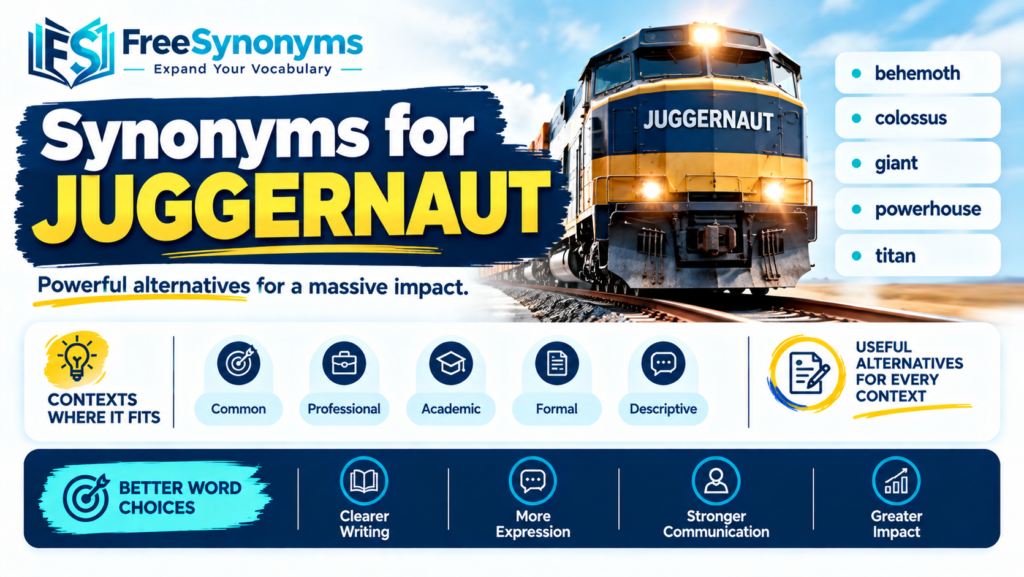

If you need a synonym for juggernaut, the best choice depends on what you mean by the word. When juggernaut describes a person, company, organization, team, movement, or other force that seems extremely powerful and difficult to stop, useful alternatives include powerhouse, force, giant, powerhouse, dominant force, behemoth, colossus, and heavyweight.
However, these words are not interchangeable in every sentence. Some emphasize size, others power, dominance, momentum, or the idea that something is difficult to stop. Choosing the right alternative therefore requires attention to context.
What Does “Juggernaut” Mean?
A juggernaut is a person, organization, institution, team, company, or other force that is extremely powerful, successful, or difficult to stop.
The word is often used figuratively:
- A company can become a juggernaut in its industry.
- A sports team can be described as a juggernaut after dominating its competition.
- A political movement may be called a juggernaut when it gains enormous momentum.
- A large project or campaign can become a juggernaut that continues growing rapidly.
The word usually carries a sense of overwhelming strength or unstoppable momentum.
For example:
The company has become a juggernaut in the streaming industry.
This suggests more than simple success. It presents the company as a powerful force that has gained enough influence, size, or momentum to dominate its field.
Quick answer: What is the best synonym for “juggernaut”?
The best synonym depends on the intended meaning:
| Synonym | Best when you mean |
|---|---|
| Powerhouse | Something exceptionally powerful or successful |
| Behemoth | Something extremely large and powerful |
| Colossus | A dominant or immensely influential force |
| Giant | A very large or powerful organization or entity |
| Heavyweight | A major and influential competitor |
| Dominant force | Something that clearly controls or leads a field |
| Force | A powerful influence or presence |
| Power | An entity with substantial influence or authority |
| Giant force | A combination of great size and influence |
| Unstoppable force | Something that appears extremely difficult to stop |
Among these, powerhouse is often the most natural general-purpose alternative, while behemoth is better when size and scale are important.
Best Synonyms for Juggernaut
1. Powerhouse
Powerhouse is one of the closest natural alternatives to juggernaut when you are describing something exceptionally strong, successful, productive, or influential.
It works particularly well for:
- companies
- sports teams
- organizations
- industries
- institutions
- individuals with exceptional ability
Example:
The technology company has become a global powerhouse.
You could also write:
The technology company has become a global juggernaut.
The two sentences are similar, but juggernaut places more emphasis on overwhelming momentum and dominance, while powerhouse emphasizes strength and capability.
2. Behemoth
Behemoth describes something exceptionally large, powerful, or influential.
It is especially useful when the subject has enormous size, scale, or market presence.
Example:
The retail behemoth operates thousands of stores across the country.
A company described as a behemoth is not necessarily unstoppable. The emphasis is more strongly on its enormous scale.
Use behemoth when you want to emphasize:
- size
- scale
- resources
- market presence
- institutional power
3. Colossus
Colossus refers to something or someone of enormous size, importance, power, or influence.
It has a somewhat more elevated or literary tone than giant.
Example:
The company emerged as a financial colossus.
In this sentence, colossus communicates extraordinary importance and power.
It is a strong choice for formal or polished writing, particularly when you want to emphasize an entity’s exceptional influence.
4. Giant
Giant is a simple and versatile alternative.
It can describe a large or highly influential company, organization, institution, or competitor.
Example:
The software giant continues to expand into new markets.
Compared with juggernaut, giant is less dramatic. It tells the reader that something is large or powerful without necessarily suggesting that it is difficult to stop.
That makes giant useful when you want a straightforward description rather than a dramatic one.
5. Heavyweight
Heavyweight describes an important, powerful, or influential participant in a particular field.
It is especially natural when discussing:
- business
- politics
- sports
- entertainment
- industry
- competition
Example:
The company is a heavyweight in the cybersecurity market.
The word does not necessarily imply overwhelming momentum. Instead, it identifies the subject as a major and influential competitor.
6. Dominant Force
Dominant force is a precise alternative when juggernaut refers to something that has substantial control or influence within a field.
Example:
The team has become a dominant force in professional basketball.
This expression is particularly useful in analytical or professional writing because its meaning is relatively clear and direct.
Unlike juggernaut, it does not carry the same dramatic or figurative quality.
7. Power
Power can work as a contextual alternative when you are describing an influential person, organization, country, team, or institution.
Example:
The company has become a major power in the automotive industry.
This is less vivid than juggernaut, but it can be more appropriate when the goal is a measured, professional tone.
8. Force
Force is another broad alternative.
When used figuratively, it can describe something that has a strong effect or substantial influence.
Example:
The organization has become a major force in environmental research.
Here, force focuses on influence rather than sheer size.
It is therefore useful when juggernaut feels too dramatic for the context.
9. Powerhouse Organization
Powerhouse organization can be useful when you specifically want to emphasize an institution’s ability, resources, influence, or performance.
Example:
The nonprofit has developed into a powerhouse organization in the education sector.
This phrase is more descriptive than the single word juggernaut and can work well in professional writing.
10. Unstoppable Force
Unstoppable force is appropriate when the most important part of juggernaut is the idea that something seems extremely difficult to stop.
Example:
After winning twelve consecutive games, the team looked like an unstoppable force.
This is a stronger expression than giant or heavyweight because it specifically emphasizes momentum and resistance to opposition.
It should not be used when you simply mean that something is large.
Juggernaut Synonyms by Meaning
Because juggernaut can communicate several related ideas, the best synonym changes according to the emphasis you want.
When You Mean “Very Powerful”
Use:
- powerhouse
- force
- power
- dominant force
- heavyweight
Example:
The university has become a powerhouse in medical research.
Here, powerhouse works because the focus is exceptional strength and achievement.
When You Mean “Extremely Large”
Use:
- behemoth
- giant
- colossus
- mammoth
Example:
The corporation has grown into a global behemoth.
In this context, behemoth emphasizes scale more than unstoppable momentum.
When You Mean “Highly Influential”
Use:
- power
- force
- heavyweight
- leader
- major player
Example:
The company is now a major player in the renewable-energy sector.
Major player is particularly useful when you want a natural business expression without the dramatic tone of juggernaut.
When You Mean “Difficult to Stop”
Use:
- unstoppable force
- relentless force
- unstoppable machine
- formidable force
Example:
The campaign became an unstoppable force after gaining support from millions of people.
These alternatives focus on momentum rather than simply size or influence.
Juggernaut Synonyms at a Glance
| Alternative | Main idea | Tone | Interchangeable with “juggernaut”? |
|---|---|---|---|
| Powerhouse | Exceptional strength or success | Neutral to strong | Often |
| Behemoth | Enormous size and power | Strong | Sometimes |
| Colossus | Immense importance or influence | Formal/literary | Sometimes |
| Giant | Large and powerful entity | Neutral | Often, depending on context |
| Heavyweight | Major competitor or participant | Professional | Contextually |
| Dominant force | Clear influence or control | Professional | Contextually |
| Force | Strong influence | Neutral | Contextually |
| Power | Authority or influence | Neutral/formal | Contextually |
| Major player | Important participant | Professional | Contextually |
| Unstoppable force | Extremely difficult to stop | Dramatic | When momentum matters |
The key point is that not every word in this table has exactly the same meaning. A useful synonym should match the specific idea you want the reader to understand.
What Is the Closest Synonym to “Juggernaut”?
There is no single synonym that is perfect in every context.
Powerhouse is often one of the closest everyday alternatives because it can describe an exceptionally strong or successful person, company, organization, team, or institution.
Consider:
Apple has become a technology juggernaut.
Possible alternatives include:
Apple has become a technology powerhouse.
Apple has become a technology giant.
Apple has become a dominant force in technology.
Each sentence works, but the emphasis changes slightly.
- Juggernaut suggests overwhelming momentum and power.
- Powerhouse emphasizes exceptional strength and success.
- Giant emphasizes size and prominence.
- Dominant force emphasizes control or influence.
That distinction is important when choosing a word for professional or polished writing.
Formal Synonyms for Juggernaut
If you are writing an academic paper, business report, professional article, or formal commentary, a dramatic word such as juggernaut may not always be the best option.
Depending on your intended meaning, consider:
- dominant force
- major power
- leading organization
- major player
- preeminent force
- industry leader
- dominant entity
- formidable competitor
Example
Original:
The company has become a juggernaut in the financial sector.
More formal:
The company has become a dominant force in the financial sector.
Another option:
The company has established itself as a leading organization in the financial sector.
The best choice depends on whether you want to emphasize dominance, leadership, or institutional importance.
Stronger Alternatives to Juggernaut
Sometimes the writer wants an expression that conveys even more intensity.
Depending on context, possible choices include:
- unstoppable force
- formidable force
- powerhouse
- behemoth
- colossus
- dominant force
- unstoppable machine
These should be used carefully because they can make a sentence sound more dramatic.
For example:
The team has become a juggernaut.
This is already a strong statement.
The team has become an unstoppable force.
This makes the claim more emphatic by directly suggesting that opponents have little ability to stop it.
Weaker or More Neutral Alternatives
If juggernaut feels too dramatic, choose a more measured term.
Useful options include:
- leader
- major player
- competitor
- industry leader
- large organization
- established company
- influential organization
- successful team
For example:
The company is a juggernaut in the software industry.
A less dramatic version would be:
The company is a major player in the software industry.
The second sentence sounds more restrained and businesslike.
Is “Giant” a Synonym for “Juggernaut”?
Giant can be a contextual synonym for juggernaut, but the words are not identical.
Both can describe an exceptionally large or influential company, organization, or institution.
Compare:
The retailer has become a retail giant.
The retailer has become a retail juggernaut.
Retail giant emphasizes size and prominence.
Retail juggernaut suggests not only size but also significant power, momentum, and influence.
Therefore, giant is a good substitute when you want a simpler and less dramatic expression.
Is “Behemoth” a Synonym for “Juggernaut”?
Behemoth is a close contextual alternative, especially when size and power are central to the sentence.
For example:
The corporation has grown into an industry behemoth.
This suggests an enormous and powerful company.
However, behemoth does not necessarily communicate the same sense of unstoppable momentum as juggernaut.
Compare:
The team became a sporting juggernaut.
The team became a sporting behemoth.
The first suggests a team that has built powerful momentum and become difficult to defeat.
The second sounds more like a description of a very large or powerful institution.
Is “Powerhouse” a Synonym for “Juggernaut”?
Powerhouse is often a strong contextual synonym for juggernaut.
It works particularly well when describing exceptional performance, strength, or success.
For example:
The university is a research powerhouse.
This means the university is exceptionally strong in research.
You could also say:
The university is a research juggernaut.
That version sounds more forceful and dramatic.
The distinction is subtle but useful:
- Powerhouse = exceptionally strong or successful.
- Juggernaut = exceptionally powerful and seemingly difficult to stop.
Is “Major Player” a Synonym for “Juggernaut”?
Major player is a contextual alternative, particularly in business and professional writing.
For example:
The company has become a major player in artificial intelligence.
This means the company has significant importance or influence in that field.
However, major player is less intense than juggernaut. A major player can be influential without dominating the entire market.
That makes it a useful alternative when you want a professional and measured tone.
How to Choose the Right Alternative to “Juggernaut”
The right replacement depends on what you want the reader to notice. Before replacing juggernaut, identify whether your sentence is mainly about power, size, influence, success, competition, or unstoppable momentum.
Choose “powerhouse” for exceptional strength or success
Use powerhouse when the subject is highly capable or successful.
The university has become a research powerhouse.
This sounds natural and positive without necessarily suggesting that the university dominates every competitor.
Choose “behemoth” for enormous size
Use behemoth when scale is the main idea.
The company has grown into a global retail behemoth.
This highlights the organization’s enormous presence and resources.
Choose “heavyweight” for a major competitor
Use heavyweight when the subject is an important participant in a competitive field.
The startup is now a heavyweight in the software industry.
This works especially well in business, sports, entertainment, and other competitive contexts.
Choose “dominant force” for clear control or influence
Use dominant force when you want a precise, professional expression.
The company has become a dominant force in the American automotive market.
This is less colorful than juggernaut but makes the idea of dominance explicit.
Choose “unstoppable force” for momentum
Use unstoppable force when something appears extremely difficult to stop.
The team has become an unstoppable force during the playoffs.
This is more dramatic than dominant force and should be reserved for contexts where that intensity is appropriate.
Choose “major player” for measured professional language
Use major player when you want to communicate importance without exaggerating the subject’s power.
The company is now a major player in the renewable-energy sector.
This is often a good choice for business writing because it sounds natural and relatively restrained.
Juggernaut in Different Contexts
The meaning of juggernaut becomes clearer when you look at the types of subjects it commonly describes.
Business
In business writing, juggernaut can describe a company that has achieved tremendous scale, influence, or momentum.
The company has transformed from a small startup into a global juggernaut.
Possible alternatives include:
- business giant
- corporate powerhouse
- industry leader
- major player
- industry heavyweight
- corporate behemoth
- dominant force
The best choice depends on the intended emphasis.
Corporate behemoth focuses on size.
Industry leader focuses on leadership.
Powerhouse focuses on strength and success.
Juggernaut combines several of these ideas while adding a sense of overwhelming momentum.
Sports
In sports, juggernaut usually describes a team or player that is extremely successful and difficult to defeat.
The team has become a juggernaut this season.
Good alternatives include:
- powerhouse
- dominant team
- dominant force
- heavyweight
- formidable opponent
- unstoppable force
For sports writing, powerhouse is usually more natural when discussing a consistently strong team.
Unstoppable force is more dramatic and works particularly well when discussing a dominant run.
Technology
Technology companies can also be described as juggernauts when they develop enormous influence or market presence.
The company has become a technology juggernaut.
Possible alternatives:
The company has become a technology giant.
The company has become a technology powerhouse.
The company has become a dominant force in the technology sector.
These versions are similar, but they are not identical.
Social or Cultural Movements
A movement can be described as a juggernaut when it gains substantial momentum and appears difficult to stop.
The movement became a cultural juggernaut.
In this context, behemoth may sound inappropriate because the movement’s physical size is not the point.
Better alternatives include:
- powerful movement
- dominant force
- cultural force
- unstoppable movement
- major influence
The exact choice depends on whether you are emphasizing influence, growth, or momentum.
Juggernaut vs. Similar Words
Several words overlap with juggernaut, but each has its own emphasis.
Juggernaut vs. Powerhouse
These words are often interchangeable when describing a highly successful organization or team.
Juggernaut emphasizes overwhelming power, momentum, or dominance.
Powerhouse emphasizes exceptional strength, ability, or success.
Compare:
The team is a basketball powerhouse.
This tells us the team is exceptionally strong.
The team is a basketball juggernaut.
This creates a stronger impression that the team is dominating and difficult to stop.
Juggernaut vs. Behemoth
Both words can describe something extremely large and powerful.
Juggernaut often emphasizes momentum and the difficulty of stopping something.
Behemoth emphasizes enormous size and power.
The company is a business juggernaut.
The company is portrayed as a powerful force with momentum.
The company is a business behemoth.
The company is portrayed primarily as an enormous entity.
Juggernaut vs. Colossus
Colossus emphasizes exceptional size, importance, or influence.
Juggernaut often has a stronger sense of movement, force, and momentum.
She became a literary colossus.
This emphasizes her enormous importance or stature in literature.
Her publishing company became a literary juggernaut.
This suggests an organization with extraordinary power and momentum.
Juggernaut vs. Giant
Giant is simpler and more neutral.
The retailer is a retail giant.
This means it is extremely large or important.
The retailer is a retail juggernaut.
This suggests something more forceful and potentially difficult for competitors to challenge.
Juggernaut vs. Heavyweight
Heavyweight usually refers to an important or powerful competitor.
The company is an industry heavyweight.
This means the company is a major participant with substantial influence.
Juggernaut goes further by suggesting exceptional momentum or dominance.
Juggernaut vs. Dominant Force
Dominant force is more literal and analytical.
The team is a dominant force in the league.
This directly states that the team has substantial control or influence.
The team is a league juggernaut.
This is more figurative and energetic.
For formal writing, dominant force may be preferable when you want clarity over rhetorical impact.
Examples: Replacing “Juggernaut” Naturally
The following examples show how different alternatives change the emphasis.
Example 1: Company
Original:
The company has become a juggernaut in online retail.
Power-focused:
The company has become a powerhouse in online retail.
Size-focused:
The company has become a behemoth in online retail.
Professional:
The company has become a major player in online retail.
Each version is grammatically natural, but the nuance changes.
Example 2: Sports Team
Original:
The team has become a football juggernaut.
Alternative:
The team has become a football powerhouse.
The second sentence emphasizes sustained strength and success.
Another possibility:
The team has become a dominant force in football.
This sounds more analytical.
Example 3: Technology
Original:
The startup has grown into a technology juggernaut.
Alternative:
The startup has grown into a technology giant.
This focuses more on size and prominence.
Or:
The startup has grown into a technology powerhouse.
This emphasizes capability and success.
Example 4: Individual
Original:
She became a juggernaut in the publishing industry.
Alternative:
She became a heavyweight in the publishing industry.
Here, heavyweight naturally presents her as a major and influential figure.
Powerhouse could also work if her exceptional ability or productivity is the focus.
Example 5: Movement
Original:
The movement became a political juggernaut.
Possible alternatives include:
The movement became a powerful political force.
The movement became a dominant political force.
The movement gained unstoppable momentum.
The last version changes the grammatical structure but clearly captures the idea of rapidly increasing force.
Common Mistakes When Using “Juggernaut” Synonyms
Mistake 1: Treating every large thing as a juggernaut
Being large does not automatically make something a juggernaut.
For example:
The warehouse is a juggernaut.
This sounds unusual unless the warehouse is being described figuratively as a powerful or overwhelming force.
If you simply mean that the warehouse is very large, enormous, massive, or huge may be more appropriate.
Mistake 2: Using “behemoth” when momentum is the main idea
If your sentence is about something that keeps advancing despite opposition, behemoth may not capture the intended meaning.
Instead, consider:
- juggernaut
- unstoppable force
- relentless force
- dominant force
Mistake 3: Using “unstoppable” as a factual claim
Calling something an unstoppable force is often rhetorical.
A team may appear unstoppable after a long winning streak, but that does not mean it literally cannot lose.
In analytical or cautious writing, dominant, highly successful, or formidable may be more appropriate.
Mistake 4: Using “major player” when dominance is essential
A major player can be important without being dominant.
Compare:
The company is a major player in the industry.
This does not necessarily mean it controls the industry.
If dominance is important, dominant force communicates that idea more clearly.
Mistake 5: Assuming “giant” always carries the same tone
Giant is generally straightforward.
Juggernaut is more vivid and often more dramatic.
Replacing juggernaut with giant can therefore make your writing less forceful.
That may be exactly what you want in professional writing, but it is worth recognizing the change in tone.
Words Related to “Juggernaut” That Are Not Exact Synonyms
Some words are associated with juggernaut but should not automatically be presented as synonyms.
Mammoth
Mammoth means extremely large or substantial.
The project requires a mammoth investment.
It can overlap with juggernaut when discussing enormous scale, but it does not inherently mean a powerful or unstoppable force.
Formidable
Formidable describes something that is difficult to deal with, overcome, or defeat.
The company is a formidable competitor.
This can overlap strongly with juggernaut, particularly in competitive contexts, but it does not necessarily imply enormous size or momentum.
Powerful
Powerful is a broad adjective describing strength, influence, or effectiveness.
The organization is extremely powerful.
It can communicate one aspect of juggernaut without carrying the word’s full figurative meaning.
Influential
Influential means capable of affecting people, decisions, or developments.
She is an influential voice in education.
Influence alone does not mean something is a juggernaut.
Successful
Successful describes achievement of a desired result.
The company is highly successful.
A successful company is not necessarily a juggernaut. The latter usually suggests a greater sense of force, scale, or dominance.
Casual Alternatives to “Juggernaut”
In everyday American English, you may not always need a dramatic word.
Depending on context, casual alternatives include:
- giant
- powerhouse
- big player
- big name
- major force
- top competitor
- dominant team
- major player
For example:
That company is a juggernaut.
A more conversational version might be:
That company is a huge player in the industry.
Or:
That company is a powerhouse.
The appropriate choice depends on the audience and the degree of emphasis you want.
Professional Alternatives to “Juggernaut”
For workplace communication, reports, presentations, and business articles, these options can sound more precise:
- industry leader
- major player
- dominant force
- leading organization
- market leader
- major competitor
- established leader
- powerhouse
For example:
Instead of:
The company has become a juggernaut in the industry.
You might write:
The company has established itself as an industry leader.
That version is less dramatic and more suitable for neutral business communication.
How to Use “Juggernaut” in a Sentence
Juggernaut is normally used as a noun.
Common structures include:
a juggernaut in + field
The company is a juggernaut in the technology industry.
a + field + juggernaut
The company has become a technology juggernaut.
a juggernaut that + verb
The organization has become a juggernaut that continues to expand.
a juggernaut of + noun
This construction is less common and should be used only when it sounds natural in context.
Because juggernaut is a noun, alternatives such as powerful, dominant, and unstoppable cannot always replace it directly. They may require the sentence to be rewritten.
For example:
The company is a juggernaut.
Cannot simply become:
The company is powerful force.
Instead:
The company is a powerful force.
or:
The company is a dominant force.
Frequently Asked Questions
What is another word for juggernaut?
Common alternatives include powerhouse, behemoth, colossus, giant, heavyweight, dominant force, major player, and unstoppable force. The best choice depends on whether you want to emphasize power, size, influence, competition, or momentum.
What is the closest synonym for juggernaut?
Powerhouse is often one of the closest general alternatives, especially when describing a highly successful company, organization, team, or individual. However, juggernaut more strongly suggests overwhelming momentum or difficulty being stopped.
Is “powerhouse” the same as “juggernaut”?
Not exactly. Both can describe something exceptionally powerful or successful, but juggernaut tends to suggest greater momentum or dominance, while powerhouse focuses more on strength, ability, and success.
Is “behemoth” a positive word?
Behemoth is generally descriptive rather than inherently positive or negative. It emphasizes enormous size and power. Depending on the context, it can sound admiring, neutral, or critical.
Is “juggernaut” a positive or negative word?
Juggernaut is usually strong and dramatic rather than inherently positive or negative. It can be complimentary when describing extraordinary success, but it can also suggest an overwhelming force that leaves little room for competitors or opposition.
Can I use “juggernaut” in formal writing?
Yes. The word is legitimate in formal writing, but its figurative and dramatic character means that a more precise term may sometimes be preferable. In analytical writing, alternatives such as dominant force, industry leader, or major player can provide a more measured tone.
What is the opposite of a juggernaut?
There is no single exact antonym in every context. Depending on the intended contrast, possibilities include underdog, minor player, weak competitor, or insignificant force. The appropriate opposite depends on whether you are contrasting power, size, influence, or competitive strength.
Is “unstoppable force” always a synonym for juggernaut?
No. It is a contextual alternative. Unstoppable force emphasizes the idea that something is extremely difficult to stop, whereas juggernaut can also emphasize enormous size, influence, or power.