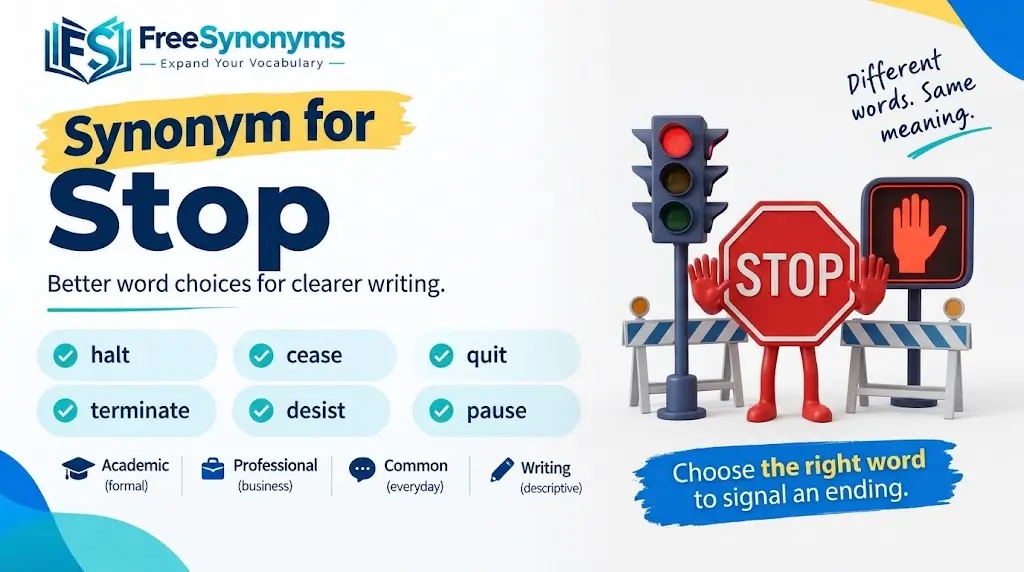
Another word for stop depends on what you mean by stop. Useful alternatives include halt, cease, end, quit, pause, discontinue, prevent, block, restrain, and finish. However, these words are not interchangeable in every sentence. The best choice depends on whether you mean ending an activity, taking a temporary break, preventing something, or bringing movement to an end.
Another Word for Stop: Quick Answer
The closest general alternatives to stop are halt, cease, end, discontinue, and quit. For a temporary interruption, use pause or break. For preventing something from happening, consider prevent, block, or prohibit. When referring to movement, halt, pull over, or come to a standstill may fit better.
The table below shows how these alternatives differ.
| Synonym or alternative | Main meaning | Formality | Best used when |
|---|---|---|---|
| Halt | Bring movement or activity to an end | Neutral/Formal | Something is being brought to a stop |
| Cease | Stop completely | Formal | An action or activity ends |
| End | Bring something to its conclusion | Neutral | An event, activity, or situation finishes |
| Quit | Stop doing something | Neutral/Casual | A person leaves or stops an activity |
| Pause | Stop temporarily | Neutral | An activity will resume later |
| Discontinue | Stop something permanently or officially | Formal | A service, product, or practice ends |
| Finish | Complete something | Neutral | An activity reaches its natural endpoint |
| Terminate | Bring something to a definite end | Formal | Contracts, services, processes, or employment end |
| Break off | Stop or end something suddenly | Neutral | A conversation, relationship, or activity ends |
| Abandon | Give something up completely | Neutral/Formal | An effort, plan, or project is given up |
| Prevent | Keep something from happening | Neutral | You stop an event before it occurs |
| Block | Keep something from progressing or passing | Neutral | Access, movement, or progress is stopped |
| Prohibit | Officially forbid something | Formal | Rules or laws stop an action |
| Restrain | Hold back or control | Formal | A person, action, or force is controlled |
| Suspend | Stop temporarily | Formal | An activity or service is paused |
What Does Stop Mean?
Stop is a versatile verb with several related meanings. It can describe ending an action, interrupting an activity, preventing an event, or bringing movement to an end.
For example:
- Please stop talking.
- The bus stopped at the corner.
- She stopped working at five.
- The police stopped the vehicle.
- We need to stop the leak.
These sentences all use stop, but the intended meanings differ. Therefore, the best synonym changes with the context.
As a noun, stop can also refer to a place where transportation pauses. For example, bus stop and train stop use the word differently from the verb stop.
Because of this range of meanings, choosing a replacement requires more than finding a word with a similar dictionary definition.
Closest Synonyms for Stop
Several words can replace stop in broad contexts. However, each one carries a slightly different emphasis.
Halt
Halt means to bring movement or an activity to a stop. It often sounds stronger or more formal than stop.
- The driver halted the car.
- The company halted production.
- The soldiers were ordered to halt.
In everyday conversation, stop is usually more natural. Meanwhile, halt works well in formal, official, military, or descriptive writing.
Cease
Cease means to stop doing something, usually with an emphasis on ending it completely.
- The factory ceased operations.
- The noise finally ceased.
- The company agreed to cease production.
Unlike pause, cease generally suggests that the activity is ending rather than temporarily stopping.
End
End means to bring something to its conclusion.
- The meeting ended at noon.
- They decided to end the discussion.
- The storm eventually ended.
This word is especially useful when something has reached its natural or intended conclusion. Therefore, end is often a better choice than stop for events, relationships, periods, and activities.
Quit
Quit usually means to stop doing something or to leave something.
- He quit smoking.
- She quit her job.
- They quit playing after the rain started.
In American English, quit is common in everyday speech. However, it can imply giving something up rather than simply bringing it to a planned conclusion.
Discontinue
Discontinue means to stop providing, producing, using, or doing something, often permanently or officially.
- The manufacturer discontinued the product.
- The service was discontinued last year.
- Doctors may discontinue a treatment for various reasons.
This alternative is particularly useful in business, technical, medical, and formal contexts.
Synonyms for Stop Doing Something
When stop means no longer performing an activity, different alternatives become useful.
Quit
Use quit when someone voluntarily stops an activity or habit.
Original:
He stopped smoking.
Alternative:
He quit smoking.
Here, quit is more specific because it emphasizes giving up the habit.
Cease
Use cease when the activity ends, especially in formal writing.
Original:
The workers stopped using the old system.
Alternative:
The workers ceased using the old system.
The second version sounds more formal and may fit a report better.
Discontinue
Discontinue works particularly well for services, practices, products, or established activities.
Original:
The company stopped offering the service.
Alternative:
The company discontinued the service.
The meaning is similar, but discontinued sounds more official.
Give Up
Give up is a common conversational alternative when someone abandons an activity, habit, attempt, or goal.
- She gave up trying to fix the computer.
- He gave up drinking soda.
- They gave up on the project.
However, give up can imply abandoning an effort rather than simply stopping it.
Synonyms for Stop Temporarily
Sometimes stop does not mean ending something permanently. Instead, it means taking a temporary break.
Pause
Pause is the clearest alternative when an activity stops temporarily.
- Please pause the video.
- She paused the conversation.
- The speaker paused for a moment.
The key idea is that the activity can continue later.
Take a Break
Take a break is a natural conversational phrase for temporarily stopping an activity.
- Let’s stop working for a few minutes.
- Let’s take a break for a few minutes.
This phrase is common in workplaces, schools, and everyday conversation.
Suspend
Suspend means temporarily stop something, often through an official decision.
- The school suspended classes because of the storm.
- The service was suspended temporarily.
Therefore, suspend is more formal than pause and often implies an external decision.
Interrupt
Interrupt means to stop something temporarily by breaking its normal continuity.
- The phone call interrupted the meeting.
- Construction interrupted traffic.
Unlike pause, interruption often happens unexpectedly or because something else intervenes.
Synonyms for Stop Moving
When stop refers to movement, alternatives such as halt, pull over, park, and come to a standstill may be more precise.
Halt
Use halt when a person, vehicle, or group stops moving.
- The train halted outside the station.
- The hikers halted near the river.
The word emphasizes the end of movement.
Pull Over
Pull over is specific to a vehicle moving toward the side of a road.
- The officer told the driver to pull over.
- We pulled over to check the tire.
It cannot normally replace stop in general situations.
For example, “Please pull over talking” is incorrect because the phrase relates to vehicle movement.
Park
Park means to stop and leave a vehicle in a particular place.
- She stopped the car.
- She parked the car.
The second sentence provides more information. It indicates not only that the vehicle stopped but also that it was left in a parking position.
Come to a Standstill
This phrase means to stop moving completely.
- Traffic came to a standstill after the accident.
- Negotiations came to a standstill.
Interestingly, the phrase can describe both physical movement and progress in an activity.
Synonyms for Stop Something From Happening
Another important meaning of stop is preventing something.
In this situation, end or cease may not be appropriate. Instead, use words such as prevent, block, prohibit, or deter.
Prevent
Prevent means to make something impossible or keep it from happening.
- The lock prevents unauthorized access.
- Quick action prevented a larger problem.
The timing matters. Prevent usually concerns something that has not happened yet.
Block
Block means to obstruct movement, access, communication, or progress.
- The fallen tree blocked the road.
- The firewall blocked the connection.
- An injury blocked his progress.
The word often suggests an obstacle rather than a simple command to stop.
Prohibit
Prohibit means officially or legally forbid something.
- The rules prohibit smoking indoors.
- The law prohibits certain activities.
Because of its formal meaning, prohibit is common in regulations, policies, laws, and official notices.
Deter
Deter means discourage someone from doing something.
- Security cameras may deter theft.
- The warning was designed to deter misuse.
Unlike prevent, deter does not necessarily make an action impossible. Instead, it reduces the likelihood that someone will choose to do it.
Formal Alternatives to Stop
Formal writing often benefits from more precise vocabulary. The best alternative depends on what exactly is ending.
Cease
Cease works well in reports, announcements, legal documents, and formal correspondence.
- The company agreed to cease operations.
Discontinue
Discontinue is useful for products, services, programs, procedures, and practices.
- The organization discontinued the program.
Terminate
Terminate indicates a definite ending. It is common in contracts, employment, subscriptions, agreements, and technical processes.
- Either party may terminate the agreement.
- The system will terminate the session after inactivity.
However, terminate can sound unnecessarily severe in ordinary conversation. Therefore, use it when its formal or definitive tone is appropriate.
Conclude
Conclude means bring something to an end, especially an event, discussion, argument, or process.
- The chair concluded the meeting.
- The report concludes with several recommendations.
It generally suggests completion rather than an abrupt stop.
Casual Alternatives to Stop
Everyday conversations often favor simpler expressions.
Quit
Quit is common when someone stops an activity.
- Quit complaining.
- He quit playing the game.
Cut It Out
Cut it out is an informal expression meaning stop doing that.
- Cut it out! You’re distracting everyone.
It can sound direct or irritated, so it is not suitable for formal writing.
Knock It Off
Knock it off is another informal way to tell someone to stop an annoying action.
- Knock it off and give your sister some space.
Because it can sound forceful, it should generally be reserved for casual situations.
Hold On
Hold on can mean stop temporarily or wait.
- Hold on a second.
- Hold on before you make a decision.
However, it does not replace stop in every context.
Professional and Business Alternatives
Business writing often requires more precision than everyday speech.
For example, a company may discontinue a product, terminate an agreement, suspend a service, or halt production.
| Situation | Better alternative | Example |
|---|---|---|
| Product no longer offered | Discontinue | The company discontinued the product. |
| Contract ends | Terminate | The client terminated the agreement. |
| Service temporarily unavailable | Suspend | The provider suspended the service. |
| Production stops | Halt | The plant halted production. |
| Meeting reaches its conclusion | Conclude | The manager concluded the meeting. |
| Employee voluntarily leaves | Quit | The employee quit the job. |
These distinctions make professional writing more precise. Instead of replacing every instance of stop with the same synonym, select the word that describes the specific action.
Academic Alternatives to Stop
Academic writing generally benefits from precise and neutral vocabulary.
Depending on the context, useful choices include cease, discontinue, terminate, suspend, conclude, and prevent.
Consider these examples:
General:
The researchers stopped the experiment.
More precise:
The researchers terminated the experiment.
General:
The treatment was stopped.
More precise:
The treatment was discontinued.
General:
The process stopped temporarily.
More precise:
The process was temporarily suspended.
The most appropriate term depends on the actual event. For that reason, academic writing should favor precision rather than formality for its own sake.
Another Word for Stop in Different Contexts
The following examples show why context matters.
Stop a Car
Use halt for a formal or descriptive context, or pull over when the vehicle moves to the side of a road.
- The driver stopped the car.
- The driver pulled over.
- The vehicle came to a halt.
Stop Working
Use quit when someone leaves employment or gives up an activity.
- She stopped working there.
- She quit her job.
Use cease or discontinue when the focus is on an activity or operation.
- The company ceased operations.
Stop Talking
Use be quiet, pause, or informal expressions such as cut it out, depending on the intended tone.
- Please stop talking.
- Please be quiet.
- Please pause the conversation.
These alternatives are not identical. Be quiet focuses on silence, while pause suggests a temporary interruption.
Stop an Argument
Use end, interrupt, break up, or settle, depending on the situation.
- The teacher stopped the argument.
- The teacher ended the argument.
- The teacher broke up the argument.
Break up can suggest physically or actively separating people who are arguing.
Stop a Problem
Use prevent when the problem has not happened, and resolve when the problem already exists and is being dealt with.
- The update prevented the problem.
- The technician resolved the problem.
Therefore, prevent and resolve should not automatically replace stop.
Stronger Alternatives to Stop
Some words communicate a stronger or more definitive ending.
Terminate
Terminate suggests a definite ending, especially for a formal process, agreement, service, or employment relationship.
Abandon
Abandon means give something up completely.
- The team abandoned the project.
The word can imply that continuing is no longer considered worthwhile or possible.
Cease
Cease often sounds more final than pause.
- The company ceased operations.
However, it does not necessarily carry the same sense of giving up that abandon does.
Forbid
Forbid means officially or personally tell someone that an action is not allowed.
- The rules forbid outside food.
It is therefore stronger and more restrictive than simply asking someone to stop.
Stop vs. Pause
Stop can mean either temporary or permanent interruption, while pause specifically emphasizes a temporary break.
Compare:
- Stop the recording.
- Pause the recording.
The first sentence does not necessarily tell us what will happen next. The second strongly suggests that the recording can resume.
Similarly:
- She stopped writing.
- She paused writing.
The first may mean she finished, quit, or simply ceased for an unspecified reason. The second indicates a temporary interruption.
Stop vs. End
Stop and end overlap, but they emphasize different ideas.
It focuses on bringing an action or process to a halt.
End focuses on reaching a conclusion.
Compare:
- The teacher stopped the discussion.
- The discussion ended.
In the first sentence, someone actively caused the discussion to stop. In the second, the discussion simply reached its end.
As a result, end is often natural for events, periods, relationships, and situations, while stop is broader.
Stop vs. Quit
Quit usually involves a person voluntarily stopping an activity, habit, job, or attempt.
- He quit smoking.
- She quit her job.
By contrast, stop has a much wider range of uses.
- He stopped smoking.
- The car stopped.
- The rain stopped.
- She stopped the machine.
You cannot replace stop with quit in all these sentences. For instance, “The rain quit” is not a standard replacement in ordinary American English.
Stop vs. Cease
Both words can mean to stop completely, but cease is more formal.
- The noise stopped.
- The noise ceased.
The second sentence has a more formal or literary tone.
In everyday conversation, stop is generally the natural choice. Meanwhile, cease can fit official reports, formal announcements, and serious written contexts.
Stop vs. Prevent
These words differ mainly in timing.
Stop can describe ending something that is already happening.
- The firefighters stopped the fire.
Prevent usually means keeping something from happening in the first place.
- The safety system prevented a fire.
Therefore, replacing stop with prevent can change the meaning of a sentence.
Common Mistakes When Choosing a Stop Synonym
Using Pause for a Permanent Ending
Pause implies that something can resume.
Incorrect choice:
- The company permanently paused the product.
If the product will no longer be offered, discontinued is more precise.
Using Quit for Objects or Events
Quit generally describes a person stopping an activity or leaving something.
- She quit smoking.
It is not a general synonym for every physical or natural stop.
Instead:
- The machine stopped.
- The rain stopped.
Using Prevent for Something Already Happening
Prevent usually concerns something that has not happened yet.
- The lock prevented unauthorized entry.
If someone is already entering and you make them stop, prevent may not accurately describe the action.
Choosing Formal Words in Casual Speech
Words such as terminate, cease, and prohibit can sound overly formal in ordinary conversation.
For example, saying “Please cease talking” is grammatically correct, but “Please stop talking” is much more natural in most everyday situations.
How to Choose the Right Alternative
Start by identifying what kind of stopping you mean.
If something ends completely, choose end, cease, discontinue, or terminate.
Someone voluntarily stops an activity, consider quit or give up.
If something stops temporarily, use pause, break, or suspend.
Movement ends, consider halt, pull over, park, or come to a standstill.
If you keep something from happening, use prevent.
If something obstructs movement or progress, use block.
A rule officially forbids an action, use prohibit or forbid.
If something reaches its natural conclusion, end or conclude may be more accurate.
The tone matters, too. Everyday speech usually favors stop, quit, pause, and end, while formal documents may call for cease, discontinue, suspend, or terminate.
Examples of Stop Synonyms in Sentences
Here are practical examples showing how different alternatives work.
- Stop: Please stop the car.
- Halt: The train came to a halt.
- Cease: The company ceased operations.
- End: The meeting ended at three.
- Quit: He quit smoking.
- Pause: She paused the video.
- Discontinue: The manufacturer discontinued the model.
- Terminate: The company terminated the contract.
- Suspend: The service was suspended temporarily.
- Prevent: The barrier prevented unauthorized entry.
- Block: A truck blocked the driveway.
- Prohibit: The policy prohibits outside food.
- Restrain: The guard restrained the individual.
- Abandon: The team abandoned the plan.
- Conclude: The speaker concluded the presentation.
Each sentence uses a word that matches a particular meaning of stop. Therefore, context should guide your final choice.
Frequently Asked Questions
What is another word for stop?
Common alternatives include halt, cease, end, quit, pause, discontinue, terminate, suspend, and finish. The correct choice depends on whether you mean ending something, stopping temporarily, preventing something, or ending movement.
What is a formal word for stop?
Formal alternatives include cease, discontinue, terminate, suspend, and halt. However, each has a different use. For example, terminate often applies to contracts or services, while discontinue commonly describes products or programs.
What is a synonym for stop doing something?
Depending on the context, you can use quit, cease, discontinue, give up, or abandon. Quit is common in everyday American English, while cease and discontinue are more formal.
What is another word for stop temporarily?
The most common alternatives are pause, suspend, interrupt, and take a break. Pause is especially natural when something is expected to continue later.
What is another word for stop someone?
Depending on the meaning, use prevent, restrain, block, halt, interrupt, or deter. For example, prevent focuses on keeping an action from happening, while restrain focuses on controlling someone or something.
What is another word for stop in formal writing?
Useful formal alternatives include cease, discontinue, terminate, suspend, halt, and conclude. Choose based on the specific action rather than simply choosing the most formal-sounding word.
Is quit the same as stop?
Not always. Quit usually describes a person voluntarily stopping an activity, habit, job, or attempt. Stop has a broader meaning and can describe people, objects, events, movement, and natural processes.
Is cease stronger than stop?
Cease often sounds more formal and can suggest a complete ending. However, it does not always mean something different from stop. In many sentences, the distinction is primarily one of tone and register.
What is a synonym for stop a process?
Depending on the situation, use halt, suspend, discontinue, terminate, or interrupt. Halt suggests bringing the process to a stop, while suspend usually indicates that it may resume later.
What is another word for stop an activity?
Useful alternatives include end, cease, quit, discontinue, pause, and abandon. The best choice depends on whether the activity ends permanently, pauses temporarily, or is given up intentionally.
Conclusion
The best another word for stop depends on the exact meaning of the sentence. Halt works well for movement or activities, cease and discontinue suit formal contexts, quit describes a person’s decision to stop, and pause indicates a temporary interruption.
For prevention, choose prevent, block, or prohibit instead of automatically using a synonym for ending. Likewise, end and conclude are often more natural when something reaches its intended conclusion.
When choosing a replacement, focus on meaning, context, tone, and formality rather than simply selecting the closest word. That approach will help you use synonyms naturally and avoid changing the meaning of your sentence.

Emily Carter
Emily Carter writes clear, accessible English vocabulary guides for students, professionals, and everyday readers. Her work explores synonyms, antonyms, word usage, and example sentences to help readers expand their vocabulary and express their ideas with confidence.