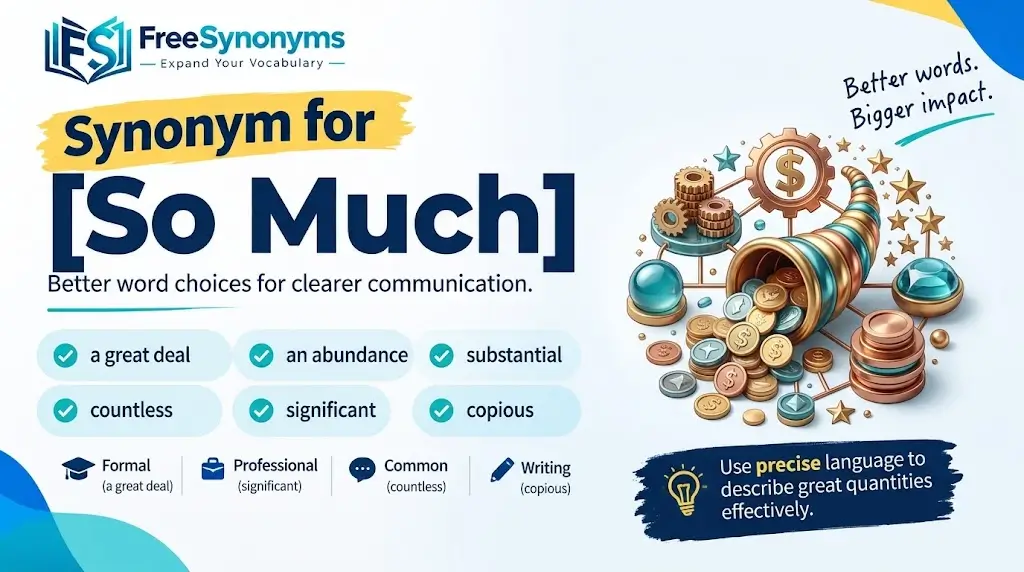

If you need another word for so much, the best choice depends on what “so much” means in your sentence. For quantity, a lot, a great deal, and a large amount are useful alternatives. For emphasis or emotion, very much, to such an extent, and that much may sound more natural.
The phrase so much has several uses in American English. Therefore, there is no single replacement that works in every sentence. The right alternative depends on whether you are describing an amount, expressing strong feeling, emphasizing degree, or referring to an unspecified quantity.
The Best Alternatives to “So Much”
Here are some of the most useful replacements:
| Alternative | Main use | Formality | Example |
|---|---|---|---|
| A lot | Large amount or degree | Casual to neutral | She has a lot of work. |
| A great deal | Large amount | Neutral to formal | He has a great deal of experience. |
| Very much | Strong degree or feeling | Neutral | I appreciate it very much. |
| That much | A specific degree or amount | Neutral | I didn’t expect that much. |
| A large amount | Large quantity | Formal | The project requires a large amount of data. |
| A considerable amount | Substantial quantity | Formal | They spent a considerable amount of time on it. |
| To such an extent | Strong degree | Formal | The issue grew to such an extent that action was necessary. |
| A ton | Large amount | Informal | We have a ton of work to finish. |
| A whole lot | Large amount or degree | Informal | She has a whole lot of energy. |
| So greatly | Strong degree | Formal/literary | The decision affected him so greatly. |
However, these alternatives are not interchangeable in every sentence. A lot usually describes quantity or degree, while very much often describes feelings, preferences, or the degree of an action.
“So Much” for a Large Amount
When so much refers to a large quantity of something uncountable, several alternatives can work naturally.
For example:
We have so much work to do.
You could write:
We have a lot of work to do.
Or:
We have a great deal of work to do.
In a formal context, you might choose:
We have a considerable amount of work to do.
The meaning remains similar, although the tone changes. A lot of sounds conversational, a great deal of sounds more polished, and a considerable amount of is more formal.
A Lot
A lot is probably the most common everyday alternative to “so much” when you mean a large amount.
For example:
- We have a lot of time.
- She spends a lot of money on books.
- There is a lot of information online.
- He has a lot of patience.
In contrast, “so much” can carry additional emphasis:
She has so much patience.
This may emphasize how surprisingly or unusually patient she is. Replacing it with “a lot of” preserves the quantity but can reduce the emotional emphasis.
A Great Deal
A great deal is a strong alternative when you want a more polished or formal expression.
For example:
The decision caused a great deal of confusion.
You could also say:
The decision caused so much confusion.
Both sentences describe a large amount of confusion. However, a great deal of often fits better in professional, academic, and formal writing.
Consider these examples:
- The research required a great deal of time.
- She has a great deal of experience.
- The announcement generated a great deal of interest.
A Large Amount
A large amount is especially useful when clarity and precision matter.
For example:
The database contains a large amount of information.
This alternative sounds more formal than “so much information.” It works well in reports, technical explanations, and academic writing.
Nevertheless, it can sound unnecessarily formal in casual conversation. In everyday speech, a lot of information is usually more natural.
Another Word for “So Much” in Formal Writing
Formal writing often benefits from more precise expressions than “so much.” Depending on the sentence, you can use a great deal, a considerable amount, a substantial amount, or to a significant extent.
For example:
The project required so much funding.
Possible formal versions include:
The project required a considerable amount of funding.
The project required substantial funding.
The project required a significant amount of funding.
The second and third versions are particularly concise because substantial and significant can describe quantity without repeating the longer phrase “so much.”
Considerable Amount
A considerable amount means a fairly large or substantial quantity.
For example:
- The company invested a considerable amount of money.
- The report contains a considerable amount of useful information.
- The process requires a considerable amount of preparation.
This expression works particularly well when you want to emphasize that the amount is larger than might normally be expected.
Substantial Amount
A substantial amount emphasizes that the quantity is significant.
For example:
The organization received a substantial amount of funding.
It can sound more formal and authoritative than “a lot of funding.” Therefore, it is often suitable for business reports, academic writing, and professional communication.
A Significant Amount
A significant amount indicates that the quantity is important or noteworthy.
For instance:
The change saved a significant amount of time.
This wording does not necessarily mean the absolute largest possible amount. Instead, it highlights the importance or noticeable size of the quantity.
When “Very Much” Is Better Than “A Lot”
Sometimes so much does not mean a large physical quantity. Instead, it expresses a strong degree of feeling, appreciation, preference, or emotional response.
In those cases, very much may be a better alternative.
For example:
I miss you so much.
A natural alternative is:
I miss you very much.
Similarly:
Thank you so much.
Can become:
Thank you very much.
The expressions are close, but the emotional force can differ slightly. So much often sounds warmer, more emphatic, or more conversational.
Appreciation and Gratitude
“Thank you so much” is extremely common in American English.
Possible alternatives include:
- Thank you very much.
- I really appreciate it.
- I greatly appreciate it.
- I truly appreciate your help.
- I am very grateful.
For casual conversation, “Thanks so much” is natural. In a professional email, “I really appreciate your help” can sound more specific and polished.
Love, Like, and Emotional Attachment
When “so much” follows a verb expressing emotion, the phrase usually indicates degree rather than quantity.
For example:
She loves her family so much.
Possible alternatives include:
She loves her family very much.
She deeply loves her family.
She cares deeply for her family.
However, these alternatives are not identical. Deeply adds emotional depth, while very much is the closest straightforward replacement.
“So Much” for Degree or Extent
Another use of so much is to emphasize how strongly something happens.
For example:
He worried so much that he could not sleep.
Here, “so much” means to such a great degree.
A more formal alternative is:
He worried to such an extent that he could not sleep.
You could also write:
He worried so intensely that he could not sleep.
The best choice depends on the desired tone. To such an extent is formal, while so intensely focuses more directly on the strength of the action.
To Such an Extent
To such an extent works especially well when one condition produces a noticeable result.
For example:
The problem grew to such an extent that the team had to intervene.
It can replace constructions such as:
The problem grew so much that the team had to intervene.
Because the phrase is formal, it fits reports, essays, and analytical writing better than casual conversation.
So Greatly
So greatly can replace “so much” when describing the degree to which something affects a person or situation.
For example:
The experience changed him so much.
A more formal version might be:
The experience changed him so greatly.
Still, “so greatly” can sound literary or formal. Therefore, very much or significantly may be more natural in many contexts.
Informal Alternatives to “So Much”
Casual American English offers several expressive alternatives, including a ton, a whole lot, and a bunch. These are useful in conversation but should be chosen carefully in professional writing.
For example:
We have so much work today.
An informal version could be:
We have a ton of work today.
Another possibility is:
We have a whole lot of work today.
These expressions add a conversational tone and can make the sentence feel more relaxed.
A Ton
A ton is an informal expression for a large amount.
Examples include:
- I have a ton of homework.
- She has a ton of energy.
- We received a ton of emails.
Although “a ton” is common in casual American English, it should generally be avoided in formal reports and academic papers.
A Whole Lot
A whole lot is another informal expression that emphasizes a large amount or degree.
For example:
That helped me a whole lot.
We have a whole lot of work left.
The expression is conversational and emphatic. In formal writing, however, considerably, substantially, or a great deal may be more suitable.
Alternatives When “So Much” Means “That Much”
Sometimes “so much” refers to a particular amount that has already been mentioned or is understood from context.
For example:
I didn’t expect so much.
In this situation, that much can be a useful alternative:
I didn’t expect that much.
The distinction is subtle. So much often introduces or emphasizes an unexpectedly large amount, whereas that much can point back to a specific quantity or degree.
Consider this exchange:
“How much food should we buy?”
“We don’t need that much.”
Here, “that much” refers to the quantity under discussion.
Alternatives for “So Much” With Countable Nouns
One important grammar point is that so much normally goes with uncountable nouns.
For example:
- so much water
- so much money
- so much time
- so much information
- so much work
With countable plural nouns, so many is normally used instead:
- so many books
- so many people
- so many questions
- so many mistakes
- so many ideas
Therefore, if someone asks for another word for “so much” in a sentence involving countable nouns, the correct alternative may actually require changing the structure to so many.
For example:
She has so much books.
This is incorrect in standard American English.
The correct version is:
She has so many books.
For an alternative, you could say:
She has a lot of books.
“So Much” vs. “A Lot”
These expressions are closely related, but they are not always identical.
A lot generally indicates a large quantity or degree:
I have a lot of work.
So much can indicate a large quantity while also adding emphasis:
I have so much work!
The second sentence can communicate surprise, frustration, excitement, or another strong reaction.
As a result, replacing “so much” with “a lot” may preserve the basic meaning but weaken the expressive quality.
Compare:
She talks so much.
She talks a lot.
Both mean that she talks frequently or extensively. However, “She talks so much” can sound more emphatic and may suggest that the amount is excessive.
“So Much” vs. “Very Much”
These expressions overlap when “much” describes degree.
For example:
I appreciate your help so much.
I appreciate your help very much.
Both communicate strong appreciation. However, so much often feels more conversational and emotionally expressive.
By contrast, very much can sound slightly more neutral:
I very much appreciate your help.
That structure is especially common in formal or professional writing.
“So Much” vs. “A Great Deal”
Both can describe a large amount, but their tone differs.
Compare:
She has so much experience.
She has a great deal of experience.
The first sounds conversational and may carry emphasis. The second sounds more polished and measured.
For a résumé, cover letter, report, or professional profile, a great deal of experience can be a useful alternative. In everyday speech, so much experience or a lot of experience is usually more natural.
Choosing the Right Alternative by Context
The best replacement depends on what you want the sentence to communicate.
| If you mean… | Consider using… |
|---|---|
| A large amount | a lot of |
| A substantial quantity | a great deal of |
| A formal large quantity | a considerable amount of |
| Strong emotion | very much |
| Strong degree | to such an extent |
| A specific quantity already discussed | that much |
| A very large amount in casual speech | a ton of |
| An emphatic casual expression | a whole lot of |
| An important quantity | a significant amount of |
| A large formal quantity | a substantial amount of |
First, identify whether “so much” describes quantity or degree. Next, consider your audience and the tone you want. Finally, choose the alternative that preserves both the meaning and the natural rhythm of the sentence.
Sentence Examples With Better Alternatives
The following examples show how the best replacement changes according to context.
Example 1: Work
Original:
I have so much work to finish.
Casual alternative:
I have a lot of work to finish.
Informal alternative:
I have a ton of work to finish.
Formal alternative:
I have a considerable amount of work to finish.
The first alternative is the most natural for everyday conversation. Meanwhile, the final version is better suited to formal writing.
Example 2: Appreciation
Original:
Thank you so much for your help.
Neutral alternative:
Thank you very much for your help.
More personal alternative:
I really appreciate your help.
Professional alternative:
I greatly appreciate your assistance.
The last option is more formal, so it may sound unnecessarily stiff in a casual message.
Example 3: Money
Original:
They spent so much money on the project.
Neutral alternative:
They spent a lot of money on the project.
Formal alternative:
They spent a substantial amount of money on the project.
The meaning remains similar, although the formal version puts greater emphasis on the size of the expenditure.
Example 4: Emotional Impact
Original:
The decision affected her so much.
Alternative:
The decision affected her very deeply.
Formal alternative:
The decision affected her to such an extent that she changed her plans.
Here, “a lot” would not be the best replacement because the sentence focuses on emotional impact rather than a simple quantity.
Example 5: Information
Original:
There is so much information available online.
Neutral alternative:
There is a lot of information available online.
Formal alternative:
There is a vast amount of information available online.
The word vast emphasizes the exceptionally large scale of the information.
Common Mistakes With “So Much” Synonyms
Choosing a synonym based only on its dictionary meaning can produce awkward sentences. Context matters just as much as basic definition.
Mistake 1: Using “A Lot” for Every Meaning
Although “a lot” is versatile, it does not replace every use of “so much” naturally.
For example:
Thank you a lot.
This sentence is understandable, but Thank you so much or Thank you very much is more natural.
Instead, use a lot when it describes quantity or degree in an appropriate construction:
I like this restaurant a lot.
Mistake 2: Using Formal Language in Casual Situations
A phrase such as a considerable amount may be grammatically correct but unnecessarily formal.
For example:
I have a considerable amount of homework tonight.
There is nothing wrong with the sentence. However, in ordinary conversation, most speakers would probably say:
I have a lot of homework tonight.
Therefore, accuracy alone is not enough. Natural tone also matters.
Mistake 3: Confusing “So Much” and “So Many”
Use so much with uncountable nouns:
so much water
so much time
so much information
Use so many with plural countable nouns:
so many books
so many people
so many questions
When in doubt, ask whether the noun can normally be counted individually.
Mistake 4: Treating Every Alternative as an Exact Synonym
Words such as vast, substantial, considerable, and significant can describe large quantities, but each adds a slightly different nuance.
For example, vast emphasizes exceptional size. Significant emphasizes importance or noticeable size. Considerable suggests a substantial quantity. Therefore, replacing “so much” requires attention to the intended meaning.
Formal, Neutral, and Casual Choices
Your audience should influence your word choice.
Formal
Use these alternatives in reports, academic writing, business communication, or other formal contexts:
- a considerable amount
- a substantial amount
- a significant amount
- a great deal
- to a significant extent
- to such an extent
For example:
The procedure requires a considerable amount of preparation.
Neutral
These options work in most everyday and professional contexts:
- a lot
- a great deal
- very much
- a large amount
- a significant amount
For example:
We have a lot of information to review.
Casual
These expressions are more conversational:
- a ton
- a whole lot
- a bunch in suitable contexts
- a heck of a lot in informal speech
For example:
We’ve got a ton of work today.
Such expressions can sound friendly and natural in conversation, but they are not ideal for formal academic or business writing.
Stronger Alternatives to “So Much”
If you want to emphasize an exceptionally large quantity, consider:
- a huge amount
- a vast amount
- a tremendous amount
- an enormous amount
- a massive amount
- an immense amount
For example:
The project generated a huge amount of data.
The archive contains a vast amount of historical information.
These choices are stronger than neutral expressions such as “a lot.” However, stronger wording should reflect the actual situation rather than simply make the sentence sound dramatic.
Better Alternatives for Professional Writing
Professional writing usually benefits from specificity.
Instead of:
The company has so much experience in this field.
Consider:
The company has extensive experience in this field.
Instead of:
The project needs so much funding.
Consider:
The project requires substantial funding.
Instead of:
The process takes so much time.
Consider:
The process is time-consuming.
These revisions do more than replace “so much.” They often make the sentence shorter and more precise.
How to Replace “So Much” Without Changing the Meaning
Start by identifying what “so much” is doing in the sentence.
If it describes a quantity, try a lot of, a great deal of, or a considerable amount of.
If it expresses strong emotion, try very much, deeply, or greatly, depending on the verb.
If it emphasizes degree, consider to such an extent, significantly, or considerably.
If the setting is casual, expressions such as a ton or a whole lot may work.
Most importantly, read the complete sentence after making the substitution. A word can be technically related to “so much” while still sounding unnatural in that particular sentence.
Frequently Asked Questions
What is another word for “so much”?
Common alternatives include a lot, a great deal, very much, a considerable amount, a substantial amount, and to such an extent. The correct choice depends on whether “so much” describes quantity, degree, or emotion.
What is a formal way to say “so much”?
Formal alternatives include a great deal, a considerable amount, a substantial amount, a significant amount, and to such an extent. Choose the phrase that matches the grammatical structure of the original sentence.
What is a casual way to say “so much”?
In casual American English, a lot, a ton, a whole lot, and very much can work depending on the sentence. “A ton” is particularly informal.
Is “a lot” the same as “so much”?
Not always. A lot generally describes a large amount or degree, while so much can add stronger emphasis, surprise, frustration, affection, or another emotional quality.
Can I use “very much” instead of “so much”?
Often, yes. For example, “I appreciate it so much” can become “I appreciate it very much.” However, “very much” does not work as a direct replacement in every sentence involving quantity.
What is a stronger word for “so much”?
Depending on context, stronger alternatives include a huge amount, a vast amount, a tremendous amount, an enormous amount, and an immense amount.
What is another way to say “thank you so much”?
Natural alternatives include thank you very much, I really appreciate it, I greatly appreciate your help, and I’m very grateful. The most suitable choice depends on how formal or personal the message should sound.
What is another way to say “I love you so much”?
Depending on the intended tone, you could say I love you very much, I love you deeply, or I care about you deeply. These expressions are similar but carry slightly different emotional nuances.
Is “so much” grammatically correct?
Yes. “So much” is grammatically correct when used appropriately, especially with uncountable nouns or when expressing degree. For example, “so much time,” “so much money,” and “I miss you so much” are standard constructions.
Should I use “so much” in formal writing?
You can, but a more precise alternative may sometimes improve formal writing. For example, “a substantial amount,” “considerable,” or “significantly” may communicate the intended idea more directly.
Conclusion
The best another word for so much depends on the meaning and context of your sentence. For a large quantity, a lot, a great deal, and a considerable amount are useful choices. For strong emotion or appreciation, very much, deeply, and greatly may fit better. For formal writing, substantial, significant, and considerable can provide a more polished tone.
Remember that synonyms are not automatically interchangeable. First determine whether “so much” refers to quantity, degree, or emotion. Then consider the audience, formality, and strength of the message. By choosing the alternative that fits the context, you can make your writing more natural, precise, and effective.